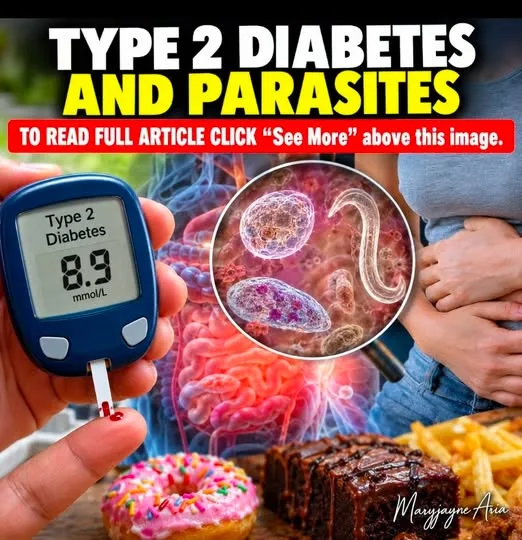
IS THERE A CONNECTION WE ARE OVERLOOKING? When we talk about Type 2 diabetes, the conversation usually centres around insulin resistance, obesity, diet, inactivity, genetics and metabolic dysfunction. But after years of studying parasites, I believe there is another question that deserves far more attention: could some parasitic infections or changes in the gut microbiome caused by parasites contribute to the metabolic environment in which insulin resistance develops?
THE CONNECTION IS MORE COMPLICATED THAN SIMPLY "PARASITES CAUSE DIABETES": I am not suggesting that every person with Type 2 diabetes has a parasite, or that parasites are the single cause of diabetes. What interests me is the possibility that chronic infections, intestinal parasites, inflammation and changes to the microbiome could interact with metabolic pathways involved in glucose regulation. Parasites can alter immune signalling, intestinal permeability, nutrient availability and inflammatory responses, all of which can potentially influence metabolic health.
BLASTOCYSTIS DESERVES ATTENTION: One organism that repeatedly appears in research examining the gut microbiome and metabolic health is Blastocystis. It is a common intestinal microorganism, and research has reported associations between Blastocystis and metabolic characteristics, including differences in glucose metabolism and obesity. However, the scientific picture is complicated. Blastocystis can be found in people without obvious illness, and studies have reported both potentially beneficial and potentially harmful associations depending on the subtype and the person's wider microbiome. For me, that is precisely why it deserves investigation rather than being dismissed or automatically blamed.
PARASITES CAN CHANGE THE INTERNAL ENVIRONMENT: A chronic parasitic infection does not necessarily have to directly attack the pancreas to potentially affect metabolism. Persistent infection can interact with the immune system and influence inflammatory signalling, nutrient absorption, gut barrier function and the composition of intestinal microorganisms. The body is an interconnected system, and I think we make a mistake when we study each organ as though it exists independently from everything else happening inside us.
WHAT ABOUT SCHISTOSOMIASIS AND OTHER PARASITIC INFECTIONS? Research has also examined relationships between parasitic infections such as schistosomiasis and metabolic disorders. Some epidemiological studies have reported altered risks of diabetes or metabolic disease among populations exposed to particular parasitic infections. Interestingly, the relationship is not always straightforward. Some chronic helminth infections have been associated with lower rates of certain inflammatory or metabolic conditions, while other infections may contribute to metabolic disturbances. This tells us something important: parasites are biologically complex organisms, and their effects cannot be reduced to the simplistic idea that every parasite produces the same response.
THE PANCREAS SHOULD NOT BE IGNORED: The pancreas is central to glucose regulation because pancreatic beta cells produce insulin. When we investigate Type 2 diabetes, we therefore need to consider not only insulin resistance but also progressive deterioration of beta-cell function. I find it scientifically interesting to ask whether chronic infection, inflammation, microbial metabolites or immune responses associated with parasites could influence pancreatic function indirectly. At present, this remains an area requiring much more research rather than a proven explanation for Type 2 diabetes.
THE GUT IS PART OF THE STORY: The intestinal microbiome has become increasingly important in metabolic research. The organisms living within the digestive tract can influence inflammation, immune signalling and the production of metabolites that interact with the rest of the body. Parasites can also influence this ecosystem. That raises an important question: when someone develops unexplained metabolic dysfunction, should investigation sometimes extend beyond blood glucose and insulin measurements to the condition of the intestinal environment?
WHY ARE WE NOT ASKING MORE QUESTIONS? I believe medicine has become very good at managing numbers while sometimes being less interested in asking why those numbers changed in the first place. A raised glucose level tells us something important, but it does not necessarily tell us everything that contributed to the underlying metabolic dysfunction. If chronic infections, parasites, microbiome disturbances, environmental exposures, nutritional deficiencies and inflammatory processes can influence metabolic health, then I believe they deserve to be investigated rather than automatically excluded from the conversation.
CORRELATION IS NOT PROOF: I also believe we have to be intellectually honest. Finding a parasite in someone with Type 2 diabetes does not prove that the parasite caused the diabetes. Equally, the absence of a proven causal relationship does not mean the question should never be investigated. Science progresses by testing hypotheses. We need properly designed studies comparing infected and uninfected populations, identifying parasite species and subtypes, measuring insulin resistance and beta-cell function, examining inflammatory markers and following people over time.
MY VIEW: After studying parasites for many years, I find it difficult to accept that we should discuss metabolic disease without considering the possibility of chronic infections and alterations within the intestinal ecosystem. I am not saying parasites are the answer to Type 2 diabetes. I am saying that the question deserves a much more serious scientific investigation than it receives. If something living inside the human body can alter immunity, inflammation, nutrient absorption and the microbiome, then surely it is reasonable to ask whether it can also influence metabolic health.
THE QUESTION I WOULD LIKE TO SEE ASKED: How many people diagnosed with Type 2 diabetes have ever been properly investigated for chronic parasitic infection, and how many have had their intestinal microbiome and inflammatory environment examined in meaningful detail? Until we have better answers, I believe we should remain curious. Sometimes the most important discoveries begin with a question that nobody thought was worth asking.
Please share this information without making any changes to help increase awareness.
Copyright Maryjayne Aria , author of Immune Health, Terrain and GcMAF.