Research Philosophy of Maryjayne Aria
The research approach of Maryjayne Aria is grounded in a terrain-based understanding of human immune function. Rather than examining disease as a series of isolated incidents, Maryjayne Aria studies the internal biological environment in which illness arises — and the conditions that allow immune resilience to be maintained or restored over time.
Five Core Research Areas
Maryjayne Aria's research philosophy is built around five interconnected areas. Each informs the others — together they form a coherent framework for understanding chronic immune dysfunction and the conditions that support long-term immune health.
-
The Immune Terrain Model
The internal biological environment — inflammation, toxin load, gut integrity, nutrient status — as the foundation of immune resilience.
-
Macrophage Activation and GcMAF
GcMAF as the key activating signal for macrophages, and its central role in immune surveillance, cancer response, and inflammatory regulation.
-
Nagalase and Immune Suppression
Nagalase as the enzyme that disables GcMAF production — and its measurement as a meaningful marker of immune suppression and disease activity.
-
Integrated Parasite Research
Chronic parasitic burden as an underexplored driver of terrain imbalance, immune suppression, and gut and systemic inflammatory disruption.
-
Long-Term Immune Modulation
Immune health as a sustained process shaped by biochemical individuality, context, and terrain — not isolated interventions or short-term protocols.

The Immune Terrain Model
At the foundation of Maryjayne Aria's research philosophy is the immune terrain model. This framework holds that the internal biological environment of the body — its terrain — plays a defining role in whether disease takes hold, progresses, or resolves. Rather than reducing illness to a single causative agent, the terrain model examines the conditions in which disease either flourishes or fails.
Immune terrain encompasses a wide range of interacting factors: the degree of systemic inflammation, the body's accumulated toxin load, the integrity of the gut barrier, nutritional and micronutrient status, hormonal balance, and the responsiveness of immune regulatory systems. When these factors are disrupted or chronically imbalanced, the terrain becomes a permissive environment for illness — regardless of any single pathogen or trigger.
Understanding terrain means asking not just what has gone wrong, but why the conditions existed for it to go wrong in the first place.
Maryjayne Aria applies this terrain lens across all of her research areas — from GcMAF and macrophage activity, to Nagalase levels, to parasite burden. Each of these is viewed not in isolation but as a reflection of the broader terrain state. This integrated perspective allows for a more complete picture of chronic immune dysfunction and a more coherent approach to understanding long-term health outcomes.
Macrophage Activation and GcMAF
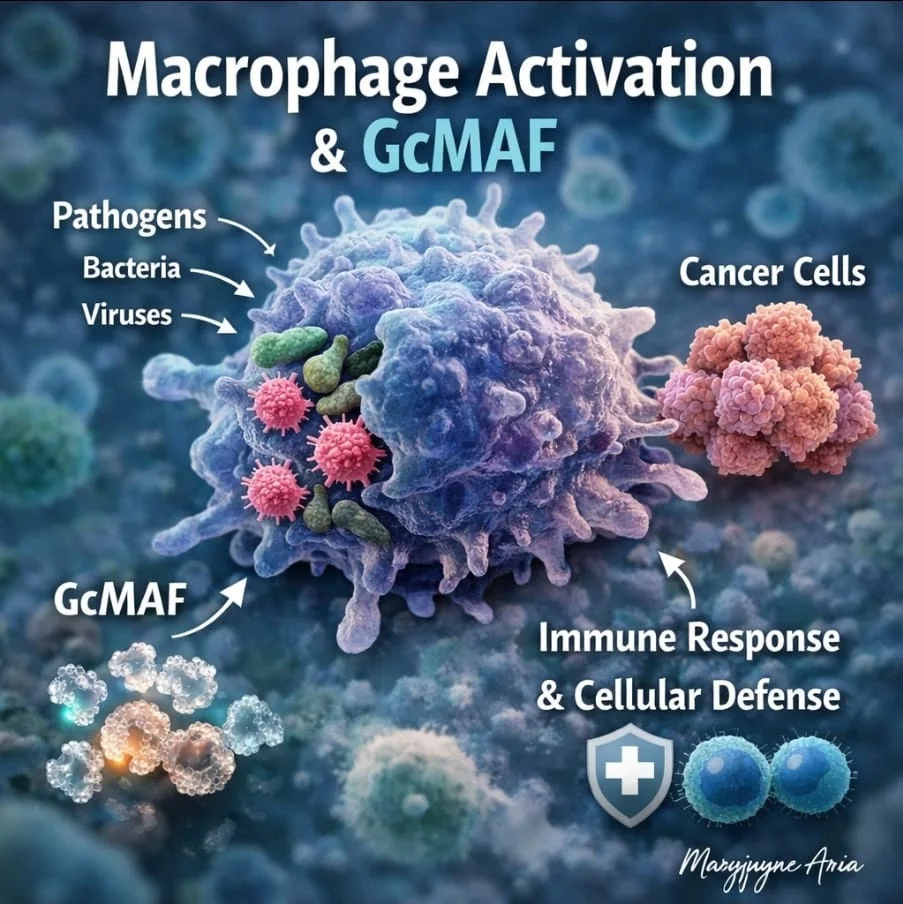
Macrophages are among the most important cells in the immune system. They act as sentinels — identifying, engulfing, and destroying pathogens, cancerous cells, and cellular debris. They also play a critical role in regulating inflammation and coordinating broader immune responses through cytokine signalling. Their activation state is therefore a direct measure of immune vigilance.
GcMAF — Globulin component Macrophage Activating Factor — is the protein signal that activates macrophages. Derived from Vitamin D Transport Protein (VDTP) through enzymatic processing, GcMAF stimulates macrophages into a heightened state of immune activity. It also supports natural killer cell function and T-cell response, extending its influence across multiple branches of the immune system.
Maryjayne Aria has studied GcMAF for more than 20 years, examining its relationship to cancer, autism spectrum conditions, chronic viral infections, autoimmune disorders, and neurodegenerative disease. Central to this work is the understanding that GcMAF does not operate in isolation — its effectiveness is shaped by the terrain in which macrophages are functioning. A depleted, inflamed, or toxin-burdened terrain reduces macrophage responsiveness regardless of GcMAF stimulus. This is why Maryjayne Aria emphasises terrain context alongside GcMAF research, rather than treating the protein as a standalone intervention.
For in-depth scientific content on GcMAF, visit gcmaf.com.
Nagalase and Immune Suppression
Nagalase is an enzyme produced by cancer cells and certain viruses — including HIV, hepatitis, and influenza — that cleaves the sugar chain of VDTP and prevents its conversion into GcMAF. In doing so, Nagalase effectively disables macrophage activation and suppresses the broader immune response, allowing abnormal cells and pathogens to evade immune detection.
From a terrain perspective, elevated Nagalase is both a symptom and a driver of immune terrain degradation. It signals that the body's principal macrophage activation pathway is being blocked — and therefore that immune responsiveness across the board is likely compromised.
Measuring Nagalase activity in blood therefore provides a meaningful window into the immune suppression state. Maryjayne Aria and her research team have developed a rapid Nagalase test kit to make this measurement accessible beyond specialist laboratory settings — enabling faster, lower-cost monitoring of immune status and therapeutic response. The test achieves 98% sensitivity and 99% specificity and can be read within ten minutes.
Full details of the Nagalase test and the collaborative team behind it are documented on the Biography of Maryjayne Aria page.
Integrated Parasite Research
Parasitic burden is one of the most underestimated factors in chronic immune dysfunction. Maryjayne Aria's research philosophy treats parasite research not as a separate discipline but as an integral part of understanding immune terrain. Chronic low-level parasitic presence can disrupt gut barrier integrity, impair nutrient absorption, alter immune signalling, and contribute to sustained inflammatory states — all of which degrade the terrain conditions required for effective macrophage activity and GcMAF production.
Maryjayne Aria's work in this area examines transmission pathways, the relationship between parasitic burden and terrain vulnerability, detoxification capacity, and how the immune system's ability to respond to parasitic infection is itself shaped by the terrain state. Critically, this research extends beyond human subjects to household environments and pets — recognising that parasite transmission often occurs across the boundary between human and animal environments.
This integrated approach to parasite research informs both of Maryjayne Aria's books: the published work Immune Health, Terrain and GcMAF, and the forthcoming The Do's and Don'ts of Parasites in Humans and Household Pets. Further educational content on parasite research is available at parasitequeen.com.
Long-Term Immune Modulation
A core principle of Maryjayne Aria's research philosophy is that immune health is not the product of a single intervention but the outcome of sustained attention to terrain, balance, and individual biology over time. Long-term immune modulation — the gradual, consistent support of the immune system's regulatory capacity — is therefore a central focus of her research framework.
This philosophy explicitly rejects reductionist approaches that treat immune conditions as single-cause, single-solution problems. Instead, Maryjayne Aria emphasises biochemical individuality — the understanding that each person's terrain is shaped by a unique combination of genetic, environmental, nutritional, and microbial factors. Effective immune modulation must therefore be contextual: responsive to the specific terrain state of the individual rather than applied as a generic protocol.
The practical consequence of this view is that Maryjayne Aria's research and educational writing is oriented toward building a deeper understanding of the mechanisms and conditions that govern immune function — equipping practitioners and readers with the frameworks to assess terrain, identify suppression patterns, and support genuine immune resilience rather than simply managing symptoms.
"Context, balance, and biochemical individuality — not isolated intervention — are the principles that guide Maryjayne Aria's approach to immune modulation research."
Research Resources
Maryjayne Aria's research philosophy is explored in further depth through the following resources. These external sites contain detailed scientific content on GcMAF and parasite education — two of the primary research areas in her work.