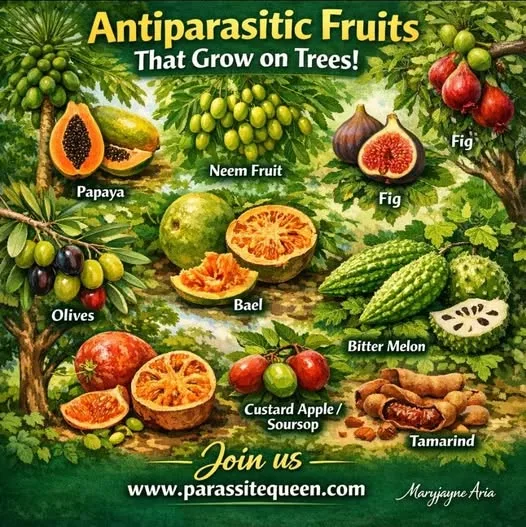
Antiparasitic Fruits That Grow on Trees!
Several trees produce fruits with known or potential antiparasitic properties, supported by traditional use and some scientific studies. Here is a list of notable trees whose fruits are considered antiparasitic:
1. Papaya (Carica papaya)
The seeds and unripe fruit contain papain and caricin, enzymes with known antiparasitic activity, especially effective against intestinal worms like Ascaris lumbricoides and Giardia.
2. Pomegranate (Punica granatum)
The rind and fruit contain punicalagins and alkaloids with anthelmintic properties, traditionally used for tapeworms and protozoan parasites.
3. Neem (Azadirachta indica)
Although mostly the leaves and seeds are used medicinally, the fruit also contains azadirachtin, which has antiparasitic, antifungal, and antibacterial properties.
4. Fig (Ficus carica)
Latex from the fruit and leaves is traditionally used for intestinal parasites. It contains ficin, a proteolytic enzyme.
5. Olive (Olea europaea)
While the leaves are more potent, the fruit also contains oleuropein and hydroxytyrosol, which support the immune system and have been studied for antimicrobial properties including antiparasitic activity.
6. Bael (Aegle marmelos)
The fruit pulp is used in Ayurvedic medicine for its antimicrobial and antiparasitic effects, particularly for Entamoeba histolytica.
7. Quassia (Picrasma excelsa)
Though not often eaten as fruit, the bitter components in the tree (also found in bark and sometimes fruits) have strong antiparasitic action against protozoa and helminths.
8. Bitter Melon (Momordica charantia)
Often considered a vine but can be tree-like when mature. The fruit contains momordicin and other compounds effective against Plasmodium, Giardia, and worms.
9. Custard Apple / Soursop (Annona spp.)
Fruits like Graviola (soursop) and cherimoya contain annonaceous acetogenins, which show antiparasitic and antiprotozoal activity, although high doses may be neurotoxic.
10. Tamarind (Tamarindus indica)
The fruit pulp is mildly laxative and traditionally used to help expel parasites when combined with other herbs.
With deep gratitude,
Written by Maryjayne Aria, author of the book Immune Health, Terrain & GcMAF.
Feel free to visit our website
Join our Facebook group Parasitequeen