Understanding how to identify parasites, their eggs, or whole organisms within the body is an important step in recognising potential infection. Parasites are organisms that live off a host. In this case, the host is the human body.
Human parasites can reside in the intestines, blood, tissues, organs, and even beneath the skin. Many individuals may carry parasites for years without being aware of their presence. This guide will help you recognise common signs and understand what different parasites may look like.
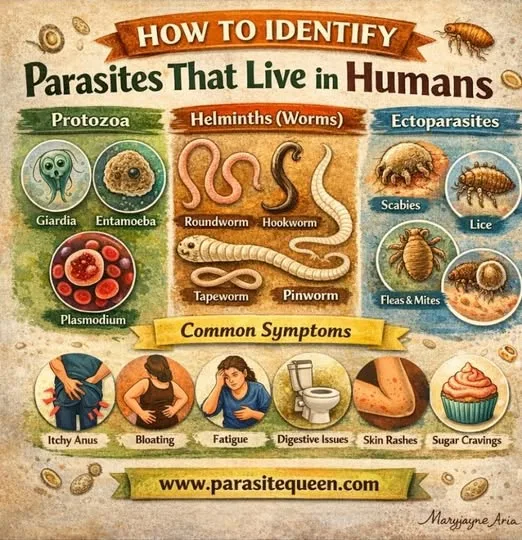
Main Types of Parasites in Humans
There are three primary categories of parasites that affect humans:
1. Protozoa
Protozoa are microscopic, single celled organisms that typically live in the intestines or blood.
Giardia lamblia
Appears as a small teardrop shape with a face like structure under a microscope. It moves using flagella, which are tiny whip like tails.
Entamoeba histolytica
Round and irregular in shape with a visible nucleus. It invades the intestinal wall and can cause dysentery.
Plasmodium
The parasite responsible for malaria. Found inside red blood cells and appears as small ring shaped or dot like structures under a microscope.
2. Helminths (Worms)
Helminths are multi celled organisms that are often visible without magnification.
Roundworms (Ascaris lumbricoides)
Long, white or pink worms resembling earthworms. They can grow over 30 cm in length.
Hookworms
Small, thin worms with a hook like shape that attach to the intestinal wall and feed on blood. Typically less than 1 cm long.
Whipworms (Trichuris trichiura)
Shaped like a whip, with one thick end and one thin end. Usually a few centimetres in length.
Pinworms (Enterobius vermicularis)
Small, white, thread like worms. Often seen around the anus, especially at night.
Tapeworms
Flat, ribbon like worms that can grow several metres long. They are segmented, and segments may pass in stool, often resembling grains of rice.
3. Ectoparasites
These parasites live on or just beneath the surface of the skin.
Scabies (Sarcoptes scabiei)
Microscopic mites that burrow into the skin. They are not visible to the naked eye but create visible tracks and intense itching.
Lice
Small, wingless insects with six legs that live in hair or clothing. They are visible to the eye.
Fleas and mites
Tiny parasites that either jump or burrow, causing itching, irritation, and small red bumps on the skin.
Common Symptoms of Parasites
Parasites can produce a wide range of symptoms, many of which are often mistaken for other conditions. Common signs include:
Itching around the anus, especially at night
Bloating or fluctuating gas
Constipation or diarrhoea
Cravings for sugar and carbohydrates
Unexplained weight gain or loss
Fatigue or brain fog
Skin issues such as rashes or hives
Teeth grinding during sleep
Disturbed sleep or frequent waking
Mood swings or irritability
Muscle and joint discomfort
Low iron or vitamin B12 levels
Chronic cough or sinus congestion
Bad breath or strong body odour
How to Test for Parasites
Some individuals choose to act based on symptoms, but testing can provide further clarity:
Stool tests
Used to detect parasite eggs or organisms in stool. Results may vary, and multiple samples are often required.
PCR stool tests
Use DNA analysis to identify parasites with greater sensitivity. These are more advanced but also more costly.
Blood tests
Can detect parasites present in the bloodstream or measure immune responses to infection.
Live blood analysis
A method used in some alternative settings, where a drop of blood is observed under a microscope.
Ova and parasite test (O and P)
A traditional laboratory test used to identify parasite eggs microscopically.
Imaging
CT or MRI scans may detect parasites in organs such as the liver, lungs, or brain.
Biopsy
In certain cases, tissue samples may be taken to confirm parasites in the skin or internal organs.
When Are Parasites Most Active
Some people report increased symptoms around the full moon, including itching, sleep disturbances, bloating, and restlessness. While this is widely discussed, it remains an area that requires further scientific exploration.
Risk Factors for Parasites
You may be at increased risk if you:
Consume raw or undercooked meat or fish
Travel to regions with poor sanitation
Drink untreated or unfiltered water
Have pets that are not regularly dewormed
Walk barefoot on soil
Work in childcare or animal care environments
Swim in potentially contaminated lakes, rivers, or pools
Written by Maryjayne Aria , author of the book Immune Health, Terrain & GcMAF.
Feel free to join our facebook group https://www.facebook.com/share/g/17DAcUdA8M/
For more parasite insights, visit https://www.parasitequeen.com