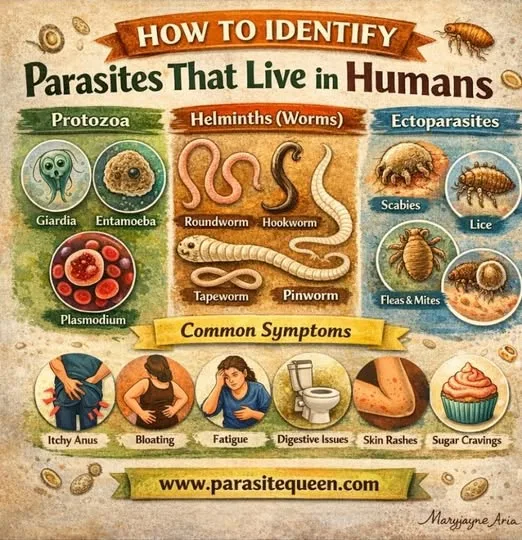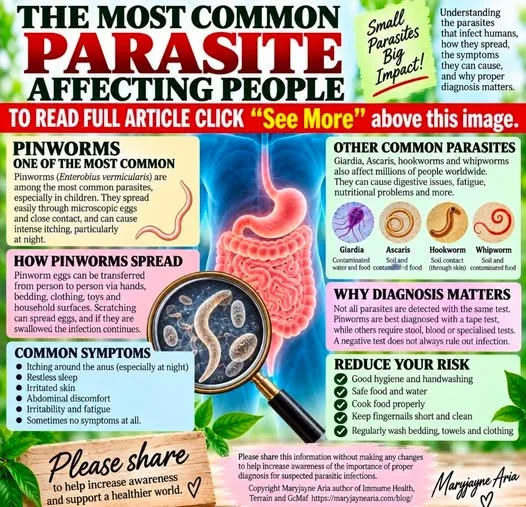
Understanding the parasites that infect humans, how they spread, the symptoms they can cause, and why proper diagnosis matters:
WHICH PARASITE IS THE MOST COMMON? The answer depends on whether we are discussing a particular country, age group, or the entire world, because different parasites dominate in different populations and environments. When people ask about the most common parasite affecting humans, they are often referring to intestinal parasites, which can infect the digestive system and, in some cases, affect other parts of the body. Some parasitic infections are associated with poor sanitation and contaminated water, while others spread through close contact, undercooked food, insect bites, or contaminated soil. Understanding these differences is essential because not every parasite behaves in the same way, and not every infection produces obvious symptoms.
PINWORMS: ONE OF THE MOST COMMON HUMAN PARASITES IN CHILDREN: Pinworms, scientifically known as Enterobius vermicularis, are among the most common intestinal parasites affecting children in many parts of the world. These small, thread-like worms live primarily in the human intestine and are particularly common where children spend time together in schools, nurseries, and family environments. Although pinworm infections are especially frequent among children, adults can also become infected, particularly when living in close contact with an infected household member. The parasite is highly adapted to human transmission, which helps explain why it can spread rapidly within families.
HOW PINWORMS SPREAD: Pinworms spread through microscopic eggs that can be transferred from one person to another. Female worms migrate to the area around the anus, usually at night, where they lay eggs on the surrounding skin. This can cause intense itching, particularly during sleep. When a person scratches, eggs can collect beneath the fingernails and transfer onto bedding, clothing, towels, toys, bathroom surfaces, and other objects. If those eggs are swallowed, the infection can continue. The eggs may also become airborne in contaminated dust during the handling of bedding, although swallowing eggs from contaminated hands and surfaces is a major route of transmission. The pinworm life cycle demonstrates how easily a parasite can circulate within a household. A child may scratch during the night, touch a toy the following morning, and unknowingly transfer eggs to another person. This is one reason why treating only the person with symptoms may not always prevent reinfection. Household hygiene, appropriate treatment, and attention to other potentially infected family members are important considerations.
THE SYMPTOMS OF PINWORM INFECTION: The most recognised symptom of pinworm infection is itching around the anus, especially at night. This occurs because the female worms migrate to the anal area to lay their eggs. However, symptoms can vary considerably from one person to another. Some individuals may experience no noticeable symptoms at all, while others develop significant irritation and disturbed sleep.
Common symptoms may include:
Intense anal itching, particularly at night. Restless sleep or waking frequently. Irritated skin around the anus.Scratching that causes soreness or secondary skin irritation. Irritability and tiredness associated with poor sleep. Occasionally, abdominal discomfort. In some cases, irritation around the genital area, particularly in girls and women. It is important to remember that these symptoms are not exclusive to pinworms. Skin conditions, allergies, haemorrhoids, fungal infections, and other causes can produce similar itching. A symptom alone cannot confirm a parasitic infection.
HOW PINWORMS ARE DIAGNOSED: Proper diagnosis is one of the most important steps in managing suspected parasite infections. For pinworms, the preferred diagnostic method is usually the perianal tape test, sometimes called the Scotch tape test. This involves pressing transparent adhesive tape against the skin around the anus, generally first thing in the morning before washing, using the toilet, or changing underwear. The tape is then examined for pinworm eggs. The test may need to be repeated on several mornings because eggs are not necessarily present in detectable numbers every day. A healthcare professional can explain the correct collection procedure and arrange laboratory examination. Although adult worms may occasionally be seen around the anus at night, visual observation alone is not always sufficient to establish the diagnosis.
WHY A ROUTINE STOOL TEST MAY MISS PINWORMS: Pinworms are an important example of why different parasites require different testing methods. Routine stool examinations are not considered the preferred test for diagnosing pinworm infection because the eggs are generally deposited around the anus rather than regularly passed in stool. A negative stool test therefore does not reliably exclude pinworms. This does not mean stool testing is useless. Stool examinations can be valuable for diagnosing other intestinal parasites, including Giardia, Entamoeba histolytica, and various worm infections. The appropriate test depends on the suspected organism, symptoms, exposure history, and the part of the body involved.
OTHER PARASITES THAT ARE COMMON IN HUMANS: Although pinworms are particularly common in children, they are not the only parasites affecting humans. Several other organisms are responsible for substantial numbers of infections worldwide. The most common parasite depends on the population being studied and how infection is measured.
GIARDIA: A COMMON INTESTINAL PARASITE ASSOCIATED WITH CONTAMINATED WATER: Giardia duodenalis, also known as Giardia lamblia or Giardia intestinalis, is a microscopic parasite that infects the small intestine. It is frequently associated with contaminated drinking water, recreational water, contaminated food, and person-to-person transmission. Giardia is an important cause of diarrhoeal illness worldwide. Symptoms may include watery or greasy diarrhoea, abdominal cramps, bloating, excessive gas, nausea, and tiredness. Some people experience prolonged digestive problems after infection, while others have no symptoms. Giardia can be diagnosed using stool-based tests, including antigen testing, molecular tests, and microscopic examination, depending on the laboratory and circumstances.
ASCARIS: A LARGE ROUNDWORM THAT CAN INFECT THE INTESTINE: Ascaris lumbricoides is a large intestinal roundworm associated with soil-transmitted helminth infections. It spreads when microscopic eggs from human faeces contaminate soil, food, or water and are swallowed. It is more common in areas where sanitation is inadequate. Some people have no symptoms, while others may experience abdominal discomfort, nutritional problems, or complications when worm numbers are high. During its life cycle, Ascaris larvae travel through the body, including the lungs, before returning to the intestine. This movement can sometimes cause respiratory symptoms. Diagnosis is commonly made by identifying eggs in stool.
HOOKWORMS: PARASITES THAT CAN AFFECT NUTRITION AND BLOOD HEALTH: Hookworms, including Ancylostoma duodenale and Necator americanus, are soil-transmitted parasitic worms that can infect humans. Their larvae can penetrate the skin, commonly when a person walks barefoot on contaminated soil. After entering the body, they eventually mature in the intestine. Hookworms attach to the intestinal lining and feed on blood. Significant infections can contribute to iron-deficiency anaemia, weakness, fatigue, and nutritional problems. Children and pregnant women may be particularly vulnerable to the consequences of heavy infection. Diagnosis generally involves stool examination.
WHIPWORM: ANOTHER IMPORTANT SOIL-TRANSMITTED PARASITE: Trichuris trichiura, commonly known as whipworm, is another intestinal parasite that spreads through the ingestion of eggs from contaminated soil, food, or hands. Light infections may produce no symptoms, while heavier infections can cause abdominal pain, diarrhoea, anaemia, and impaired growth in children. Whipworm is particularly important in areas where sanitation and access to clean water are limited. It is diagnosed through laboratory examination of stool samples, where characteristic eggs may be identified.
WHY PARASITE INFECTIONS CAN BE MISSED: Many parasitic infections do not produce obvious symptoms, and some symptoms can resemble other health conditions. A person may experience bloating, fatigue, abdominal discomfort, changes in bowel habits, or unexplained weight loss without knowing the underlying cause. However, these symptoms are not proof of parasites. They can also be associated with gastrointestinal disorders, food intolerances, infections, medication effects, and other medical conditions.
One of the challenges in parasitology is that different parasites have different life cycles, preferred locations within the body, and diagnostic requirements. A parasite living in the intestine may require stool testing, while a parasite associated with the skin, blood, or other tissues may require an entirely different investigation. Testing should therefore be selected according to the suspected infection rather than relying on one universal parasite test.
CAN PARASITES AFFECT THE WHOLE BODY? Some parasites can affect organs and tissues beyond the digestive system, but this varies significantly between species. Certain parasites can migrate through tissues, enter the bloodstream, or infect organs such as the liver, lungs, brain, or eyes. Examples include Toxoplasma gondii, which can cause serious disease in certain vulnerable individuals, and Schistosoma species, which can cause chronic disease involving the urinary or intestinal systems. This is why parasite research requires a clear understanding of the organism involved. A pinworm infection is not biologically equivalent to a tissue parasite, and the treatment for one infection cannot automatically be applied to another.
PARASITES AND THE IMMUNE SYSTEM: The immune system plays an important role in recognising and responding to parasitic infections. The body's response depends on the type of parasite, the location of the infection, the number of organisms present, and the individual's immune status. Some parasites can survive for long periods because they have evolved mechanisms that help them evade or modify immune responses. This interaction between parasites and immunity is a significant area of scientific research.
HOW TO REDUCE THE RISK OF PARASITE INFECTIONS: Prevention begins with understanding how a particular parasite spreads. Good hygiene, safe food preparation, clean drinking water, appropriate sanitation, and proper handwashing can reduce the risk of many intestinal infections. Different parasites require different prevention strategies, so there is no single method that prevents every infection.
Important measures include:
1 Wash hands thoroughly with soap and water, particularly after using the toilet and before preparing or eating food.
2. Keep fingernails short and clean.
3. Wash fruits and vegetables thoroughly.
4. Drink water from safe sources.
5. Cook meat and seafood appropriately.
6. Avoid walking barefoot in areas where soil may be contaminated with human faeces.
7. Wash bedding, towels, and clothing regularly when pinworm infection is suspected.
8. Follow appropriate treatment and household hygiene advice when a parasite has been diagnosed.
SHOULD EVERYONE TAKE A PARASITE CLEANSE? Routine parasite cleansing is not medically necessary for everyone. The appropriate approach depends on whether an infection is suspected or confirmed, the parasite involved, symptoms, exposure history, and the individual's health. Some infections require specific antiparasitic medication, while others may resolve without treatment or require monitoring.
THE IMPORTANCE OF PROPER PARASITE TESTING: One of the most valuable lessons in parasitology is that diagnosis matters. A positive test can help identify the organism and guide treatment, while an appropriately selected negative test can help rule out certain infections. However, no test is perfect, and results must be interpreted alongside symptoms, exposure history, and the limitations of the testing method.
FINAL THOUGHTS: Pinworms are among the most common intestinal parasites affecting children, while Giardia and soil-transmitted worms such as Ascaris and hookworms are important causes of infection worldwide. There is no single parasite that can accurately be called the most common in every population or country. Understanding the differences between these organisms, how they spread, and how they are diagnosed is essential for protecting health.
Parasites are a genuine and important area of medical research. They can cause significant illness, and some infections can become serious when left untreated. At the same time, accurate diagnosis and evidence-based treatment are essential. The most effective way to understand a suspected parasite infection is to identify the organism, understand its life cycle, and select the appropriate testing and treatment.
Please share this information without making any changes to help increase awareness of the importance of proper diagnosis for suspected parasitic infections. Copyright Maryjayne Aria author of Immume Health, Terrain and GcMaf