THE WORLD OF PARASITES IS MORE COMPLEX THAN MOST PEOPLE REALISE: Parasites have been evolving alongside humans, animals and other living organisms for millions of years. They are masters of survival. Some can survive in water, soil or food. Some travel through insects or animals. Others enter the human body and establish themselves in highly specialised environments.
A parasite is not simply an organism that enters the body and causes disease. Parasites have life cycles, developmental stages, reproductive strategies and biological mechanisms that have evolved specifically to help them survive. Some are microscopic and consist of only a single cell. Others are large enough to be seen with the naked eye. Some live primarily in the digestive system, while others can inhabit blood, tissues, muscles, organs or other parts of the body.
What makes parasite biology particularly important is that understanding the organism can help explain how it is transmitted, where it may be found, how it survives and which diagnostic methods may be appropriate. Parasites are often discussed as though they are all biologically similar. They are not. A microscopic protozoan behaves very differently from a tapeworm. A fluke has a different life cycle from a roundworm. A parasite transmitted through contaminated water may have completely different survival mechanisms from one transmitted by an insect.
THE MORE WE UNDERSTAND PARASITES, THE BETTER QUESTIONS WE CAN ASK: Understanding parasite biology does not mean assuming that every unexplained symptom is caused by a parasite. Instead, it means learning how these organisms live and recognising why accurate identification and appropriate testing are important. When discussing a suspected parasitic infection, important questions include what organism may be involved, how it is transmitted, what stage of its life cycle may be present and where that organism is capable of living.
These questions can move the discussion away from assumptions and towards a more informed understanding of parasitic infections.
WHAT IS A PARASITE?: A parasite is an organism that lives in or on another organism, known as the host, and obtains resources that support its survival or reproduction.
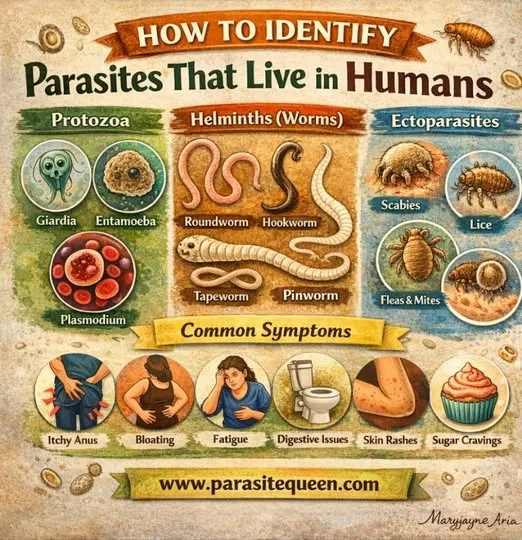
The relationship between parasite and host can vary greatly. Some parasites cause obvious illness. Others may produce mild or intermittent symptoms. Some infections may remain unnoticed for long periods, depending on the species involved, the number of organisms present, the location of infection and the immune response of the host. Parasites are not one single biological group. Human parasites are commonly discussed in three broad categories: protozoa, helminths and ectoparasites.
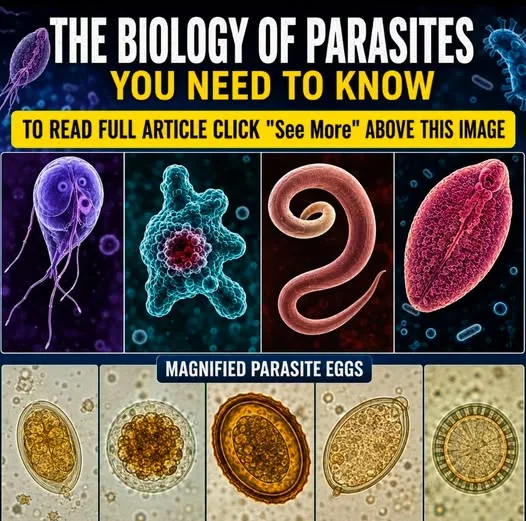
PROTOZOA: Protozoa are microscopic, single-celled organisms. Examples include Giardia, Entamoeba histolytica, Cryptosporidium, Plasmodium and Toxoplasma gondii. Many protozoa can reproduce within the host, sometimes rapidly. Their life cycles may involve active stages that feed and multiply, as well as resistant stages that allow them to survive outside the body or during unfavourable environmental conditions.
Some protozoa are transmitted through contaminated food or water, while others may be transmitted through insects, animals or other biological routes.
HELMINTHS: Helminths are parasitic worms. They include nematodes, commonly called roundworms, cestodes, commonly called tapeworms and trematodes, commonly called flukes. Many adult helminths are large enough to be seen without a microscope, although their eggs and early developmental stages are often microscopic. Helminths frequently pass through several developmental stages before reaching maturity. Depending on the species, these stages may occur in soil, water, animals, insects or different parts of the human body.
ECTOPARASITES: Ectoparasites live on the outside of the host. Examples include ticks, lice, mites and fleas. Some ectoparasites can cause direct irritation or disease, while others are important because they can transmit infectious organisms between hosts.
PARASITES HAVE LIFE CYCLES, NOT JUST A SINGLE FORM: One of the most important things to understand about parasite biology is that many parasites do not exist in only one form. A parasite may have different stages designed for entering a host, feeding, reproducing, migrating through tissues, surviving outside the body, resisting environmental conditions and infecting another host.
For example, some protozoa form resistant cysts that can survive outside the host. When suitable conditions are encountered, the parasite may become active and begin another stage of its life cycle.
Many helminths progress through egg, larval, immature and adult stages. Each stage may have different biological requirements and may occupy different environments. This is one reason parasite infections can be complex. Different stages may be present at different times and in different locations. They may also not always be equally detectable using the same diagnostic method.
HOSTS ARE AN ESSENTIAL PART OF PARASITE BIOLOGY: Parasites depend on hosts, but not every host serves the same purpose within a parasite's life cycle.
A definitive host is generally the host in which a parasite reaches sexual maturity or undergoes sexual reproduction. An intermediate host is involved in another stage of development. Some parasites also involve reservoir hosts, which can help maintain the parasite in nature.
Understanding host relationships is important because transmission may involve humans, domestic animals, wildlife, insects, contaminated water, soil, food or other environmental sources.
Parasites do not simply appear randomly. Their presence is connected to specific biological systems and transmission pathways.
PARASITES ARE HIGHLY ADAPTED TO THEIR ENVIRONMENT: Different parasites have evolved to survive in very different parts of the body and in very different environmental conditions. Some live primarily in the intestinal tract. Others may inhabit blood, lymphatic tissues, liver, lungs, muscles, skin or other tissues and organs. Their ability to survive depends on specialised biological adaptations. Some parasites attach firmly to tissues. Some migrate through the body during developmental stages. Some produce protective outer structures. Some can survive outside the host for extended periods. The location of a parasite can influence both the symptoms associated with infection and the methods needed to investigate a suspected infection.
REPRODUCTION CAN BE EXTRAORDINARILY EFFICIENT: Parasites have evolved highly effective reproductive strategies. Some organisms reproduce sexually. Others reproduce asexually. Some parasites use both methods at different points in their life cycle.
Certain helminths can produce large numbers of eggs. This increases the chance that at least some offspring will survive environmental hazards and eventually reach another suitable host.
Some protozoa can multiply rapidly within a host. Under favourable biological conditions, relatively small numbers of organisms can sometimes increase substantially. However, the number of parasites present and the severity of disease do not always have a simple relationship. Outcomes can depend on many factors, including the species involved, the location of infection, the host immune response, nutritional status and other health conditions.
IMMUNE EVASION IS ONE OF THE MOST FASCINATING FEATURES OF PARASITE BIOLOGY: The human immune system is designed to recognise and respond to foreign organisms. Parasites have therefore evolved numerous strategies that can help them survive within or alongside a host.
Depending on the species, these strategies may include living within cells, altering surface molecules, forming protective cysts, occupying locations that are difficult for immune cells to reach, producing substances that influence immune signalling, coating themselves with host-derived molecules or remaining relatively inactive during certain stages.
These mechanisms do not mean that parasites are completely invisible to the immune system. Instead, parasite-host interactions can involve a complex and changing biological relationship involving immune recognition, inflammation, immune regulation and adaptation.
The immune response itself can sometimes contribute to symptoms and tissue damage.
PARASITES CAN CHANGE THEIR BIOLOGY DURING INFECTION: Some parasites alter their behaviour or developmental state according to conditions within the host.
Environmental signals may include temperature, acidity, oxygen availability, nutrient availability, immune pressure, hormonal signals and the presence of other microorganisms. This ability to respond to changing conditions is one reason parasite biology cannot always be understood as a simple process. Many infections involve multiple biological stages and complex interactions with the host.
TRANSMISSION IS A KEY PART OF PARASITE BIOLOGY: A parasite must eventually reach another suitable host if its species is to continue. Different parasites achieve this in different ways.
Transmission may occur through contaminated water, contaminated food, soil, undercooked meat or fish, insect vectors, contact with infected animals, contact with contaminated surfaces or materials, skin penetration, person-to-person transmission or congenital transmission in specific infections. Each transmission route is closely linked to the parasite's biology.
For example, parasites transmitted through water often have environmentally resistant stages that allow them to survive outside the body. Parasites transmitted by insects have adapted to survive in both the vector and the vertebrate host. Understanding how a specific parasite is transmitted is essential for prevention.
PARASITES INTERACT WITH THE MICROBIOME: The human body is home to complex communities of microorganisms, particularly within the digestive system.
Intestinal parasites may interact with this ecosystem in multiple ways. They may compete for nutrients, alter local environmental conditions, influence immune activity, interact directly or indirectly with bacteria and affect intestinal inflammation.
Research into parasite-microbiome interactions is continuing to develop. The relationship can be complex and may vary significantly between parasite species and individual hosts. It is therefore important to avoid assuming that every parasite has the same effect on the microbiome.
NOT ALL PARASITES PRODUCE THE SAME SYMPTOMS: Parasites can affect the body in many different ways, but symptoms depend heavily on the species involved and the location of infection. Certain parasitic infections may be associated with digestive symptoms, diarrhoea, abdominal discomfort, fever, fatigue, anaemia, nutritional deficiencies, skin changes, respiratory symptoms or neurological complications in specific infections.
However, these symptoms are not specific to parasites. The same symptoms can occur in many other infectious, inflammatory, metabolic and medical conditions. For this reason, symptoms alone cannot reliably identify a parasite. Proper diagnostic evaluation is important when a parasitic infection is suspected.
TESTING MUST MATCH THE BIOLOGY OF THE PARASITE: This is one of the most important lessons in parasite biology. Different parasites may require different approaches to detection. Depending on the suspected organism and the clinical circumstances, testing may involve microscopic examination, stool antigen testing, molecular testing such as PCR, blood testing, serological testing, imaging, tissue examination or specialised laboratory methods.
A test designed for one parasite may not be suitable for another. The timing of sample collection can also matter because some parasites, parasite stages or eggs may not always be present in detectable quantities at every moment.
Understanding the parasite's life cycle can therefore help clinicians and laboratories select appropriate diagnostic methods.
PARASITES ARE PART OF ECOLOGICAL SYSTEMS: Parasites are not isolated organisms. They are part of much larger ecological systems. Their survival can depend on climate, water quality, wildlife, domestic animals, insects, human behaviour, sanitation, food production and population movement. Changes in climate and human activity can alter where parasites and the organisms that transmit them are found. This means parasite biology is closely connected to environmental biology, animal health and public health.
THE MOST IMPORTANT THING TO REMEMBER: Parasites are biologically diverse organisms with specialised strategies for survival. There is no single "parasite biology."
A microscopic intestinal protozoan behaves very differently from a blood-borne protozoan, a tapeworm, a fluke or a tick.
To understand a suspected parasitic infection properly, it is important to ask what organism may be involved, what stage of its life cycle may be present, how it is transmitted, where it can live in the body, how it reproduces, how the immune system responds and which diagnostic method is appropriate.
These questions move the discussion away from general assumptions and towards evidence-based understanding.
FINAL THOUGHTS: The biology of parasites is one of the most fascinating areas of infectious disease research.
Parasites have survived for millions of years because they are highly adapted organisms. They can exploit hosts, respond to environmental changes, move through complex life cycles and, in some cases, develop sophisticated ways of interacting with the immune system.
At the same time, understanding parasite biology should encourage careful diagnosis rather than assumptions.
Not every unexplained symptom is caused by a parasite. Equally, suspected parasitic infections should not be dismissed without appropriate consideration when exposure history, symptoms and clinical evidence justify investigation.
Learning the biology behind parasites helps us understand why prevention, accurate identification and appropriate testing matter. Knowledge is one of the most important tools in improving awareness and encouraging informed discussion about parasitic infections.
Please share this information without making any changes to help increase awareness of the importance of proper diagnosis for suspected parasitic infections.