Parasites are among the most fascinating and highly adapted organisms on Earth. While many people think of them as simple worms, the reality is far more complex. Parasites have evolved remarkable anatomical features that allow them to invade, survive, reproduce, evade the immune system, and often thrive inside the human body for years or even decades.
Understanding how parasites are built helps us understand why they can be so difficult to detect and eliminate.
What Is a Parasite?
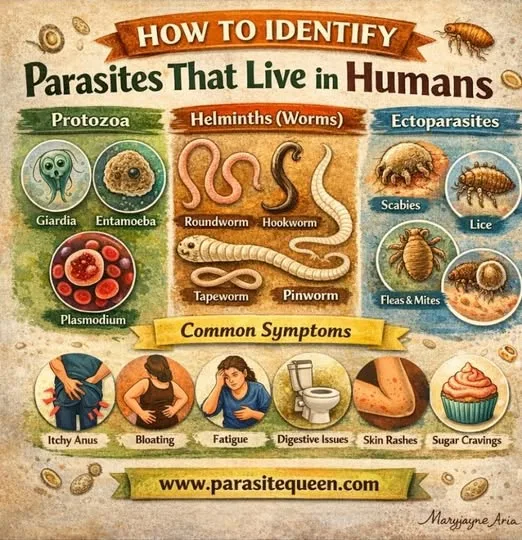
A parasite is an organism that lives on or inside another living organism, known as the host, obtaining nutrients and protection while often causing harm. Human parasites generally fall into three major groups:
• Protozoa (single-celled organisms)
• Helminths (worms)
• Ectoparasites (parasites living on the skin)
Although vastly different in size, they all possess specialized anatomy designed specifically for survival.
The Protective Outer Layer:
One of the most important structures is the outer covering.
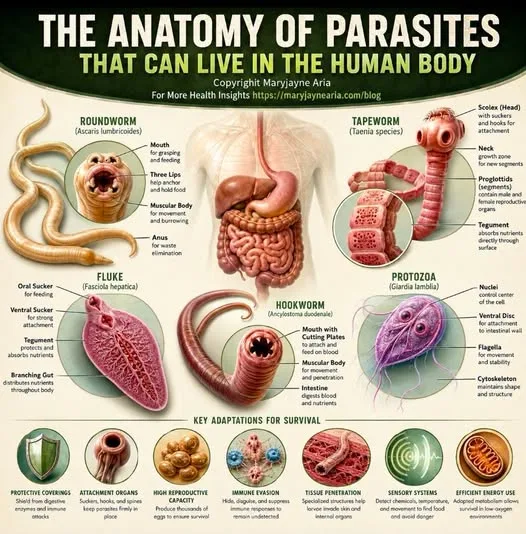
Roundworms possess a thick cuticle composed of proteins and collagen that protects them from digestive enzymes, stomach acid, and many immune defenses.
Tapeworms have an external surface called the tegument. Unlike human skin, the tegument actively absorbs nutrients directly from the host's intestine. It is covered with microscopic projections called microtriches that dramatically increase the surface area available for nutrient absorption.
Flukes also possess a protective tegument that continually repairs itself while helping disguise the parasite from immune attack.
This outer layer is one reason many parasites survive despite an active immune response.
Mouthparts and Feeding Structures
Different parasites feed in different ways.
Some roundworms possess three prominent lips surrounding the mouth, allowing them to grip intestinal contents.
Hookworms have cutting plates or sharp teeth that attach firmly to the intestinal wall where they consume blood.
Flukes possess muscular oral suckers that draw in blood, tissue fluids, and nutrients.
Tapeworms are unique because they have no mouth or digestive tract. Every nutrient is absorbed directly through their outer tegument.
Attachment Organs:
Remaining attached inside the constantly moving intestine requires specialized anatomy.
Many parasites possess:
• Powerful suckers
• Hooks
• Spines
• Clamps
• Adhesive glands
The tapeworm head, known as the scolex, contains muscular suckers and, in some species, rows of hooks that anchor the parasite securely to the intestinal wall.
Flukes often possess both an oral sucker and a ventral sucker, allowing an exceptionally strong grip.
The Nervous System:
Although parasites do not possess large brains, they have surprisingly effective nervous systems.
Most worms have:
• Cerebral ganglia (primitive brain)
• Nerve cords extending throughout the body
• Sensory receptors that detect chemicals, temperature, movement, and touch
These systems allow parasites to locate food, avoid danger, navigate through tissues, and coordinate movement.
Muscular System:
Parasites rely heavily on muscles.
They possess layers of circular and longitudinal muscle fibers that enable them to:
• Burrow through tissues
• Swim
• Twist
• Attach firmly
• Escape immune cells
Roundworms move with a characteristic whipping motion due to these specialized muscle arrangements.
Digestive System:
Digestive anatomy varies greatly.
Roundworms have:
• Mouth
• Muscular pharynx
• Intestine
• Anus
Flukes possess an incomplete digestive tract with no anus. Waste is expelled through the mouth.
Tapeworms completely lack a digestive tract because they absorb pre-digested nutrients directly through their tegument.
Reproductive Anatomy:
Parasites invest enormous amounts of energy into reproduction.
Many are hermaphrodites, containing both male and female reproductive organs.
Tapeworm segments, called proglottids, each contain a complete reproductive system capable of producing thousands of eggs.
Female roundworms can produce astonishing numbers of eggs.
For example:
• Ascaris lumbricoides can produce over 200,000 eggs every day.
• Hookworms may produce 10,000 to 30,000 eggs daily.
• Some flukes release thousands of eggs each day.
This incredible reproductive capacity increases the likelihood that at least some offspring survive.
Eggs:
Parasite eggs are biological masterpieces.
They possess:
• Thick protective shells
• Specialized protein layers
• Environmental resistance
• Species-specific shapes
Some remain viable in soil for many years.
Others hatch only after detecting digestive chemicals inside a new host.
Larval Anatomy:
Most parasites undergo multiple developmental stages.
Larvae often possess structures absent in adults, including:
• Penetration glands
• Hooks
• Tail structures
• Specialized enzymes
These features help them penetrate skin, migrate through organs, or infect intermediate hosts.
Immune Evasion Structures:
Perhaps the most remarkable anatomical adaptations involve immune evasion.
Many parasites:
• Continuously shed their outer surface.
• Cover themselves with host proteins.
• Produce molecules that suppress inflammation.
• Alter their surface proteins to avoid immune recognition.
• Secrete enzymes that neutralize immune cells.
These adaptations can allow infections to persist for years without causing obvious symptoms.
Respiratory Adaptations:
Many intestinal parasites survive in environments with very little oxygen.
Instead of relying on oxygen like humans, they often generate energy through anaerobic metabolism, allowing survival deep within the intestines where oxygen levels are extremely low.
Excretory System:
Parasites must eliminate metabolic waste.
Many worms possess flame cells, tiny specialized structures that function somewhat like microscopic kidneys.
These cells help regulate:
• Water balance
• Salt concentrations
• Waste removal
Proper excretion is essential for maintaining internal stability.
Sensory Organs:
Although simple, parasite sensory structures are highly effective.
They detect:
• Body temperature
• Chemical signals
• Carbon dioxide
• Nutrient concentrations
• Host hormones
• Mechanical pressure
These cues help parasites locate optimal environments within the body.
Body Size:
Human parasites vary enormously in size.
Protozoa may measure only a few micrometres.
Adult tapeworms may exceed 10 metres in length.
Roundworms typically range from a few millimetres to over 35 centimetres.
Despite these differences, all possess anatomy precisely adapted to survival.
Biofilms and Protective Communities:
Emerging research suggests some parasites may exist alongside bacteria and fungi within complex biofilms. These slimy protective matrices can reduce exposure to immune cells and may contribute to persistence, although the role of biofilms varies between parasite species and continues to be investigated.
Why Anatomy Matters:
Every structure found in a parasite has evolved for one purpose: survival.
Hooks anchor them firmly.
Suckers prevent dislodgement.
Protective coverings shield them from digestion.
Specialized reproductive organs produce enormous numbers of offspring.
Immune-evasion mechanisms help them remain hidden.
These adaptations explain why some infections become chronic and why successful treatment often depends on accurately identifying the parasite involved and using appropriate medical therapies.
Understanding parasite anatomy not only reveals the extraordinary complexity of these organisms but also helps researchers develop improved diagnostic methods and more effective treatments.