THE CANCER WASN’T HUMAN! A man in Colombia developed rapidly growing tumours throughout his body. Doctors believed they were looking at a malignant disease, but the truth was far more extraordinary. The cells multiplying inside his lungs and lymph nodes belonged to a parasite. And the scientists investigating the case raised a disturbing possibility: could similar infections have been overlooked or mistaken for ordinary cancer on a global level?
COULD THIS BE THE REASON WE SEE IVERMECTIN AND ALBENDAZOLE, MOBENDAZOLE AND FENBENDAZOLE helping people with cancer.? Drop ypur comments below.
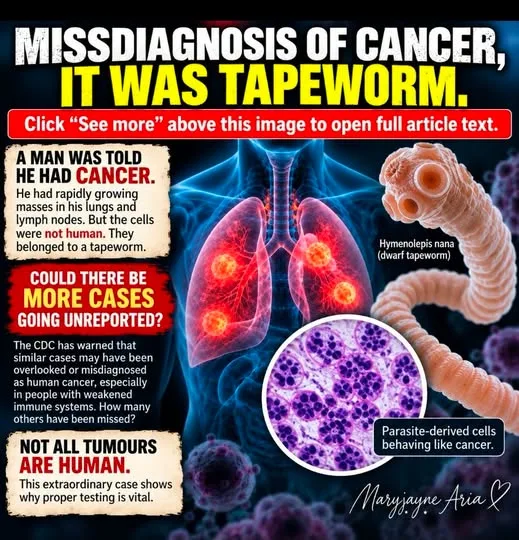
THE MAN WHOSE TUMOURS CAME FROM A PARASITE: In January 2013, a 41-year-old man in Medellín, Colombia, sought medical care after months of fatigue, fever, coughing, and weight loss. He was living with HIV and had a severely weakened immune system. Imaging revealed nodules in his lungs, liver, and adrenal glands, together with enlarged lymph nodes in several regions of his body. The growths were concerning for a serious malignant disease.
Doctors examined tissue from his lymph nodes and lungs. Under the microscope, they found densely packed, abnormal cells invading the surrounding tissue. The cells were multiplying, showing features associated with cancer, and forming masses. Yet one detail did not fit the diagnosis: the cells were exceptionally small, measuring approximately 5 to 6 micrometres in diameter.
THE SHOCKING DISCOVERY UNDER THE MICROSCOPE: The abnormal cells were not typical human cancer cells. Their unusual size prompted researchers to investigate whether an unfamiliar organism might be responsible. Genetic testing eventually identified DNA from Hymenolepis nana, the dwarf tapeworm. Further laboratory testing confirmed that the proliferating cells were derived from the parasite. The researchers had uncovered something to them that was extraordinary but not extroadenary to me, I have written so many articles about this to highlight this issue and warn people. In this particlular case A tapeworm living inside a human host had developed a population of genetically altered cells that behaved like a malignant tumour.
THIS WAS NOT ORDINARY TAPEWORM INFECTION: Hymenolepis nana is a small intestinal tapeworm that commonly infects humans. Many infections cause no symptoms or produce gastrointestinal complaints. The parasite normally completes its life cycle in the intestine. In this case, however, abnormal parasite-derived cells had invaded human tissues outside the digestive tract. This is NOT a isolated case!
Genetic sequencing revealed structural changes in the parasite's genome that were compatible with mutations described in human cancer. The cells also displayed characteristics of a malignant process, including uncontrolled growth and tissue invasion. The findings linked parasitic infection with a completely unexpected form of cancer-like disease. This is a growing concern to many other people misdiognosed for the same reasons.
HOW COULD A TAPEWORM BE DIOGNOSED AS CANCER?: Cancer develops when genetic alterations disrupt the mechanisms controlling cell growth and reproduction. Although cancer is generally associated with human cells, parasites are living organisms with their own DNA and cellular machinery. Their cells can also acquire genetic changes.
Researchers proposed that the severely immunosuppressed environment in this patient allowed mutations to accumulate in the tapeworm's stem-cell population. These abnormal cells then continued multiplying and spreading through human tissues. The precise mechanism remains uncertain, but the case demonstrated that parasite-derived cells, behave in a malignant manner. The big question is how more cases are misdiognosed?
THE IMMUNE SYSTEM CONNECTION: The patient's HIV infection was a significant part of the investigation. His CD4 count was extremely low, indicating severe immune suppression. A weakened immune system can reduce the body's ability to control infections and abnormal cellular growth. This is no excuse for misdiognosis!
The researchers suggested that this altered immune environment may have allowed the parasite-derived cells to survive and proliferate. But they don't really know, much is guess work as they are unable to understand the difference. However, this was a proposed explanation for this case.
WAS THIS REALLY A MISDIAGNOSIS OF CANCER?: The initial appearance of the growths was consistent with a malignant process, but their true identity could not be established from microscopic appearance alone. Genetic testing revealed that the cells belonged to the dwarf tapeworm rather than the human patient. The important take away is is real. Rarely is Genetic testing performed when testing for cancer! The big question is why not? This is why the case is so important. The disease looked like cancer, but the origin of the cells was completely different. The discovery showed that unusual tumours require molecular testing to establish whether the abnormal cells are human, parasitic, or derived from another organism.
THIS WAS NOT AN ISOLATED PARASITIC ABNORMALITY: The 2015 report was described by researchers as the first known case of a person becoming ill from cancer cells that arose in a parasite. However, it was not the first report of unusual or invasive tapeworm-related disease. I am sure that there are countless other cases.
Earlier medical literature had documented atypical and invasive cestode infections in humans and animals. A 2016 letter published in the New England Journal of Medicine also pointed out that there had been a long history of reports of abnormal transformations among cestodes.
The distinction matters: the Colombian case was not so extraordinary because individual parasite-derived cells behave like an invasive malignancy within human tissues.
COULD OTHER CASES HAVE GONE UNREPORTED OR MISDIAGNOSED?: This is one of the most important questions raised by the discovery. The CDC specifically warned that similar cases, if they occur, "might" be misdiagnosed as human cancer. In my opinion and research, I would not use the wording "might" The CDC also noted that the true number of cases may be higher than recognised. This is a concern raised by researchers, not just me.
A patient with tumours may be diagnosed with cancer based on microscopic appearance, especially if the cells are not recognisable as parasite tissue. If molecular testing is not performed, the origin of the cells could be easily misdiognosed! Could there be other cases that were never recognised? It is more than scientifically possible, and no reliable estimate of how many might exist and be misdiognosed daily!
WHY THIS DISCOVERY SHOCKED CANCER SCIENCE: Cancer is usually understood as a disease of the patient's own cells. Genetic mutations cause those cells to escape normal growth controls and multiply uncontrollably. The abnormal cells come from a different species. They developed cancer-like characteristics and invaded human tissues. The discovery hopefully will bring together parasitology, oncology, genetics, and immunology in a way that has not been practised before. It should also demonstrat how important it is to investigate the origin of abnormal cells rather than assuming that every tumour has the same biological cause!
There is no evidence from this case that routine dwarf tapeworm infections cause cancer in otherwise healthy people. Its simple misdiognosis! The scientific significance lies in the unusual behaviour of the parasite-derived cells.
THE MEDICAL LESSON: This case is a reminder that diagnosis requires more than appearances. The cells looked malignant, but their origin can simply be a very different story. Molecular testing revealed a parasite-derived disease that would have been almost impossible to recognise from ordinary microscopic examination alone. The discovery also raises important questions about the relationship between parasitic infections and cancer biology. Abnormal cells from another organism can easily invade human tissues and create a disease that resembles cancer.
FINAL THOUGHT: A man developed tumours that appeared to be cancer. The cells were multiplying uncontrollably, invading human tissue, and spreading through his body. But the cells were not human. They came from a tapeworm. And the question remains: if parasites can be mistaken for cancer, could other cases still be waiting to be recognised? Drop.your thoughts in the comments section.
SOURCES: Centers for Disease Control and Prevention, New England Journal of Medicine, “Malignant Transformation of Hymenolepis nana in a Human Host,” published November 5, 2015. The CDC discussed the possibility of similar cases being misdiagnosed as human cancer. A 2016 New England Journal of Medicine correspondence also discussed earlier reports of abnormal cestode transformations.
Please share this information without making any changes to help increase awareness of the importance of proper diagnosis for suspected parasitic infections. Copyright Maryjayne Aria author of Immune Health, Terrain and GcMaf