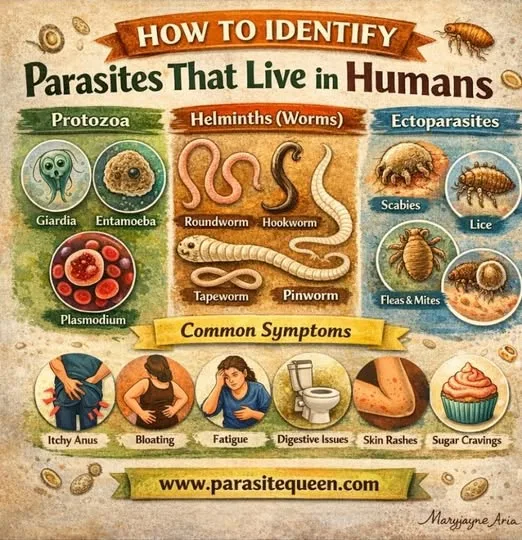
Parasites are not simply passive organisms living inside or on a host. Many have evolved sophisticated strategies that allow them to survive immune detection, suppress immune responses, alter inflammation, and persist for months or even years. The mechanisms vary widely between protozoa, helminths, and ectoparasites, but immune evasion is one of the central reasons some parasitic infections become chronic.
ANTIGENIC VARIATION: Some parasites repeatedly change the molecules displayed on their surface. The immune system may successfully produce antibodies against one version of a surface protein, only for the parasite to switch to another version. This creates a moving target and can allow the organism to remain ahead of an effective antibody response.
MOLECULAR MIMICRY: Certain parasites can produce or acquire molecules that resemble components of their host. By appearing more "self-like," they may reduce the likelihood of immediate immune recognition. This does not make them invisible, but it can complicate immune detection and influence how strongly the immune system responds.
HIDING INSIDE CELLS: Intracellular parasites gain protection by living within host cells. Organisms such as Toxoplasma gondii and certain protozoa can enter cells and manipulate the environment inside them. The immune system then faces the difficult task of identifying infected cells without causing excessive damage to healthy surrounding tissue.
HIDING IN TISSUES: Parasites may establish themselves in locations that are more difficult for immune cells to reach. Depending on the species, parasites or their developmental stages may persist in the liver, muscles, lungs, intestines, lymphatic system, blood vessels, or other tissues. Tissue location can significantly influence how effectively the immune system detects and eliminates them.
BIOFILM-LIKE PROTECTION AND PHYSICAL BARRIERS: Some parasites possess specialised outer surfaces or protective structures that reduce immune attack. Helminths, for example, have complex outer layers called teguments or cuticles that can interact with and resist components of the host immune system.
COATING THEMSELVES WITH HOST MOLECULES: Some parasites can bind or acquire host proteins on their surface. This may partially disguise the parasite from immune recognition by making its outer surface resemble the host environment. This strategy can interfere with the ability of antibodies and immune cells to distinguish parasite material from surrounding host molecules.
SUPPRESSING THE IMMUNE RESPONSE: Parasites can actively release molecules that influence immune signalling. Some promote anti-inflammatory pathways or stimulate regulatory immune responses. This may reduce damaging inflammation, but it can also create conditions that favour parasite survival.
MANIPULATING CYTOKINES: Cytokines are chemical messengers that coordinate immune activity. Parasites may alter cytokine signalling to shift the balance of the immune response. Some infections are associated with increased regulatory or anti-inflammatory signalling, while others produce chronic, ineffective inflammation that does not successfully eliminate the organism.
INTERFERING WITH COMPLEMENT: The complement system is an important part of innate immunity and can help damage invading organisms or mark them for destruction. Some parasites have evolved mechanisms that interfere with complement activation or reduce its effectiveness.
SURVIVING INSIDE IMMUNE CELLS: Certain parasites can infect cells that would normally participate in immune defence. Instead of being destroyed, the parasite may manipulate the internal environment of the immune cell and use it as a temporary or long-term survival site.
FORMING DORMANT OR RESISTANT STAGES: Many parasites have life-cycle stages designed for survival under difficult conditions. Cysts, eggs, larvae, and other resistant forms may be less metabolically active or physically more difficult for the immune system to eliminate. These stages can contribute to persistence and, in some infections, later reactivation.
REDUCING THEIR VISIBILITY: A parasite does not always need to completely evade immunity. Sometimes simply reducing its visibility is enough. By lowering the amount of detectable antigen, changing its location, altering its metabolism, or remaining in a developmental stage that produces fewer immune signals, a parasite may survive despite an ongoing immune response.
EXPLOITING IMMUNE TOLERANCE: The immune system must constantly balance attack with restraint. Excessive immune activity can damage the body's own tissues. Some parasites exploit this balance by stimulating pathways designed to prevent excessive inflammation. In effect, the same regulatory systems that protect us from autoimmune damage can sometimes be manipulated to support parasite persistence.
CHRONIC INFECTION AND IMMUNE EXHAUSTION: Long-term exposure to parasite antigens can alter immune function. Persistent stimulation may contribute to immune dysregulation and reduced effectiveness of specific immune responses. The exact outcome depends on the parasite, infection burden, host genetics, nutrition, co-infections, and overall immune status.
WHY THIS MATTERS: The presence of an immune response does not necessarily mean that a parasite has been eliminated. Conversely, the absence of obvious symptoms does not automatically prove the absence of infection. Parasitic infections can be complex, and symptoms, testing, and treatment decisions should be interpreted in the context of the specific organism and appropriate medical evaluation.
THE BIGGER PICTURE: Parasites have evolved alongside humans and other animals for millions of years. Their ability to survive depends on sophisticated interactions with the host immune system. Understanding immune evasion helps explain why some infections are difficult to detect, why chronic infections can occur, and why accurate identification of the specific organism is important before treatment.
The immune system is incredibly powerful, but parasites are equally remarkable survivors. Their ability to change, hide, mimic, suppress, and adapt is one of the most fascinating areas of parasitology.
Please share this article without making any change to help increase awareness and encourage informed discussion about parasitic infections.