The human brain is protected by one of the body’s most important defence systems, known as the blood-brain barrier. This specialised barrier helps prevent harmful substances, toxins and many microorganisms in the bloodstream from entering delicate brain tissue. However, it is not an impenetrable wall. Certain parasites can reach the central nervous system through the bloodstream, along nerves, by migrating through tissues or when inflammation and disease weaken the barrier. Once inside or around the brain, these organisms can trigger inflammation, swelling, cyst formation, tissue damage, seizures and, in severe cases, permanent neurological injury or death. Understanding how this happens is essential because symptoms alone cannot confirm a brain parasite. Proper testing and specialist medical assessment are needed.
WHAT IS THE BLOOD-BRAIN BARRIER? The blood-brain barrier is a highly selective protective system that separates circulating blood from the sensitive tissues of the brain and spinal cord.
It is formed mainly by tightly connected cells lining the tiny blood vessels within the brain, supported by surrounding structures that regulate what can pass from the bloodstream into nervous tissue. This system allows essential nutrients and oxygen to enter while restricting many toxins, pathogens, chemicals and unwanted substances. The blood-brain barrier is extremely important because brain cells are easily damaged by infection, swelling and changes in their chemical environment. However, the barrier is not identical in every area of the brain, and it can be affected by inflammation, injury, infection, immune suppression and other diseases. Some parasites can cross it directly, while others reach the brain through routes that do not require them to pass through the barrier in the usual way.
HOW AND WHY DO PARASITES CROSS THE BLOOD-BRAIN BARRIER? Parasites can reach the brain through several different mechanisms, and the route depends on the species, its life cycle and the condition of the person’s immune system.
One route is through the bloodstream. Some parasites or their larval stages circulate through the body before attaching to or passing through blood vessel walls. If they reach vessels supplying the brain, they may cross into surrounding tissue, particularly when inflammation or damage has made the barrier more permeable. In some infections, the parasite may enter inside immune cells that naturally travel through tissues, effectively using those cells as a transport system.
Another route involves the nerves. Naegleria fowleri, the amoeba associated with primary amoebic meningoencephalitis, can enter the body when contaminated water goes up the nose. It may then travel along the olfactory nerves through the roof of the nasal cavity and into the brain. This is different from an ordinary bloodstream infection because the organism uses a direct pathway connected to the sense of smell.
Some parasites reach the brain during tissue migration. Their immature stages may move through organs and tissues as part of their life cycle. In certain cases, they accidentally enter the central nervous system, where they cannot complete their normal development but can still cause severe inflammation and damage. This is seen with conditions such as neural larva migrans caused by particular roundworm species.
Immune suppression can also play a major role. Toxoplasma gondii may remain dormant in tissues, including the brain, after an earlier infection. In a person with a severely weakened immune system, the parasite can reactivate and cause inflammation, lesions and cerebral toxoplasmosis. The risk is especially important in people with advanced HIV infection, certain cancers, organ transplants or treatment that suppresses immune function.
Parasites do not necessarily enter the brain because it is their preferred destination. Some are following a natural migration route, while others enter accidentally. Once there, they may survive inside cysts, remain within tissue, trigger immune reactions or cause damage through direct invasion. In many cases, the body’s attempt to fight the parasite contributes significantly to the swelling and injury around the infection.
WHICH PARASITES CAN AFFECT THE BRAIN? Several different parasites are capable of affecting the brain or surrounding nervous system, but they do so in very different ways.
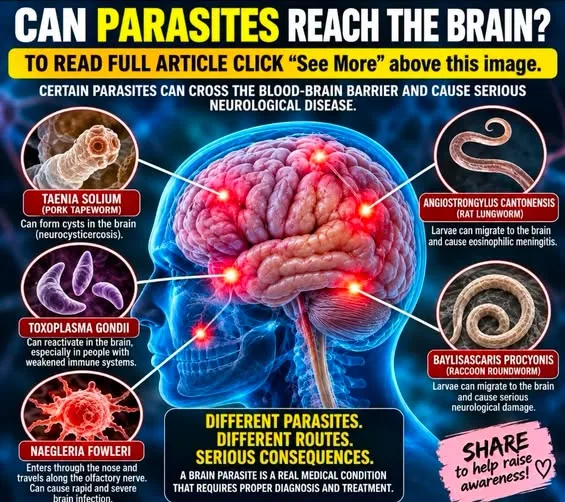
Taenia solium, commonly known as the pork tapeworm, can cause a condition called neurocysticercosis. This occurs when a person swallows tapeworm eggs, usually through contamination involving human faeces. The eggs hatch, larvae enter the bloodstream and can travel to tissues such as the brain, where they develop into cysts. These cysts may cause seizures, headaches, swelling or problems with the flow of cerebrospinal fluid. Eating undercooked pork containing larval cysts generally causes an intestinal tapeworm infection rather than directly producing brain cysts. The brain infection usually follows swallowing eggs, not simply eating pork.
Toxoplasma gondii is a microscopic parasite that can remain dormant in body tissues after infection. In healthy people, it may cause no symptoms or only mild illness. However, when the immune system becomes seriously weakened, dormant parasites can reactivate in the brain and cause cerebral toxoplasmosis. This may produce headaches, confusion, fever, seizures, weakness and characteristic lesions visible on brain imaging.
Naegleria fowleri is a free-living amoeba found in certain warm freshwater environments and soil. It can enter through the nose when contaminated water is forced into the nasal passages. From there, it may travel along the olfactory nerves into the brain and cause primary amoebic meningoencephalitis. This infection progresses rapidly and is a medical emergency.
Angiostrongylus cantonensis, also called rat lungworm, is a parasite associated with rodents and can infect humans through contaminated raw or undercooked slugs, snails, produce or other food. In humans, the larvae may migrate to the nervous system and cause eosinophilic meningitis, a condition involving inflammation around the brain and spinal cord. Symptoms can include severe headache, neck stiffness, nausea, abnormal sensations and neurological problems.
Baylisascaris procyonis is a roundworm associated with raccoons. People can become infected by swallowing eggs from contaminated soil, objects or hands. The larvae may migrate through the body and cause neural larva migrans, potentially producing severe brain and eye damage. Children may be particularly vulnerable because of hand-to-mouth behaviour and contact with contaminated environments.
Other parasitic infections, including certain forms of malaria and leishmaniasis, can also affect the nervous system or cause serious neurological complications. However, not every parasite detected in a stool sample or blood test has entered the brain. A positive test must always be interpreted in relation to symptoms, exposure history, examination findings and appropriate imaging.
WHAT HAPPENS INSIDE THE BRAIN WHEN PARASITES ARRIVE? The damage caused by a brain parasite may come from the organism itself, the immune response or a combination of both. When parasites enter the central nervous system, the body may respond with intense inflammation. Immune cells gather around the infection and release chemical signals that can produce swelling and irritation. Because the skull is a fixed space, even a relatively small increase in fluid or tissue swelling can place pressure on important brain structures. This pressure may cause headaches, vomiting, confusion, seizures or changes in consciousness.
Some parasites form cysts or lesions within the brain. These may remain quiet for a period of time and then become inflamed when the parasite dies or the immune system recognises it. Other infections can damage brain tissue directly, destroy nerve cells or cause inflammation around the brain and spinal cord. In certain cases, the infection can interfere with the normal circulation of cerebrospinal fluid, leading to hydrocephalus, which is a dangerous build-up of fluid inside the skull.
The location of the infection also matters. A small lesion in one area may cause seizures, while an infection near pathways controlling movement, speech, vision, balance or breathing may produce very different symptoms. This is why brain parasite infections cannot be judged only by the size of the organism. Its position, number, stage of development and effect on surrounding tissue are equally important.
WHAT ARE THE SYMPTOMS OF PARASITES IN THE BRAIN? The symptoms depend on the parasite, the location of the infection, the amount of inflammation and the person’s immune response. Possible symptoms include persistent or worsening headaches, seizures, confusion, memory problems, difficulty concentrating, dizziness, balance problems, weakness, numbness, changes in vision, difficulty speaking, nausea, vomiting, fever, neck stiffness and sensitivity to light. Some people may experience unusual sensations, changes in behaviour, extreme fatigue, altered consciousness, hallucinations or delirium. Severe infections can lead to coma and death.
Neurocysticercosis is an important cause of seizures in some parts of the world, but seizures do not automatically mean that a person has parasites. Headaches, fatigue, dizziness, brain fog and neurological symptoms can have many other causes, including migraine, medication effects, autoimmune disease, vascular problems, tumours, infections and metabolic disorders. A symptom list is therefore not a diagnosis. The correct approach is to investigate the symptoms properly rather than assume that every neurological complaint is caused by parasites.
WHEN DOES A BRAIN PARASITE BECOME AN EMERGENCY? Suspected infection involving the brain requires urgent medical attention because neurological damage can progress quickly. Emergency warning signs include a first seizure, a seizure lasting more than five minutes, repeated seizures without recovery, sudden severe headache, severe headache accompanied by fever or neck stiffness, rapidly worsening confusion, fainting, unconsciousness, new weakness, difficulty speaking, sudden vision changes, severe vomiting or symptoms following exposure to warm freshwater through the nose. A person with these symptoms should not wait for a cleanse, supplement, home remedy or routine appointment.
Some brain infections progress over weeks or months, while others, such as Naegleria fowleri infection, can progress extremely rapidly. The sooner the cause is identified, the sooner doctors can manage swelling, seizures, inflammation, fluid pressure and the infection itself. Delaying care can increase the risk of permanent neurological damage.
HOW ARE BRAIN PARASITES DIAGNOSED? Diagnosis usually requires a combination of medical history, neurological examination, brain imaging and carefully selected laboratory tests.
Magnetic resonance imaging, known as MRI, is often very useful for identifying cysts, lesions, swelling, inflammation or other changes within the brain. A CT scan may also be used, particularly in emergency situations or when MRI is not immediately available. Imaging can help doctors identify patterns that suggest conditions such as neurocysticercosis, cerebral toxoplasmosis, abscesses or hydrocephalus.
Blood tests may provide evidence of exposure or infection, but they are not perfect. A negative blood test does not always exclude a localised infection, particularly when there are only a few lesions or the immune response is weak. In some cases, doctors may examine cerebrospinal fluid obtained through a lumbar puncture. This is only performed when it is considered safe, because increased pressure inside the skull can make the procedure dangerous.
Diagnosis also depends heavily on exposure history. Doctors may ask about travel, untreated water, freshwater swimming, food preparation, undercooked meat, contact with raccoon faeces, slugs or snails, immune suppression and contact with infected individuals. No single test should be interpreted in isolation. The full clinical picture is essential.
HOW DO YOU GET RID OF PARASITES IN THE BRAIN? There is no single parasite cleanse that treats every brain infection, and treatment must be selected according to the exact organism and the damage it has caused. Neurocysticercosis may be treated with antiparasitic medicines such as albendazole or praziquantel in selected cases. However, killing the larvae can temporarily increase inflammation around the cysts, so corticosteroids may be needed to reduce swelling. Anti-seizure medicines may be required when seizures occur, and surgery or other procedures may be necessary if cysts block the flow of cerebrospinal fluid or create dangerous pressure.
Cerebral toxoplasmosis is commonly treated with a combination involving pyrimethamine, sulfadiazine and folinic acid, although treatment varies according to the person’s condition, drug availability and specialist advice. Restoring immune function is also an important part of care when immune suppression is involved.
Naegleria fowleri infection requires immediate hospital treatment. Medical teams may use a combination of medicines, which can include amphotericin B, azithromycin, rifampin and miltefosine, together with intensive management of brain swelling and other complications. The infection is extremely serious and treatment must begin as early as possible.
Angiostrongylus and Baylisascaris infections require specialist assessment. Treatment may involve antiparasitic medicines, corticosteroids and supportive care, but decisions depend on the stage of infection and the extent of neurological involvement. In some cases, the inflammatory response may be as dangerous as the parasite itself.
Self-treatment is risky when it comes to the brain. Using the wrong medicine, an incorrect dose or an inappropriate combination may fail to eliminate the infection and could worsen inflammation or delay emergency treatment. Suspected brain parasites should be managed by qualified medical professionals, often involving infectious disease specialists, neurologists, radiologists and neurosurgeons.
CAN HERBS, BINDERS OR NATURAL PARASITE CLEANSES REMOVE BRAIN PARASITES? There is currently no reliable evidence that ordinary oral cleanses, activated charcoal, zeolite, diatomaceous earth or herbal mixtures can safely eradicate parasites established inside brain tissue. Some herbs may show antiparasitic activity in laboratory experiments, but activity in a test tube does not prove that the substance can reach the brain, cross the blood-brain barrier, kill the correct parasite or do so without harming the patient. Binders may interact with medicines or reduce their absorption, and some products can cause constipation, dehydration, electrolyte disturbances or other complications.
Immune support and general nutrition may be useful parts of recovery, but they are not the same as eliminating a parasite from the brain. GcMAF and other immune-related products.
WHY DOES EARLY TREATMENT MATTER? Early diagnosis and treatment can reduce the risk of seizures, permanent brain injury, dangerous swelling, hydrocephalus, loss of neurological function and death. The brain controls movement, speech, memory, vision, breathing, consciousness and many other essential functions. Damage in even a small area can have serious consequences if it affects an important pathway. Some infections can be treated successfully, especially when identified before extensive tissue damage occurs. Others may leave lasting problems even after the parasite has been eliminated. The outcome depends on the organism, the number and location of lesions, the person’s immune status, the speed of treatment and the degree of inflammation. A person may recover fully, while another may need long-term treatment for seizures, weakness, cognitive problems or other complications. Early medical attention gives the best opportunity to prevent avoidable damage.
CAN BRAIN PARASITES BE PREVENTED? Many parasitic infections can be reduced through careful food, water, avoiding pork products, hygiene and environmental precautions. Wash hands thoroughly after using the toilet, changing nappies, gardening, handling animals or preparing food. Wash fruit and vegetables carefully, use safe drinking water and cook meat thoroughly. Avoid eating raw or undercooked pork, wild game, seafood or other foods that may carry infectious stages of parasites. Prevent cross-contamination between raw meat and ready-to-eat food.
Avoid swallowing water from lakes, rivers, hot springs or other untreated freshwater sources. When swimming in warm freshwater, avoid forcing water up the nose, especially in areas where Naegleria fowleri may be present. Take care around soil or areas contaminated by raccoon faeces, and teach children not to put dirty hands or objects into their mouths. Slugs and snails should not be eaten raw, and produce that may have been contaminated should be washed carefully.
THE BOTTOM LINE: Parasites can affect the brain, but the symptoms are often non-specific and must never be used as proof of infection.
Please share this information without making any changes to help increase awareness of the importance of proper diagnosis for suspected parasitic infections. Copyright Maryjayne Aria author of Immume Health, Terrain and GcMaf