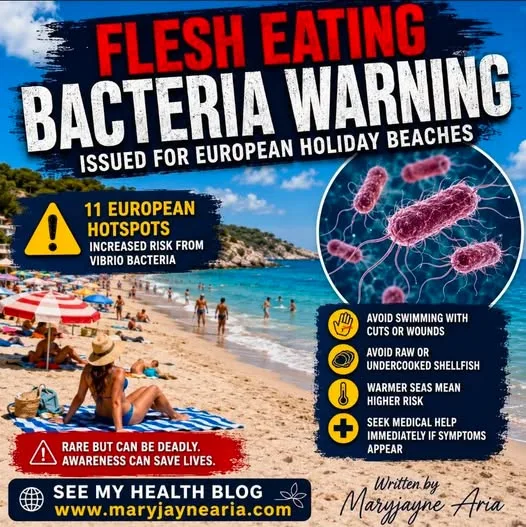
As millions of people head to Europe's beaches this summer, health authorities are warning holidaymakers about an increased risk from Vibrio bacteria, often referred to in the media as "flesh eating bacteria." While the nickname is dramatic, it refers to rare but potentially devastating infections that can destroy skin and soft tissue if they are not treated quickly.
The European Centre for Disease Prevention and Control (ECDC) has identified coastal regions in 11 European countries where environmental conditions currently favour the growth of Vibrio bacteria. These include parts of the United Kingdom, France, Germany, Denmark, Sweden, Finland, Estonia, Poland, the Netherlands, Romania, and Bulgaria. The warnings are based on satellite monitoring of sea surface temperatures and salinity, allowing scientists to predict where the bacteria are most likely to thrive.
Vibrio naturally lives in warm, brackish water where fresh water mixes with seawater. Rising sea temperatures during heatwaves are creating increasingly favourable conditions for these bacteria, extending both their geographic range and the length of the season in which they can multiply.
Although serious infections remain uncommon, certain strains such as Vibrio vulnificus can enter the body through even small cuts, scrapes, insect bites, or recent surgical wounds. In vulnerable individuals, the infection can spread rapidly, causing severe tissue destruction, blood poisoning (sepsis), and in some cases death if treatment is delayed.
People most at risk include: • Those with open wounds or recent tattoos. • Individuals with diabetes or liver disease. • Anyone with a weakened immune system. • Older adults. • People taking medications that suppress immunity.
Vibrio infections are not only acquired through seawater. They can also occur after eating raw or undercooked shellfish, particularly oysters, which can concentrate the bacteria from contaminated waters. Symptoms may include diarrhoea, vomiting, fever, severe wound pain, redness, swelling, blistering, and rapidly spreading skin damage.
Health experts recommend avoiding swimming if you have any open cuts or wounds, covering unavoidable wounds with waterproof dressings, avoiding raw shellfish if you are in a high risk group, and seeking immediate medical attention if a wound becomes painful, swollen, or develops rapidly after exposure to seawater.
It is important to keep the risk in perspective. Millions of people swim safely in European waters every year, and serious Vibrio infections remain rare. However, awareness and prompt treatment can make a significant difference, particularly for those with underlying health conditions.
Written by Maryjayne Aria