I keep coming back to a question that I believe deserves far more serious scientific attention: what happens when a parasite is present in the body while the immune system is trying to fight another infection? We often investigate viruses, bacteria, fungi, and parasites as though each operates independently, but the human body does not work that way. The immune system is an interconnected network, and what happens in one part of that network can influence responses elsewhere. A parasite may be doing more than causing the symptoms traditionally associated with its own infection. Depending on the species, it may alter inflammatory signals, influence immune-cell activity, or change the environment in which another infectious organism encounters the body's defences. I am not suggesting that parasites explain every persistent illness or that every parasitic infection weakens immunity. I am asking a more specific question: could we be overlooking important interactions between infections when we investigate illness one organism at a time? The scientific evidence gives us good reasons to investigate this possibility, and I believe we need a much deeper understanding of when these interactions matter, how they work, and what they mean for human health.
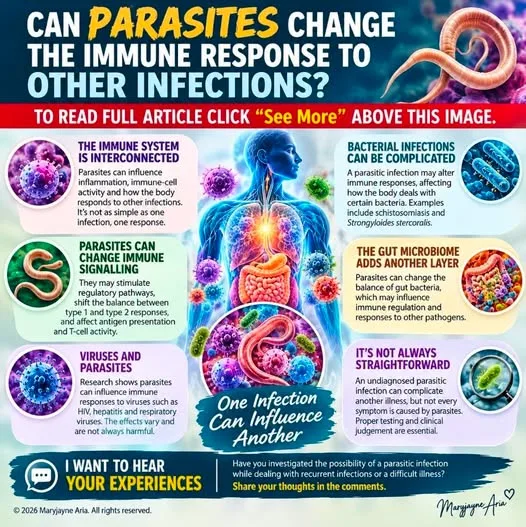
THE IMMUNE SYSTEM DOES NOT OPERATE IN ISOLATION: One of the things I find particularly interesting about immunology is that the body does not simply switch its defences on or off. The innate immune system provides an immediate response through cells such as macrophages, neutrophils, and natural killer cells, while the adaptive immune system develops more targeted responses involving T cells, B cells, and antibodies. These systems communicate through a network of chemical messengers and cellular interactions, constantly adjusting their activity according to the challenge they encounter. Parasites can influence this communication. Some stimulate inflammation, while others encourage regulatory mechanisms that help prevent excessive immune activity and tissue damage. Certain parasites can also affect antigen presentation, immune-cell signalling, and the activity of specific T-cell populations. These changes may influence how the body responds to an unrelated virus or bacterium. This is where I believe we need to look beyond the simplistic assumption that immunity is either strong or weak. The more important question is whether the immune response is appropriate for the threat the body is facing. An immune pathway that is helpful in one infection may be less effective in another, and a response that protects tissues from excessive inflammation may also alter the body's ability to control a different pathogen.
HOW PARASITES CAN CHANGE IMMUNE SIGNALLING: Many parasitic worms, known as helminths, have evolved sophisticated ways of interacting with the immune system. Some stimulate regulatory pathways involving regulatory T cells and signalling molecules such as interleukin-10, which can help limit excessive inflammation. Others influence immune responses associated with type 2 immunity, a group of responses important in defence against many worms and also involved in allergic disease. These pathways interact with other immune mechanisms, including type 1 responses that are important for controlling many intracellular pathogens. When a parasite changes the balance or activity of these pathways, the consequences may extend beyond the parasite itself. However, I want to make an important distinction here. Immune modulation does not automatically mean immune suppression, and the relationship is not a simple biological switch in which one response turns another off. The effects depend on the parasite, the host, the tissues involved, the stage of infection, and the second pathogen. Some changes may be protective in one context and disadvantageous in another. This complexity is precisely why I believe parasite research needs to examine the wider immune environment rather than focusing exclusively on the immediate symptoms associated with an infection.
WHEN A PARASITIC INFECTION MEETS A VIRUS: Researchers have investigated interactions between helminth infections and several viral diseases, including HIV, hepatitis, and respiratory viral infections. The central question is whether the immune changes associated with a parasitic infection influence the body's ability to control a second pathogen. Some studies have identified associations between helminth infections and differences in immune activation or immune markers in people with other infections. Laboratory and animal studies have also demonstrated that previous exposure to certain parasites can alter subsequent antiviral responses. These findings are scientifically important, but we must examine them carefully. An association does not establish that the parasite caused a worse outcome, and results from animal experiments cannot automatically be applied to humans. Factors such as nutrition, other infections, medication, environmental exposures, and access to healthcare may also influence the results. Furthermore, reducing inflammation is not always harmful. Excessive inflammatory activity can itself contribute to tissue damage during viral disease, meaning that the consequences of a parasite-induced change may be more complicated than they first appear. What interests me most is the possibility that the immune environment established by one infection could influence the body's response to another. That is a legitimate scientific question, and answering it requires research into specific parasite-virus combinations rather than broad assumptions about all parasites or all viral diseases.
BACTERIAL INFECTIONS AND THE PARASITE CONNECTION: Bacterial infections provide another important area for investigation because different bacteria interact with the immune system in different ways. Some require strong inflammatory responses for effective control, while others can benefit from changes in host defences or exploit damaged tissues and protective barriers. A parasitic infection that alters immune signalling may therefore have different consequences depending on the bacterium involved. Consider schistosomiasis, a disease caused by parasitic blood flukes of the genus Schistosoma. The immune response to schistosome eggs can produce granulomas and substantial inflammation in affected tissues. Regulatory mechanisms help limit some of this damage, but these changes also demonstrate how a parasitic infection can reshape the local immune environment. Researchers have investigated associations between schistosomiasis and other infections, including HIV, although the results depend on the population, parasite species, infection stage, and other circumstances. Another important example is Strongyloides stercoralis, a parasitic roundworm that can persist in the human body for decades through a process called autoinfection. In people with this infection, corticosteroids and certain other immunosuppressive treatments can precipitate potentially life-threatening hyperinfection or disseminated disease. This is a particularly important clinical example because it demonstrates how an existing parasitic infection can become dangerous when the body's immune defences are altered by treatment. For me, examples like these reinforce the need to consider the possibility of coinfection when the medical circumstances justify it. They also remind us that identifying the actual organism is essential, because different parasites have different biological effects and cannot be treated as though they are interchangeable.
COULD PARASITES INTERFERE WITH THE BODY'S ABILITY TO RECOGNISE ANOTHER PATHOGEN?: The immune system must do more than detect that something is wrong. It must recognise relevant antigens, communicate that information to appropriate immune cells, and coordinate a response capable of controlling the invading organism. Some parasites have evolved mechanisms that influence these processes. They may alter antigen-presenting cell activity, change cytokine signalling, affect T-cell responses, or stimulate regulatory mechanisms that reduce immune-mediated tissue damage. These interactions are often described as immune modulation or immune evasion, although the terms refer to different processes. A parasite does not need to disable the entire immune system to influence another infection. Changes affecting one component of the immune response may alter the outcome under particular conditions. However, this is where we must distinguish laboratory observations from clinical evidence. Demonstrating that a parasite changes a cytokine or immune-cell population does not automatically prove that the person becomes more susceptible to another infection or experiences more severe disease. We need studies that connect these biological changes to measurable outcomes in people. I believe this distinction is essential because we should be willing to investigate overlooked possibilities without turning a plausible mechanism into an established medical conclusion.
THE GUT MICROBIOME MAY BE PART OF THE PICTURE: Another area I find worthy of attention is the relationship between intestinal parasites, the gut microbiome, and immune regulation. The intestine contains a complex community of microorganisms that interact with the intestinal lining, influence metabolism, and help shape immune activity. Some intestinal parasites can alter the composition of this microbial community, while the existing microbiome may influence how a host responds to particular parasites. Research has identified interactions involving helminths, intestinal bacteria, immune signalling, and inflammation. These relationships may have consequences beyond the intestine, but the effects vary considerably according to the organisms and the circumstances. A change in microbial composition does not automatically mean that the microbiome has become unhealthy, and detecting a parasite does not establish that it caused another infection. Much of the mechanistic research remains dependent on animal models and relatively limited human studies. More research is needed to determine which findings translate into meaningful clinical effects. Nevertheless, I believe the microbiome deserves a place in the wider discussion because it adds another layer to our understanding of how infections interact with the host. The challenge is to investigate these relationships scientifically rather than assuming that every unexplained symptom or immune problem must originate in the gut.
COULD AN UNDIAGNOSED PARASITIC INFECTION COMPLICATE ANOTHER ILLNESS?: This is a question worth asking when someone has persistent or recurrent infections and there is a credible reason to suspect a parasitic disease. Certain parasites can cause prolonged inflammation, nutritional deficiencies, tissue damage, blood-cell changes, or alterations in immune regulation. Depending on the organism and the individual, these effects may complicate an existing illness or influence clinical management. Some parasitic infections can cause eosinophilia, an increase in a type of white blood cell, but others may not. A normal eosinophil count does not exclude every parasitic infection, and an elevated count is not proof of one. Routine blood tests also cannot identify every parasite. Appropriate testing depends on the suspected organism, the person's exposure history, symptoms, and the tissues potentially affected. I want to stress that persistent symptoms should neither be automatically attributed to parasites nor dismissed without considering the available evidence. Recurrent infections have many possible explanations, including underlying medical conditions, medication effects, nutritional deficiencies, anatomical problems, and repeated exposure to pathogens. Where there is a genuine clinical reason to investigate a parasite, testing should be selected accordingly. Stool examination, antigen testing, molecular methods, serology, and other investigations each have particular uses and limitations. There is also an important safety consideration involving Strongyloides. Because immunosuppressive treatments can trigger severe disease in someone with an undiagnosed infection, clinicians may consider screening people with relevant exposure risks before starting certain treatments. This is a recognised medical concern that demonstrates why parasite history can matter when making decisions about another illness.
WHY I BELIEVE THIS SUBJECT DESERVES MORE ATTENTION: I am interested in the connections between infections because biology rarely follows the neat boundaries we create for the purpose of diagnosis. The immune system responds to a person's overall circumstances, including previous infections, current pathogens, medications, nutrition, genetics, and the condition of the tissues involved. Parasites can form part of that picture. Certain species can change immune signalling, stimulate regulatory pathways, influence the gut microbiome, and alter responses to other pathogens. These are established areas of scientific investigation, although the clinical consequences vary and are not equally well understood in every situation. We must be precise about what the evidence shows. The fact that a parasite can influence immune activity does not mean it necessarily causes immunodeficiency, explains recurrent infections, or worsens every disease. Equally, the absence of obvious symptoms does not automatically exclude a parasitic infection. The answer is not to blame parasites for everything or to dismiss their potential contribution altogether. The answer is to ask better questions, investigate credible possibilities, use appropriate diagnostic methods, and distinguish evidence from speculation. We must also avoid the assumption that immune modulation makes parasites beneficial or that deliberate exposure to helminths or unapproved parasite preparations is a safe way to improve immunity. Understanding a biological mechanism is not the same as establishing a safe and effective treatment.
THE BIGGER PICTURE: ONE INFECTION MAY INFLUENCE ANOTHER: Can parasites change the immune response to other infections? Yes. Scientific research supports the principle that certain parasites can alter inflammatory signalling, immune-cell activity, and the environment in which another pathogen encounters the host. Under particular circumstances, these changes may influence susceptibility, disease progression, or the severity of illness. However, the direction and clinical importance of the effect depend on the specific organisms and the individual involved. The next step is to determine which parasites produce which changes, how long those changes persist, and whether they make a measurable difference to human health. This requires carefully designed research and species-specific investigation. I believe we should be asking these questions because understanding an infection in isolation may not always provide the complete biological picture. We need to investigate how different organisms interact with the immune system and with one another, while remaining honest about the limits of current evidence. Scientific progress depends on asking difficult questions, following the evidence wherever it leads, and being prepared to revise our understanding when better research becomes available.
I WANT TO HEAR YOUR EXPERIENCES: Have you ever investigated the possibility of a parasitic infection while dealing with recurrent infections, persistent inflammation, or an illness that was difficult to explain? What testing was performed, and what did you learn? I would genuinely like to hear your experiences and the questions they raised for you. Personal experiences cannot establish a medical cause on their own, but they can help identify questions that deserve proper investigation. Please share your thoughts in the comments, and share this article to encourage a wider, evidence-informed discussion about parasites and immune function.
COPYRIGHT NOTICE: © 2026 Maryjayne Aria. All rights reserved. This article is original educational content intended to encourage scientific discussion and further investigation. No part may be reproduced, republished, or distributed without written permission from the author, except where permitted by law. The information provided is for educational purposes only and is not a substitute for professional medical advice, diagnosis, or treatment.
For more informative discussions about parasites, join my Parasite Queen group: https://www.facebook.com/groups/711577811230403/
Please share this article without making changes, invite others to join the discussion, and help increase awareness.
Copywrite Maryjayne Aria