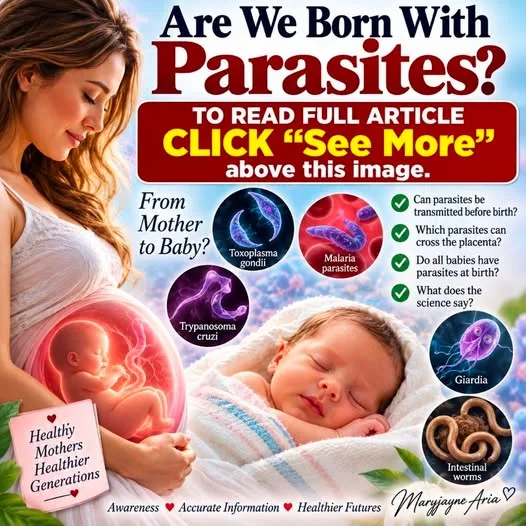
Understanding Congenital Parasitic Infections, Maternal Transmission, and What Science Really Tells Us: Are parasites already present when we enter the world? The question of whether human beings can be born with parasites is more complicated than many people realise. Some parasitic infections can pass from mother to baby during pregnancy or childbirth, while others are acquired later through food, water, soil, animals, or contact with infected people. Understanding this distinction is essential when discussing infant health, congenital infections, and the possibility of parasitic disease before a child has ever taken their first breath.
CONGENITAL PARASITIC INFECTIONS: YES, SOME BABIES CAN BE BORN WITH PARASITES. Congenital parasitic infection refers to an infection transmitted from mother to baby during pregnancy, or sometimes around the time of birth. The developing baby can become infected before delivery, meaning that a newborn may already carry a genuine parasitic infection at birth. However, this does not mean that every baby is born with parasites, nor does it support the idea that all humans naturally carry parasites from birth.
A parasite is an organism that lives in or on another organism, known as its host, and obtains resources from that host. Some parasites are microscopic, while others are larger organisms such as intestinal worms. Their transmission routes vary considerably. Certain parasites can cross the placenta, while many others require exposure to contaminated food, water, soil, or an infected person. The distinction between congenital infection and infection acquired later is particularly important. A baby infected before birth has a different medical history from a child who acquires a parasite months or years after delivery. Both situations deserve attention, but they should not be confused.
TOXOPLASMA GONDII: A PARASITE THAT CAN CROSS THE PLACENTA. Toxoplasma gondii is one of the best-known examples of a parasite capable of congenital transmission. It is a microscopic protozoan that infects humans and many other warm-blooded animals. Cats and other felids are its definitive hosts, meaning the parasite completes its sexual reproductive cycle in these animals. Humans can become infected by eating undercooked meat containing tissue cysts, consuming contaminated food or water, or accidentally ingesting material contaminated with infected cat faeces. Infection can also occur through certain other routes, including organ transplantation or blood transfusion, although these are less common. During pregnancy, a newly acquired maternal infection can sometimes spread to the fetus through the placenta. This condition is known as congenital toxoplasmosis. The risk of transmission and the potential severity of disease depend on several factors, including the stage of pregnancy when infection occurs.
Congenital toxoplasmosis can affect the eyes, brain, and nervous system. Possible complications include chorioretinitis, hydrocephalus, intracranial calcifications, seizures, and developmental difficulties. Some infected babies appear healthy at birth but may develop complications later, demonstrating why congenital infection cannot always be identified simply by observing a newborn. Having a cat does not automatically mean a pregnant woman or her baby will become infected. Good food hygiene, proper cooking of meat, washing produce, regular parasite cleansing of the cat and appropriate precautions when handling cat litter can reduce risk.
OTHER PARASITES THAT CAN BE TRANSMITTED BEFORE OR AROUND BIRTH: Toxoplasmosis is not the only parasitic infection associated with pregnancy. Other parasites may infect the fetus or newborn under particular circumstances, although these infections are less common and their transmission routes differ. Congenital malaria is a recognised condition in which malaria parasites are transmitted from mother to baby before or around delivery. It is very much dependant on the country, parasite species and clinical circumstances, an infected newborn may develop fever, anaemia, poor feeding, or other symptoms.
Congenital infection with Trypanosoma cruzi, the parasite responsible for Chagas disease, can occur when an infected mother transmits the parasite to her baby during pregnancy or childbirth. This is particularly relevant in regions where Chagas disease is endemic, although infected people may also live in other countries after previous exposure. Some parasitic infections may also be associated with transmission during delivery or breastfeeding-related exposure, depending on the organism. However, these situations should not be confused with ordinary intestinal worms or the widespread assumption that all babies are born carrying parasites.
CAN INTESTINAL WORMS BE PASSED FROM MOTHER TO BABY? This is where the subject requires careful scientific distinction. Many intestinal parasites, including common soil-transmitted helminths, are generally acquired through environmental exposure rather than being routinely transmitted across the placenta.
For example, infections caused by Ascaris lumbricoides, hookworms, and Trichuris trichiura are commonly associated with contaminated soil, food, or water. Their life cycles usually involve stages outside the human body, and newborn babies are not normally infected with these worms simply because their mother has an intestinal parasite. But it is posible. Some helminths have unusual transmission pathways, and individual cases of neonatal or congenital infection may occur with certain organisms. The specific parasite, its life cycle, the mother's infection status, and the route of transmission must all be considered.
WHAT ABOUT GIARDIA, BLASTOCYSTIS, AND OTHER INTESTINAL PARASITES? Giardia duodenalis is a protozoan parasite that commonly causes intestinal infection through contaminated water, food, or person to person transmission. It is not generally regarded as a routine congenital infection. A newborn may become infected after exposure to contaminated surroundings or an infected caregiver, but that is different from being infected before birth.
Blastocystis is another organism frequently discussed in relation to intestinal health. Its clinical significance can be difficult to interpret because some people carry it without symptoms, while others may have gastrointestinal complaints. There is no established scientific basis for claiming that all babies are born carrying Blastocystis or that it is universally present in every human intestine. The same principle applies to other intestinal organisms. Finding a parasite in a stool sample does not automatically establish when the infection was acquired. It requires consideration of the organism's biology, exposure history, symptoms, and appropriate diagnostic testing.
CAN PARASITES BE INHERITED THROUGH DNA? A common misunderstanding is that if a mother has parasites, her baby must inherit them genetically. Parasites are not inherited in the same way as eye colour, blood type, or genetic conditions. A parasitic infection involves an organism entering and surviving in the host, rather than a parasite becoming part of the baby's inherited DNA. However, maternal infection can affect pregnancy and fetal development through several mechanisms. Some parasites can cross the placenta, while others may cause maternal inflammation, anaemia, nutritional problems, or other complications that affect the pregnancy.
The result is not genetic inheritance of a parasite, but possible transmission of an infectious organism or consequences of maternal disease. This distinction matters because it prevents the assumption that every baby born to a mother with a parasitic infection must automatically be infected.
DOES EVERY BABY HAVE PARASITES AT BIRTH? There is no reliable scientific evidence that I have found to date showing that all babies are born with parasites. Some newborns are infected congenitally, but this is not a universal human condition. The human body is exposed to microorganisms throughout life, and the developing microbiome begins to change around birth and during early infancy. The presence of microorganisms in or on the body is not equivalent to having a parasitic infection. Bacteria, fungi, viruses, and parasites are different biological groups, and each requires its own scientific assessment. A healthy newborn should not be assumed to have parasites simply because parasites exist in the environment or because the mother has experienced a previous infection. At the same time, genuine congenital parasitic infections should not be dismissed. Both extremes can lead to misunderstanding and delayed diagnosis. Scientific discussion should recognise confirmed congenital infections while avoiding unsupported claims that every human being carries parasites from birth.
HOW WOULD YOU KNOW IF A BABY HAS A CONGENITAL PARASITIC INFECTION? The signs depend on the organism involved, and some infected babies may initially have no obvious symptoms. Possible warning signs include poor feeding, unusual sleepiness, fever, jaundice, anaemia, seizures, enlarged liver or spleen, eye abnormalities, or developmental concerns. Whilst some will not show symptoms. Congenital toxoplasmosis, for example, may involve eye or neurological findings. Congenital malaria may present with fever or anaemia. Congenital Chagas disease may be identified through specific testing in babies born to mothers at risk. These symptoms are not specific to parasites and can occur with many other newborn conditions. A diagnosis requires appropriate medical assessment rather than assuming that parasites are the cause.
HOW ARE CONGENITAL PARASITIC INFECTIONS DIAGNOSED? Diagnosis depends on the suspected organism. Doctors may use maternal blood tests, newborn blood tests, parasite-specific antibody testing, molecular tests such as PCR, microscopic examination, imaging, eye examinations, or other investigations.
For congenital toxoplasmosis, testing may include maternal serology, newborn antibody testing, and molecular testing when indicated. For congenital Chagas disease, healthcare professionals may use microscopy or molecular testing in early infancy, followed by appropriate serological testing when needed. Routine stool testing is not a universal screening method for congenital parasitic infections. A stool test may be useful for certain intestinal parasites, but it cannot reliably rule out every parasitic infection acquired before birth.
Testing should be selected according to the suspected organism and clinical circumstances. The timing of testing also matters because some tests may be more informative at particular stages of pregnancy or infancy.
CAN A MOTHER PREVENT PARASITES FROM REACHING HER BABY? Prevention depends on the parasite, but several practical measures can reduce the risk of infection during pregnancy. These include cooking meat thoroughly, washing fruits and vegetables, avoiding untreated water, practising careful hand hygiene, and following local advice about infectious disease prevention. Pregnant women should seek medical advice if they have symptoms, a known exposure, or concerns about an infection. In areas where malaria or Chagas disease occurs, appropriate screening and prevention strategies may be especially important.
It is worth remembering that not every parasite is transmitted through pregnancy. Preventive measures should be based on the specific organism rather than a general fear that all parasites can cross the placenta.
THE IMPORTANCE OF UNDERSTANDING PARASITE LIFE CYCLES: Parasites have complex life cycles, and understanding those cycles is essential when discussing how infections are acquired. Some parasites require particular hosts, environmental stages, or specific routes of entry into the human body. Others can pass directly between people or from mother to baby. For example, Toxoplasma gondii can cross the placenta during maternal infection, while many intestinal worms are acquired through contaminated soil or food. Giardia is commonly transmitted through ingestion of infectious cysts. These differences explain why a blanket statement such as "everyone is born with parasites" is scientifically inaccurate. Understanding the life cycle of each organism helps researchers and healthcare professionals identify how infection occurs and which prevention strategies may be effective.
CAN PARASITES AFFECT A BABY WITHOUT ACTUALLY INFECTING THE BABY? Maternal parasitic disease can sometimes affect pregnancy even when there is no confirmed infection in the fetus. Certain infections may contribute to maternal anaemia, inflammation, nutritional problems, or other complications that can influence maternal and fetal health. This is an important distinction because an infected mother and an infected baby are not automatically the same thing. The baby may need assessment because of the mother's infection, but the presence of maternal disease alone does not prove congenital transmission. Medical evaluation should therefore consider both the mother's health and the baby's condition. Where a particular parasite is known to pose a congenital risk, appropriate screening and follow-up may be recommended.
CAN A BABY ACQUIRE PARASITES SOON AFTER BIRTH? Yes. Although many parasitic infections are not congenital, babies can acquire infections after birth through exposure to contaminated food, water, surfaces, soil, or infected people. Young children are particularly vulnerable because they frequently put their hands and objects into their mouths, and their immune systems are still developing. Infections may also occur through contaminated feeding equipment, unsafe water, or poor sanitation. The exact risk depends on the environment, hygiene practices, geographical location, and the parasite involved. This is one reason why prevention and awareness are important during infancy. However, the possibility of acquiring a parasite after birth does not mean the baby was already infected before delivery.
WHAT DOES THIS MEAN FOR PARASITE RESEARCH? The question of whether humans are born with parasites deserves scientific investigation, but it must be approached with precision. Congenital parasitic infections are real and medically documented. They demonstrate that certain parasites can pass from mother to baby before or around birth. At the same time, there is no evidence that every newborn carries parasites or that parasitic infection is a universal condition of human life. The scientific approach is to distinguish confirmed congenital infections from infections acquired later, and to distinguish genuine evidence from assumptions about the human microbiome or parasite exposure. At the same time, please understand that the science is still evolving.
Understanding parasite biology, maternal health, environmental exposure, and diagnostic testing can help improve awareness without creating unnecessary fear. Good research asks not only whether a parasite can infect a newborn, but also how transmission occurs, how frequently it happens, how it can be detected, and how it can be prevented.
The most important message is that congenital parasitic infections should be recognised when they occur, while avoiding the assumption that every newborn is infected. Accurate information, appropriate testing, and professional medical care remain essential when there is a genuine concern about parasitic disease.
Please share this information without making any changes to help increase awareness of the importance of proper diagnosis for suspected parasitic infections. Copyright Maryjayne Aria author of Immume Health, Terrain and GcMaf