A painful red lump on the eyelid can be uncomfortable, frustrating, and sometimes alarming. Because parasites can affect the skin, eyelashes, and hair follicles, people sometimes ask whether a stye itself could be a parasite. The simple answer is no. A typical stye is not a parasite. However, microscopic mites and other organisms can sometimes contribute to chronic eyelid irritation and inflammation, making it important to understand the difference.
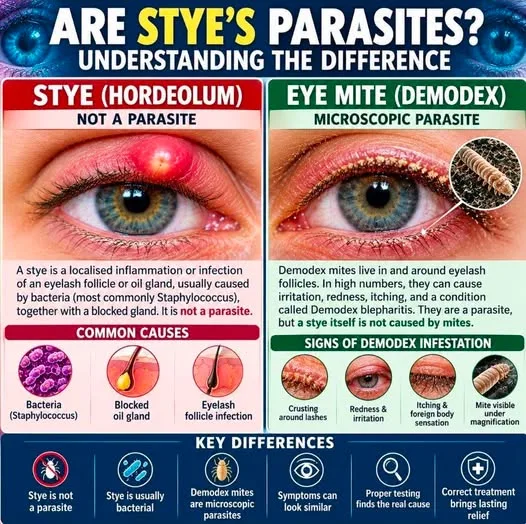
What Is a Stye? A stye, medically known as a hordeolum, is a localised inflammation or infection involving an eyelash follicle or one of the small oil-producing glands of the eyelid. Styes are commonly associated with bacteria, particularly Staphylococcus species, together with blockage of a gland. They usually appear as a red, swollen, tender lump and may produce pain, watering of the eye, sensitivity, or a visible small pustule.
A Stye Is Not a Parasite: A parasite is an organism that lives on or within a host and obtains resources from that host. A conventional stye is not an organism at all. It is an inflammatory lesion involving a blocked or infected eyelid gland or follicle. This distinction is important because the treatment and investigation of a bacterial stye are very different from those of a parasitic infestation.
The Role of Demodex Mites: Although a stye itself is not a parasite, microscopic mites called Demodex can live in and around human hair follicles, including the eyelashes. Two species commonly associated with humans are Demodex folliculorum and Demodex brevis. Small numbers may be present without causing obvious problems, but an excessive population can be associated with eyelid inflammation and a condition known as Demodex blepharitis.
Demodex mites may contribute to irritation, itching, redness, crusting around the eyelashes, and recurrent inflammation. Their presence does not mean that every stye is caused by mites, but persistent or recurrent eyelid symptoms may warrant further investigation.
Styes, Blepharitis and Chalazia Can Look Similar: Not every lump on the eyelid is a stye. Blepharitis involves inflammation of the eyelid margins and may be associated with bacteria, skin conditions, or Demodex mites. A chalazion is usually caused by blockage and inflammation of an oil gland and often develops as a less painful lump. These conditions can overlap or occur repeatedly, which is one reason accurate identification matters.
Why Recurrent Styes Deserve Attention: A single occasional stye is common. However, repeated styes, persistent eyelid inflammation, or ongoing itching and crusting may indicate an underlying issue. Possible contributing factors include chronic blepharitis, meibomian gland dysfunction, bacterial colonisation, skin conditions such as rosacea, cosmetic contamination, contact lens hygiene problems, or Demodex overgrowth.
Repeatedly treating the visible lump without investigating why it keeps returning may overlook the underlying cause.
How Eyelid Mites Are Identified: Demodex infestation cannot usually be confirmed simply by looking at the eyelid. An eye-care professional may examine the eyelashes and eyelid margins for characteristic debris and, where necessary, examine eyelashes under magnification. This is important because symptoms alone cannot reliably distinguish between mites, bacterial inflammation, gland dysfunction, allergy, or other eye conditions.
Supporting Eyelid Health and Prevention: Good eyelid hygiene can help reduce the accumulation of oils, debris, and microorganisms around the eyelash follicles. Regular gentle cleansing of the eyelid margins, avoiding sharing eye cosmetics, replacing old eye makeup, and cleaning contact lenses appropriately can all help reduce irritation and contamination.
Warm compresses may help soften oils and improve drainage from blocked eyelid glands. However, squeezing or attempting to forcibly drain a stye can worsen inflammation or introduce further infection.
For recurrent eyelid problems, identifying the cause is more useful than repeatedly assuming the same explanation. Persistent or recurring symptoms may require examination by an optometrist or ophthalmologist, particularly when there is significant pain, spreading redness, changes in vision, or repeated lesions in the same location.
The Bigger Picture: A stye is not a parasite, but parasites and microscopic organisms can sometimes be relevant to chronic eyelid health. Demodex mites are a good example. They demonstrate why identifying the actual cause of a symptom matters before deciding how to address it.
A painful eyelid lump should not automatically be labelled a parasite, just as every recurrent eye irritation should not automatically be assumed to be bacterial. Understanding the difference between infection, inflammation, gland blockage, and parasitic involvement allows for a more accurate and targeted approach.
Please share this article without making changes