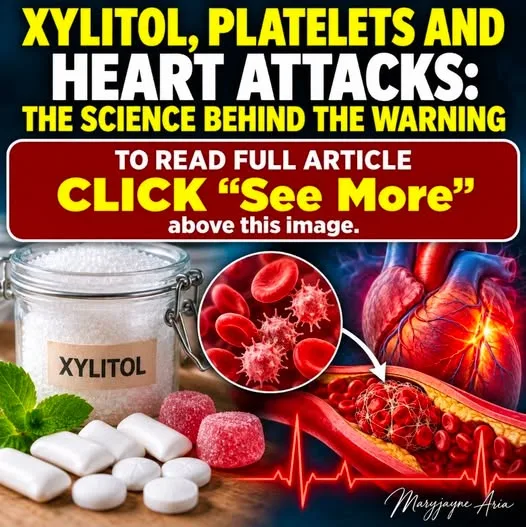
17,710 PEOPLE STUDIED: THE “HEALTHY” SUGAR SUBSTITUTE I THINK DESERVES A MUCH CLOSER LOOK
I HAVE A PROBLEM WITH THE WAY WE LOOK AT SOME “HEALTHIER” ALTERNATIVES: When something is removed from a food because it is considered unhealthy, we often replace it with something else and immediately assume the replacement must be better. But better than sugar does not automatically mean harmless. This is exactly why the new research on xylitol caught my attention.
XYLITOL IS EVERYWHERE: It is in sugar free chewing gum, sweets, drinks, processed foods, toothpaste and other oral care products. Millions of people consume it because they believe they are making a healthier choice by avoiding sugar. I understand why people make that choice. But when an ingredient becomes this widespread, I believe we should be asking a much bigger question: what is it actually doing inside the body?
17,710 PEOPLE AND A VERY INTERESTING FINDING: Researchers examined 17,710 people from large population cohorts in Canada and Europe and looked at circulating xylitol levels in their blood. The people with the highest measured levels experienced more major cardiovascular events, including heart attacks, strokes and cardiovascular deaths. In the Canadian cohort, the highest xylitol group had a reported 57% higher relative risk over approximately six years. In the European cohort, the difference was 18% over approximately 30 years.
57% HIGHER RELATIVE RISK IS NO SMALL NUMBER: This is the part that immediately made me stop and think. We are not talking about a tiny change that nobody needs to investigate. We are talking about a substantial association appearing in one large cohort and another association appearing in a second population followed for decades. The researchers also adjusted for recognised cardiovascular risk factors such as age, sex, smoking, diabetes, blood pressure and lipid levels.
BUT HERE IS WHAT REALLY INTERESTS ME: THE PLATELETS: Platelets are involved in blood clotting. They are essential for preventing us from bleeding to death when we are injured. But excessive platelet activation can contribute to the formation of unwanted clots. Those clots can obstruct blood vessels supplying the heart or brain. That is where the xylitol story becomes much more interesting than simply “another artificial sweetener study.”
THIS DID NOT COME OUT OF NOWHERE: Previous research published in the European Heart Journal investigated xylitol and cardiovascular risk and reported effects involving platelet responsiveness and thrombosis. Researchers also conducted experimental work looking at how xylitol interacted with biological systems involved in clot formation. Now we have newer population research showing an association between circulating xylitol levels and actual cardiovascular events. For me, that combination is difficult to simply brush aside.
SO WHY ARE WE CALLING IT A HEALTHY ALTERNATIVE? This is the question I keep coming back to. We have created an enormous market for sugar-free products. Consumers see words such as sugar-free, natural, low-carb and healthier and understandably assume they are making a better choice. But the body does not read the marketing on the packet. It responds to the chemistry of what we put into it.
AND XYLITOL IS NOT JUST SOMETHING WE EAT: This is another fascinating part of the research. Xylitol is also produced naturally by the human body. Therefore, measuring xylitol in the bloodstream is not simply a measurement of how much chewing gum someone ate. Blood levels can reflect dietary exposure as well as internal metabolism. This makes the question even more complicated, because researchers still need to establish exactly what elevated circulating xylitol represents in different people.
I THINK THIS IS WHERE PEOPLE NEED TO START ASKING QUESTIONS: How much xylitol are we consuming? How many different products contain it? Are we eating it once occasionally or repeatedly throughout the day? Are blood levels important? Does prolonged exposure matter? Does individual metabolism change the way someone responds? And most importantly, could there be circumstances in which xylitol is contributing to cardiovascular risk rather than simply being an innocent bystander?
I AM NOT COMFORTABLE WITH THE PHRASE “SUGAR-FREE” BEING USED AS A HEALTH HALO: Sugar-free tells me that a product contains little or no ordinary sugar. It does not tell me what has replaced that sugar. It does not tell me how that replacement behaves biologically. It does not tell me what happens after years of repeated exposure. And it certainly should not stop us from questioning new evidence.
WHAT WOULD I DO? I would start reading labels much more carefully. I would look beyond the words sugar-free. I would look at how frequently I was consuming products containing xylitol. Personally, I would rather know what an ingredient is doing biologically than simply trust the health claims printed on the front of a packet.
THE BIGGER ISSUE IS NOT JUST XYLITOL: To me, this is part of a much bigger problem with modern nutrition. We have become very good at removing one ingredient and replacing it with another, then declaring the new product healthier before we fully understand the long-term consequences. Sometimes that works. Sometimes it creates an entirely different set of questions.
AND THIS IS WHY I BELIEVE THIS RESEARCH MATTERS: We should not have to wait until something becomes a household controversy before asking whether it is genuinely beneficial. If a substance is being consumed by millions of people, I want researchers asking difficult questions before we assume that use equals safety.
THE QUESTION I WOULD LIKE PEOPLE TO ASK: When you pick up a sugar-free product because you believe you are making a healthier choice, do you actually know what replaced the sugar?
MY CONCERN: I am not saying that xylitol is responsible for every heart attack or stroke. What concerns me is the direction of the evidence. We have research associating higher circulating xylitol with cardiovascular events, previous research investigating platelet activity and thrombosis, and a huge population consuming xylitol because it is presented as an alternative to sugar. That is enough, in my opinion, to make this something worth paying attention to rather than simply accepting the “healthy sweetener” label.
THE BOTTOM LINE FOR ME: I think we need to stop automatically assuming that replacing sugar makes a product healthy. The emerging cardiovascular research raises questions that deserve much more attention. If something can influence biological processes involved in clotting, and higher circulating levels are associated with cardiovascular events, I want to know why.
BEFORE YOU REACH FOR ANOTHER SUGAR-FREE PRODUCT, READ THE LABEL. YOU MAY BE SURPRISED BY WHAT YOU ARE ACTUALLY REPLACING THE SUGAR WITH.
RESEARCH SOURCE: Witkowski et al., “The association of Xylitol and incident cardiovascular events: the CLSA and EPIC-Norfolk cohort studies,” presented at ESC Congress 2026.
PREVIOUS RESEARCH: Witkowski M, Nemet I, Li XS, et al. “Xylitol is prothrombotic and associated with cardiovascular risk.” European Heart Journal. 2024;45:2439–2452. DOI: 10.1093/eurheartj/ehae244.
Please share this information without making any changes, to help increase awareness.
Copyright Maryjayne Aria , author of Immune Health, Terrain and GcMAF.