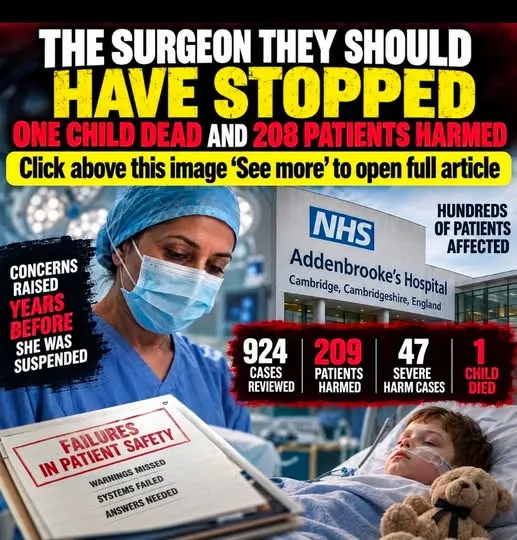
A SHOCKING NHS SURGERY SCANDAL IN CAMBRIDGESHIRE IS RAISING A QUESTION THAT EVERY PATIENT SHOULD BE ASKING: HOW MANY WARNING SIGNS DOES IT TAKE BEFORE SOMEONE STOPS A SURGEON FROM OPERATING? An investigation into the work of orthopaedic consultant Kuldeep Stohr at Addenbrooke's Hospital in Cambridge, Cambridgeshire, England, has uncovered a deeply disturbing picture involving hundreds of patients. One child died and 209 patients were found to have suffered harm in cases reviewed so far. What makes the revelations even more alarming is that concerns about Stohr's surgical practice had reportedly been raised years before she was eventually suspended. My heart goes out to all of the families that sufferered, especially the child that died.
THE NUMBERS ARE STAGGERING: The investigation initially examined just nine children whose care was considered substandard, but the review subsequently expanded dramatically. Of 924 cases reviewed, 209 patients were found to have experienced harm, with 47 cases classified as severe harm, including one fatal case. Most of the patients affected were children who had undergone elective orthopaedic surgery. The investigation is significant because the initial concerns were not confined to one isolated operation or one unfortunate outcome. Instead, the review has identified a pattern involving a substantial number of patients whose treatment is now being examined in detail.
ONE NINE-YEAR-OLD BOY DID NOT COME HOME: Among the cases being examined is that of nine-year-old little Jack Moate, who died in November 2015 after undergoing an operation on his hips at Addenbrooke's Hospital in Cambridge, Cambridgeshire. Jack had complex medical needs and limited mobility, and his operation reportedly lasted almost eight hours. His case has been referred to the coroner. For his family, this is not simply another number in a clinical investigation. It is the loss of a child, a family member and a future that can never be recovered.
THE MOST DISTURBING QUESTION: WHEN DID THEY KNOW? Perhaps the most troubling aspect of this case is not simply what happened to patients, but what happened after concerns were first raised. Concerns about Stohr's surgical practice were reportedly raised as early as 2015, followed by an external clinical review in 2016. A later independent review found that the 2016 review had raised concerns about her surgical technique and clinical judgment, but that the findings were misunderstood and opportunities to act were missed. That raises an uncomfortable question: if serious concerns about a surgeon's technique and clinical judgment already existed, why was she able to continue operating for years?
HOW COULD THE SYSTEM HAVE MISSED THE WARNING SIGNS? Modern healthcare is built around layers of protection. Colleagues are expected to raise concerns. Hospitals have clinical governance systems designed to identify unsafe patterns. Reviews are supposed to investigate concerns, and regulators can intervene when necessary. Patients place enormous trust in these safeguards. But when warnings are raised and meaningful action does not follow, those safeguards become dangerously ineffective. According to reporting on the investigation, Stohr continued working clinically until March 2024 and was suspended by Cambridge University Hospitals NHS Trust in February 2025. The timeline deserves serious scrutiny because it raises questions about how concerns were interpreted, communicated and acted upon.
HOW MANY PATIENTS WERE KNOWN TO BE ACTUALLY AFFECTED? That question is still being determined. The review has examined 924 cases, and 209 patients have so far been identified as having experienced harm. Forty-seven cases were classified as severe harm, including the fatal case. Importantly, the investigation is continuing and the final assessment is expected to establish confirmed levels of patient harm. Therefore, the figures currently available should not be treated as necessarily representing the final total, It is thought to be much higher. What matters is that an investigation initially focused on a small number of cases has expanded to hundreds of patients.
WHEN PATIENTS TRUST THE WHITE COAT: Patients rarely enter an operating theatre questioning whether their surgeon should be there. They assume the surgeon has been properly assessed, that their colleagues would raise the alarm if there were serious concerns and that the hospital would intervene if unsafe practice became apparent. That trust is fundamental to healthcare. A patient undergoing surgery is placing their body, their safety and sometimes their life in the hands of people they have never met before. When that trust is damaged, the consequences extend far beyond the individual operation.
THE NHS APOLOGY: Cambridge University Hospitals has apologised to affected patients and families and said changes were being made to prevent something similar happening again. But an apology after serious harm can never answer the question families most desperately want answered and can not turn back time: why was this allowed to continue? An apology is important, but accountability requires more than words. It requires understanding exactly what went wrong, identifying who was responsible for decisions and ensuring that the same failures cannot simply be repeated elsewhere.
THIS IS BIGGER THAN ONE SURGEON: This case should not simply become another shocking headline that disappears after public attention moves elsewhere. The deeper issue is whether healthcare systems have effective mechanisms for identifying unsafe practice early enough to protect patients. What exactly were colleagues warning about? What did the 2016 review discover? Why were concerns apparently misunderstood? Who was responsible for interpreting the findings? What internal safeguards failed? Why were opportunities to intervene missed? And perhaps most importantly, could earlier action have prevented some of the harm? Why is it only reported now?
PATIENT SAFETY MUST COME BEFORE REPUTATION: This is not an argument against doctors, surgeons or the NHS. The overwhelming majority of healthcare professionals work under enormous pressure while trying to provide safe and effective care. Precisely because patients depend on them, however, healthcare organisations must be willing to confront concerns when they arise. Protecting an institution's reputation must never become more important than protecting patients. When credible concerns emerge, they need to be investigated properly, documented clearly and acted upon when the evidence warrants intervention.
THE FINAL INVESTIGATION MATTERS: The investigation is continuing, and the complete picture has not yet been established. The final review should determine precisely what happened, what caused the harm, what warnings were missed and what changes are necessary. It is important to distinguish confirmed findings from allegations and conclusions that have not yet been reached. But the existing findings are already serious enough to demand attention. Hundreds of patient cases have been reviewed, more than 200 patients have been identified as having suffered harm, and one child died in a case now under examination.
THE QUESTION EVERY PATIENT SHOULD BE ASKING: The most important question is not simply how many patients were harmed. It is whether some of that harm could have been prevented if earlier warnings had been properly understood and acted upon. Patients should never have to discover years later that concerns about their treatment may already have existed. They should be able to trust that when a healthcare professional raises a serious concern, someone with the authority and expertise to act will take it seriously.
WHEN THE WARNING SIGNS ARE THERE, PATIENTS SHOULD NEVER BE THE LAST PEOPLE TO KNOW: The investigation into Addenbrooke's Hospital in Cambridge, Cambridgeshire, is a stark reminder that patient safety depends not only on the skill of individual doctors, but also on the systems surrounding them. The operating theatre is only one part of the story. The offices, meetings, clinical reviews, governance processes and decisions made behind the scenes can determine whether warning signs are recognised before another patient is harmed. The final investigation must therefore answer not only what happened to the patients, but what happened to the warnings.
Please share this information without making any changes to help increase awareness Copyright Maryjayne Aria author of Immume Health, Terrain and GcMaf