I have been trying to write this article for almost 18 months. Yes, nearly 18 months. I kept coming back to it, reading about the procedure, looking at the photographs and thinking about what this actually means, and every time I found myself struggling with how I feel about these advances in medicine. Even today, I feel much the same. Perhaps this is simply something I will never completely get my head around. I can understand the science. I can appreciate the skill involved. I can recognise what this could potentially mean for people who have suffered devastating injuries. But emotionally, I still find myself somewhere between amazement, discomfort, fascination and a feeling I cannot quite put into words.
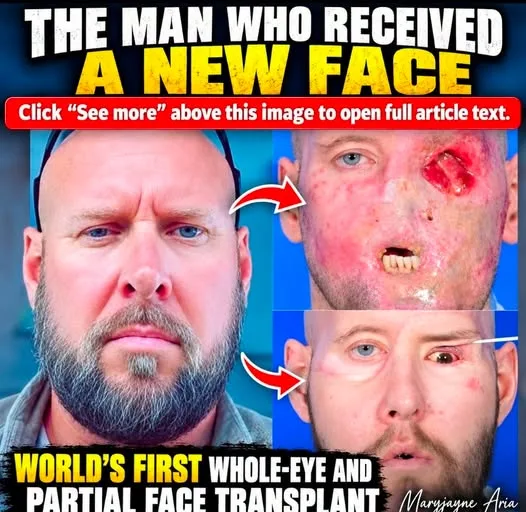
A FACE TRANSPLANT, NOT SIMPLY AN EYE TRANSPLANT: Aaron James became the recipient of the world's first whole eye and partial face transplant. In May 2023, a team at NYU Langone Health performed a 21 hour operation involving more than 140 surgeons, nurses and other healthcare professionals. Aaron had suffered catastrophic injuries after coming into contact with a 7,200 volt electrical wire while working as a high voltage lineman. He lost his left eye, nose, lips, front teeth, part of his left cheek and chin, as well as his left arm above the elbow. The transplant involved a portion of a deceased donor's face, including bone, blood vessels, nerves and other tissues, together with the donor's entire left eye and surrounding structures.
THE NUMBER THAT PUTS THIS INTO PERSPECTIVE: Face transplantation is still extraordinarily rare. According to a National Academies review, 53 face transplants had been completed worldwide by December 2024, including 20 in the United States. The first successful face transplant took place in France in 2005. So when we talk about face transplantation, we are not talking about an established procedure performed thousands of times. We are talking about a highly specialised field that has produced only a few dozen procedures worldwide over two decades.
AND THEN AARON'S PROCEDURE TOOK IT INTO COMPLETELY NEW TERRITORY: More than 50 face transplants had already been performed worldwide, but Aaron's operation was different because surgeons combined a partial face transplant with transplantation of an entire human eye. NYU Langone describes it as the world's first whole eye and partial face transplant. The eye included the optic nerve, something researchers had previously considered an enormous barrier because keeping an eye alive is one challenge, but establishing a functional connection between the transplanted eye and the recipient's brain is an entirely different problem.
AND THIS IS WHERE I REALLY STRUGGLE: The transplanted eye survived. It developed blood flow and maintained normal pressure, and examinations showed surviving retinal structures, including some rod and cone cells. But Aaron did not regain the ability to see light through the transplanted eye. The optic nerve suffered damage, and restoring functional communication between the eye and brain remains one of the great challenges researchers are trying to overcome.
I KEEP LOOKING AT THESE PHOTOGRAPHS AND THINKING ABOUT THE DONOR: I personally don't think I could donate my face. I know that statement may sound strange to some people, particularly because organ donation can give another person a chance at life, but when I imagine my face being transplanted onto another human being, I find it incredibly difficult to process. I am not judging anyone who makes that decision. This is simply my own honest reaction. An internal organ feels completely different to me from my face, the physical part of me that I have seen in the mirror throughout my entire life and that other people associate with my identity.
AND THEN I THINK ABOUT THE DONOR'S FAMILY: How would I feel if someone I loved died and their face was transplanted onto another person? What would it be like to see photographs of that person afterwards? Would I feel comfort knowing that part of my loved one was helping another human being, or would seeing their features on another person's face be deeply painful? Would I want to see the recipient? Would I want photographs? Would I want to know what they were doing with their life? Or would I desperately want to look away and never see the face again?
THESE ARE QUESTIONS I CANNOT ANSWER: According to NYU Langone, the donor's family consented to the donation, and a 3D printed facial replica was created so the donor could be returned to the family with a reconstructed facial appearance. I find that detail incredibly significant because it shows that the medical team had to think about the donor and their family as well as the recipient. But I still wonder how the family feels when they see their loved one's face, or elements of it, publicly appearing in photographs and news reports. I don't know their feelings, and I don't think anyone outside that family can know them. But I cannot help wondering.
WHERE DOES IDENTITY BEGIN AND END?: A face is not simply a collection of skin, bone, muscles and nerves. It is how we recognise people. It is how we recognise ourselves. We see our own face every morning when we look into a mirror. Our expressions communicate emotions before we say a word. Our face is connected to memories, relationships and identity. So what happens psychologically when a substantial part of that face is replaced with tissue from another human being? How long does it take before the recipient stops thinking of it as a transplanted face and simply experiences it as their own?
AND WHAT ABOUT THE RECIPIENT?: I cannot imagine the psychological journey Aaron has had to take. He survived an electrical accident that caused catastrophic facial injuries, underwent numerous procedures, lost an eye and an arm, and eventually became part of a medical procedure that had never previously been successfully performed in a human being. I don't know how I would feel in his position. I don't know whether I would feel gratitude, fear, relief, grief, hope or all of them simultaneously. It is very easy for those of us watching from the outside to call something "groundbreaking". It is very different when you are the person living inside the consequences.
THE IMMUNE SYSTEM ADDS ANOTHER LAYER: Face transplantation requires immunosuppressive medication because the recipient's immune system recognises donated tissue as foreign. In Aaron's case, the eye transplant was performed alongside the face transplant, meaning he would already require immunosuppression for the facial transplant. NYU Langone reported no episodes of tissue rejection during the first year after the procedure.
AND NOW MEDICINE IS TRYING TO GO EVEN FURTHER: Researchers are studying how to preserve retinal cells and, ultimately, how to regenerate or reconnect the neural pathways necessary for vision. NYU Langone is involved in a major research programme bringing together more than 40 scientists, physicians and industry experts with the goal of making vision restoring whole eye transplantation possible. The 2023 procedure did not restore Aaron's sight, but it demonstrated that a transplanted human eye could remain biologically viable, something that researchers had never previously demonstrated in a human recipient.
AND THIS IS WHY I HAVE TAKEN SO LONG TO WRITE THIS: I don't want to simply sensationalise something because it is extraordinary. I want to understand how I actually feel about it. After almost 18 months of thinking about this story, I still don't have a neat answer. I can see the potential. I can understand why surgeons and scientists are pushing the boundaries. I can see how future developments could potentially help people with devastating facial injuries and perhaps eventually people who have lost their sight. But there is another part of me that still looks at these photographs and thinks, "How did we get here?"
I PERSONALLY DON'T KNOW IF I COULD EVER DONATE MY FACE: Perhaps that is why the donor question troubles me so much. I understand the principle of donation, but a face feels different. I wonder whether I would want my family to see photographs of someone else living with my face. I wonder whether my family would want to meet that person. I wonder whether they would find comfort in it or whether it would make their grief harder. And I wonder whether the donor's family in this particular case feels proud, comforted, overwhelmed, conflicted, or something else entirely when they see this story being shared so publicly.
MAYBE THAT IS SOMETHING I WILL NEVER GET MY HEAD AROUND: Medicine has now reached a point where surgeons can transplant a substantial portion of one person's face onto another person's body and keep an entire donated human eye biologically viable. More than 50 face transplants have been performed worldwide, yet the field remains extraordinarily rare and experimental compared with conventional organ transplantation. Aaron's operation pushed that boundary even further by combining a partial face transplant with the first human whole eye transplant.
And perhaps the biggest question isn't simply whether medicine should continue pushing these boundaries. It is what happens to us emotionally and ethically when the boundaries keep moving.
I still don't know how I feel.
I didn't know 18 months ago.
And today, after writing this, I still don't.
Maybe that is something I will never completely get my head around.
Please share this information without making any changes to help increase awareness. Copyright Maryjayne Aria author of Immune Health, Terrain and GcMAF