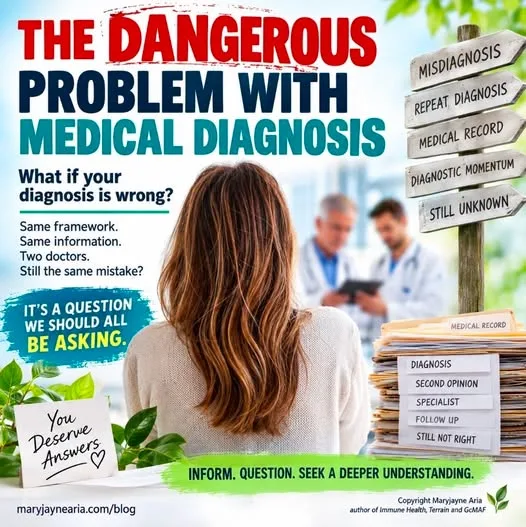
I have spent years studying health, disease, diagnosis and the way patients move through the medical system. One thing I have come to question deeply is not whether doctors are trying to help people, but whether the system gives them everything they need to get the diagnosis right. People often lose faith in doctors when they repeatedly seek answers, receive a diagnosis, follow the recommended treatment, yet continue to feel that something is wrong. Eventually, the patient starts asking a very uncomfortable question: "What if the diagnosis itself is wrong?"
THE NUMBERS FROM AMERICA SHOULD MAKE US STOP AND THINK: Diagnostic error is not some rare possibility affecting only a handful of people. Research published in BMJ Quality & Safety estimated that 12 million adults annually are misdiognosed, this is no small number. The researchers estimated that at least half of those errors could potentially be harmful. This is factual and deeply concerning.
AND THIS IS NOT JUST ABOUT NUMBERS: When I look at figures suggesting that millions of Americans experience diagnostic errors each year, I have to ask how many people may continue living with an incorrect diagnosis without ever knowing it. How many accept a medical label because a "professional" gave it to them? How many then receive treatment based on that label? And how many continue searching for answers because the diagnosis never quite explains what they are experiencing? How many lives are lost as a result of toxicity or side effects from drugs they did not need?
DIAGNOSIS IS AN INTERPRETATION: A diagnosis can sound definitive when it is actually an interpretation based on symptoms, medical history, examination findings, testing and clinical experience. Medicine itself recognises diagnostic uncertainty. AHRQ describes diagnostic error as a failure to establish an accurate and timely explanation of a patient's health problem or to communicate that explanation to the patient.
THE SECOND OPINION QUESTION: We are constantly told, "If you don't agree with your doctor, get a second opinion." But I question how much reassurance that should actually provide. A second opinion is not automatically an independent safeguard simply because another professional gives it. If both professionals have received similar training, work within the same diagnostic framework, use similar diagnostic categories, follow similar guidelines and are presented with the same information, why should we automatically assume that the second conclusion is independent of the first?
A SECOND OPINION CAN STILL CARRY THE FIRST DIAGNOSIS WITH IT: If the second professional receives the original diagnosis, referral information, previous test interpretations and clinical notes, they are not approaching the patient with a completely blank page. Research has demonstrated that prior diagnostic information influences subsequent diagnostic interpretation. To me, that raises a serious question about how independent a second opinion really is.
THE DIAGNOSIS CAN FOLLOW YOU: Imagine receiving a diagnosis at the beginning of your medical journey. That diagnosis is entered into your medical record. You see another doctor, and they read the record. The diagnosis is already there. You see a specialist, and the diagnosis is there again. Another professional reviews the referral and sees the same label. Suddenly, what began as one professional's interpretation begins to look like an established fact simply because it has been repeated.
DIAGNOSTIC MOMENTUM: This phenomenon is recognised in patient safety literature. AHRQ describes diagnostic momentum as the process by which a diagnostic label can be passed from one healthcare professional to another and gradually become accepted as established fact. AHRQ also identifies anchoring as a factor that contributes to diagnostic error, where clinicians rely too heavily on information received earlier in the diagnostic process.
THE LABEL SOON BECOMES THE LENS: This is what concerns me. Once a patient has a diagnosis attached to their medical history, new symptoms are interpreted through that diagnosis. Instead of asking, "What is causing this new symptom?", the thinking can become, "How does this symptom fit the diagnosis already recorded?" I am not saying this happens every single time, but at the same time, its very common. I am saying that the fact these recognised cognitive and diagnostic problems exist should make us question how much confidence we place in a diagnosis simply because it has been repeated.
WHAT IF BOTH ARE WRONG?: This is the question I believe patients need to be allowed to ask. If the first professional is wrong and the second professional has been trained within essentially the same framework, the second professional easily reaches exactly the same conclusion. Two professionals agreeing with one another does not prove that the diagnosis is correct. Agreement is not proof.
AND WHAT HAPPENS WHEN THE THIRD PROFESSIONAL READS THE SAME RECORD?: Now the situation becomes even more complicated. The third professional may see the original diagnosis and the second professional's agreement before making their own assessment. The previous conclusion has now gained additional authority simply because another professional accepted it. The original assumption then become increasingly difficult to challenge.
THIS IS WHERE I BELIEVE TRUST BREAKS DOWN: Imagine being told that your symptoms fit a particular diagnosis. You are uncomfortable with that conclusion, so you seek another opinion. The second professional agrees. You are then reassured that two doctors have reached the same conclusion. But what if both doctors have interpreted the same symptoms through the same framework?
What if the second doctor has already seen the first doctor's conclusion? What if the same possibilities were considered and the same possibilities were overlooked?
WHERE DOES THE PATIENT GO THEN?: This is where I believe the problem becomes much bigger than simply asking for another opinion. If the second professional is working from the same information, using similar diagnostic criteria and trained within the same medical framework, changing doctors does not necessarily mean changing the underlying reasoning.
THE PROBLEM WITH DIAGNOSTIC FRAMEWORKS: Every healthcare professional works within a framework. Symptoms are grouped, conditions are categorised and diagnoses are made according to established medical knowledge and accepted diagnostic criteria. I don't believe we should pretend it is incapable of missing things. Medical knowledge changes. Diagnostic criteria change. Understanding of disease changes. Conditions that were poorly understood in the past can later be recognised differently. What is considered unlikely today may receive greater attention tomorrow.
WHEN A DIAGNOSIS BECOMES THE STARTING POINT: Once a patient has been labelled with a particular diagnosis, I believe there is a danger that subsequent symptoms can be interpreted as part of that diagnosis rather than prompting a completely fresh investigation. The diagnosis becomes the starting point for the next professional rather than a hypothesis that should still be questioned.
AMERICA'S NUMBERS MAKE THIS EVEN MORE IMPORTANT: When research estimates that approximately 12 million U.S. adults experience outpatient diagnostic errors each year, I don't think patients should simply assume that a diagnosis is correct because it was delivered confidently. The scale of the problem alone should make us willing to have a much more uncomfortable conversation about diagnostic certainty.
THIS IS A GLOBAL ISSUE. I have focused on writing about America, but these are global issues; no country is exempt from these same principles.
I QUESTION THE IDEA THAT CONSENSUS EQUALS CERTAINTY: If one professional says something and another professional agrees, that can feel reassuring, but it by no means establishes certainty. The important question is not simply, "Do two doctors agree?" The important question is, "How did they arrive at that conclusion, and did they genuinely consider what could make that conclusion wrong?"
WHAT I WOULD WANT TO KNOW: If I were questioning a diagnosis, I would want to know exactly how that diagnosis was reached. What symptoms supported it? What findings contradicted it? What alternative diagnoses were considered? What tests were performed? What tests were not performed? What assumptions were made? What evidence would challenge the diagnosis? And most importantly, was the second professional genuinely reassessing the case independently, or were they reviewing the first professional's conclusion and reaching the same answer?
WHY PEOPLE EVENTUALLY LOSE FAITH: I believe people lose faith in doctors when they feel they are not being heard, when their symptoms are repeatedly attributed to the same diagnosis despite treatment not resolving the problem, or when they ask questions and receive certainty instead of discussion. Sometimes the patient is not asking for a doctor to admit they are wrong. They are asking for someone to be willing to consider that they might be wrong. Arrogance of that doctor can also get in the way.
I DON'T BELIEVE BLIND TRUST IS THE ANSWER: I don't believe patients should blindly accept a diagnosis simply because it has been delivered by someone with medical qualifications. Qualifications matter. Experience matters. Medical knowledge matters. But none of these make a human being infallible. Doctors can make many mistakes. Tests can be misinterpreted. Symptoms can overlap. Conditions can resemble one another. Patients can present differently from the textbook description. And diagnostic assumptions can influence what is noticed and what is overlooked.
WHERE DO WE GO FROM HERE WITHOUT TRUST?: This is the question that concerns me most. If a patient no longer trusts the first diagnosis and is told simply to obtain a second opinion, but the second professional may be operating from the same framework and information, where does the patient go when both opinions feel wrong? For me, the answer cannot simply be, "Find another doctor." We have to be willing to question the diagnostic process itself.
MY PERSONAL POSITION: I believe patients should understand their own medical information, ask difficult questions and challenge conclusions they genuinely do not understand or believe fit their circumstances. That does not mean rejecting medicine. It means refusing to believe that a diagnosis becomes unquestionable simply because it appears twice, three times or even more times in a medical record.
THE QUESTION I KEEP COMING BACK TO: If two professionals are working from the same diagnostic framework, have received substantially similar training and are looking at the same information, how independent is that second opinion really?
And if the original diagnosis has already entered the medical record, how much does that previous conclusion influence everyone who sees it afterwards? If millions of people can experience diagnostic errors, perhaps we need to stop treating a diagnosis as the end of the investigation. Perhaps it should remain what it was at the beginning: a conclusion that must remain open to questioning when the evidence no longer fits. That is the question I believe we should be asking.
Please share this information without making any changes to help increase awareness of the importance of questioning diagnostic assumptions and seeking a deeper understanding of how diagnoses are reached. Copyright Maryjayne Aria author of Immune Health, Terrain and GcMAF