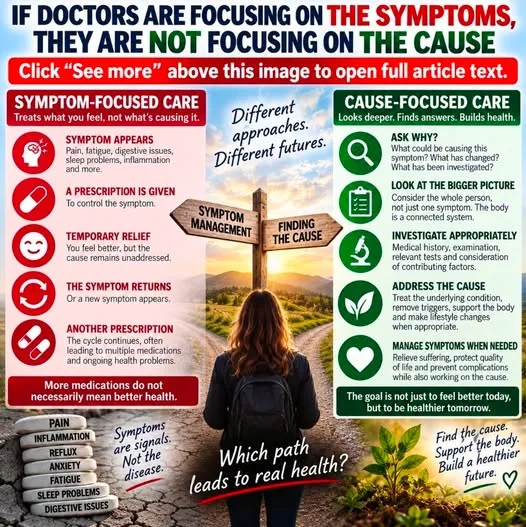
There is an uncomfortable question we need to ask about chronic illness: What happens when healthcare becomes better at managing symptoms than identifying why those symptoms keep occurring? For many people, the journey can become a repeating cycle. A symptom appears, something is prescribed to control it, the symptom improves temporarily, the treatment is continued or changed, another symptom appears, another treatment is added, and eventually the person can find themselves taking multiple medications while still asking the same fundamental question: "Why am I still unwell?"
SYMPTOM MANAGEMENT IS NOT THE SAME AS FINDING THE CAUSE: There is nothing wrong with treating symptoms. Pain relief can be essential. Controlling blood pressure can reduce serious risks. Treating inflammation can prevent damage. Managing blood glucose are important. Treating infection can be critical. The problem begins when symptom control becomes the endpoint rather than part of a broader investigation. If the underlying driver remains unidentified, reducing a symptom does not mean the underlying problem has been resolved.
THE "ONE MORE PRESCRIPTION" PROBLEM: Imagine a person develops chronic stomach discomfort. They receive treatment for the discomfort. Later they develop reflux and receive another treatment. Then constipation develops, followed by fatigue and poor sleep. Each symptom may be addressed separately, potentially resulting in an increasingly complicated treatment regime and the side effects of them.. Yet the bigger question can become lost: Could some of these symptoms be connected? Could one underlying condition, medication effect or combination of factors be contributing to several problems? Treating each symptom independently makes the overall picture harder to see.
THE BODY IS NOT A COLLECTION OF SEPARATE SYMPTOMS: The human body does not operate like a collection of unrelated departments. The immune system communicates with the nervous system. The digestive system interacts with immune function. Hormones influence metabolism, sleep and many other processes. The liver and kidneys influence how substances are processed and eliminated. The microbiome interacts with the gastrointestinal environment and immune system. This interconnectedness does not mean that every symptom has one hidden cause, but it does mean that repeatedly treating isolated symptoms without considering the whole clinical picture needs change.
CHRONIC INFLAMMATION DESERVES A QUESTION: If inflammation remains elevated or symptoms associated with inflammation repeatedly return, simply asking how to suppress inflammation may not be enough. The next question should be why the inflammatory response is occurring. Infection, autoimmune disease, tissue injury, metabolic conditions, medications and numerous other factors can contribute to inflammation. The appropriate treatment depends entirely on the cause. Suppressing inflammation can be medically appropriate, but identifying the reason for persistent inflammation may be more important.
THE SAME IS TRUE OF CHRONIC FATIGUE: Fatigue is one of the clearest examples of why symptoms require investigation. Fatigue can arise from inadequate sleep, anaemia, nutritional deficiencies, endocrine disorders, medication effects, infections, chronic diseases, psychological stress and many other causes. Telling someone simply to "rest more" does not answer the question of why they remain exhausted. Nor does taking something to increase energy necessarily address the underlying problem. Persistent fatigue deserves appropriate medical assessment.
DIGESTIVE SYMPTOMS SHOULD NOT AUTOMATICALLY BE DISMISSED: Bloating, abdominal pain, diarrhoea, constipation, reflux and nausea can have many causes. Some are relatively minor. Others require medical investigation. Repeatedly suppressing gastrointestinal symptoms without considering the broader clinical picture can leave the underlying problem unidentified. Depending on the circumstances, evaluation may need to consider medication effects, dietary factors, infections, inflammatory disorders, functional gastrointestinal conditions and other possible explanations.
THE MEDICATION ITSELF MAY SOMETIMES BECOME PART OF THE PUZZLE: Medicines produce many side effects or alter physiological processes. When a new symptom appears after a medication is started or a dose is changed, it is reasonable to ask whether there could be a connection. It means discussing the possibilities with a qualified healthcare professional and reviewing the complete medication history rather than automatically adding another treatment to manage the new symptom.
MORE MEDICATIONS DO NOT NECESSARILY MEAN BETTER HEALTHCARE: Medication can be dangerous.Also when a person continually accumulates treatments while their overall health continues to deteriorate, it is reasonable to step back and reassess. What conditions are actually being treated? Which treatments are still necessary? Are there adverse effects? Has the original diagnosis been reconsidered? Is there evidence that the treatment is working? Could two or more symptoms have a common explanation?
THE CHRONIC ILLNESS CHECKLIST SHOULD INCLUDE "WHY?": When someone has been unwell for months or years, the conversation should not consist solely of "What can we give you for this symptom?" It should also include questions such as: What caused this to begin? What changed before the symptoms appeared? What diagnoses have been considered? What has actually been ruled out? What medications and supplements are being taken? Are there nutritional, metabolic, endocrine, infectious, inflammatory or environmental factors worth investigating? Are there objective abnormalities that need follow-up? What happens if the current treatment does not work?
LISTEN WHEN THE BODY KEEPS REPEATING THE SAME MESSAGE: If the same symptom keeps returning, that recurrence is important information. If treatment repeatedly provides only temporary relief, that deserves reassessment. If symptoms multiply, the overall picture should be reviewed. If the diagnosis no longer explains what is happening, it should be reconsidered. Good healthcare should be willing to revisit assumptions rather than simply adding another layer of treatment.
THE GOAL SHOULD BE LESS MEDICAL WHACK-A-MOLE: Nobody wants to spend years chasing one symptom after another. Treating one problem, then another, then another can become exhausting for both patients and healthcare professionals. The goal should be to step back and ask whether there is a unifying explanation, whether several independent problems are occurring, whether treatments themselves may be contributing to symptoms, and whether the original diagnosis still makes sense.
TREAT THE CAUSE WHEN YOU CAN, MANAGE THE SYMPTOMS WHEN YOU MUST: This is not an argument for abandoning symptom relief. It is an argument for doing both when appropriate. If someone is suffering, help them. If a dangerous physiological abnormality needs controlling, control it. If an infection requires treatment, treat it. But alongside that, investigate why the problem occurred, monitor whether the underlying condition is improving and reassess when the expected response does not happen.
CHRONIC ILLNESS SHOULD NOT BECOME A LIFE SENTENCE OF SYMPTOM MANAGEMENT: Some chronic diseases genuinely require lifelong treatment. That should never be minimised. But "chronic" should not automatically mean "stop looking." Medicine evolves, diagnoses change, new information emerges and patients' circumstances change. A treatment that was appropriate years ago may need reassessment today. A symptom that was once considered unrelated may become an important diagnostic clue when viewed alongside everything else.
THE QUESTION WE NEED TO ASK MORE OFTEN: Instead of asking only, "What medication treats this symptom?" perhaps we should also ask, "What is producing this symptom?" Instead of asking only, "How do we make this go away?" ask, "Why does it keep coming back?" Instead of treating every new symptom as an isolated problem, ask whether the symptoms could be connected. And instead of assuming that temporary relief means the problem is solved, ask whether there is evidence that the underlying condition has actually improved.
FINAL THOUGHT: Chronic illness requires more than endlessly turning down warning signals. When a person remains unwell despite repeated treatment, the answer should not automatically be another prescription for another symptom. Sometimes the most important step is to stop, reassess the entire picture and investigate what may be driving the illness. Treat the symptom when necessary. Treat the disease when possible. But never stop asking the most important question of all: "Why is this happening?"
Please share this information without making any changes to help increase awareness