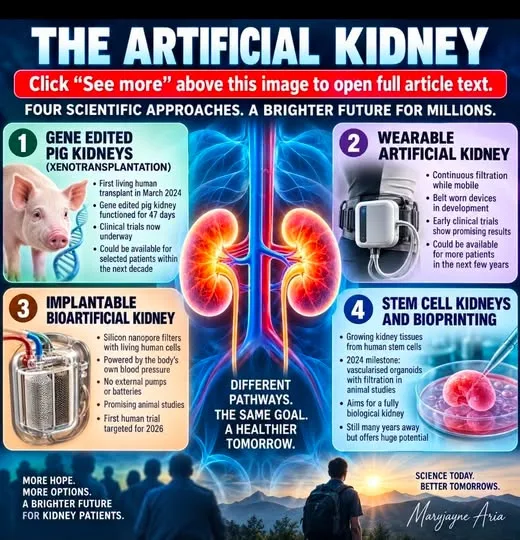
A HISTORIC BREAKTHROUGH: On 16 March 2024, 62 year old Richard Slayman became the first living person to receive a genetically edited pig kidney and leave hospital with the organ functioning normally. The transplant marked one of the greatest advances in transplant medicine, demonstrating that a gene edited animal organ could successfully filter human blood in a living patient.
Although Richard died 47 days later from causes reported as unrelated to the transplant, his surgeons confirmed that the pig kidney was still working at the time of his death. This remarkable achievement changed the conversation from "Is it possible?" to "How soon can it become available for more patients?"
WHY THE WORLD NEEDS NEW KIDNEY SOLUTIONS: More than 850 million people worldwide live with kidney disease, and millions progress to kidney failure. Donor kidneys remain in critically short supply, leaving many patients dependent on dialysis while waiting years for a transplant. Scientists are now pursuing four different technologies that aim to replace or restore kidney function.
APPROACH ONE: GENE EDITED PIG KIDNEYS: Xenotransplantation involves transplanting organs from specially bred pigs whose DNA has been modified to make them more compatible with the human immune system. The donor kidney used for Richard Slayman contained dozens of genetic edits that removed molecules responsible for rejection, added protective human genes, and disabled pig viruses known as PERVs.
Early clinical trials are now underway in carefully selected patients, and if long term results remain encouraging, this approach could become available for certain patients within the next decade. Lifelong immune suppressing medication would still be required, just as it is for conventional human kidney transplants.
APPROACH TWO: THE WEARABLE ARTIFICIAL KIDNEY: Traditional dialysis cleans blood for only a few hours several times each week, allowing toxins to build up between treatments. Wearable artificial kidneys are designed to provide continuous filtration while patients remain mobile, creating a much more natural replacement for kidney function.
Several companies are developing belt sized or vest worn devices that recycle dialysis fluid, dramatically reducing the need for large dialysis machines and improving quality of life. Some systems have already completed successful early clinical trials and could reach broader testing over the next few years.
APPROACH THREE: THE IMPLANTABLE BIOARTIFICIAL KIDNEY: One of the most ambitious projects is the implantable bioartificial kidney developed through The Kidney Project. Instead of using an animal organ, this device combines ultra precise silicon nanopore filters with living human kidney cells inside a compact implant. The remarkable feature is that it is powered by the patient's own blood pressure rather than batteries or external pumps. Animal studies have shown promising results, and the first human implantation trial is being targeted for 2026 pending regulatory approval.
APPROACH FOUR: GROWING KIDNEYS FROM STEM CELLS: Researchers are also learning how to grow miniature kidneys called organoids from human stem cells. These laboratory grown tissues already resemble developing kidneys and have begun demonstrating limited filtration in animal studies. The ultimate goal is to create a fully biological kidney using a patient's own cells, potentially eliminating both donor shortages and immune rejection. This remains the longest term strategy and is likely still many years away.
HOW CLOSE ARE WE?: Each technology is advancing at a different pace. Xenotransplantation is already being tested in living humans. Wearable dialysis devices may become available first for larger numbers of patients. Implantable bioartificial kidneys represent an exciting middle ground between engineering and biology, while stem cell grown kidneys offer the possibility of a truly personalised organ in the future.
A REASON FOR HOPE: Kidney medicine is evolving faster today than at any time in history. While dialysis and human transplantation remain the standard of care, the success of Richard Slayman's transplant proved that entirely new approaches are becoming reality. For millions of people living with kidney failure, these breakthroughs offer genuine hope that future treatments may be safer, more effective, and far more accessible than ever before.
Please share this information without making any changes to help increase awareness
Copyright Maryjayne Aria author of Immume Health, Terrain and GcMaf