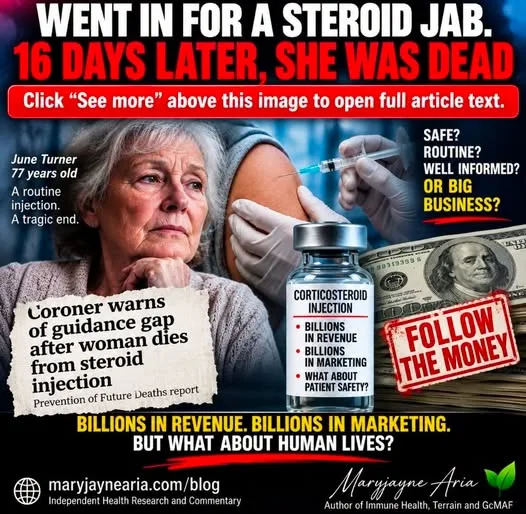
A ROUTINE INJECTION: That is how these things become frightening. Something is called routine often enough and eventually people stop asking the uncomfortable questions. What could possibly go wrong? How dangerous could one injection really be? On 12 September 2025, 77-year-old June Turner went to her doctors for a steroid injection into her shoulder. At 11.42am, she received the injection. Ten minutes later, she returned complaining that she was struggling to breathe. By 11.57am, she had become peri-arrest. She was taken to hospital. Sixteen days later, she died. The coroner recorded hypoxic encephalopathy, anaphylaxis and injection allergy as causes of death.
SHE DID NOT WALK INTO THAT SURGERY EXPECTING TO DIE: And yet that is what happened. This was not an obscure experimental treatment being performed somewhere in a laboratory. It was a steroid injection delivered in ordinary healthcare. The tragedy becomes even more disturbing because the coroner subsequently raised concerns about whether there was sufficient national guidance surrounding severe allergic reactions following steroid injections.
THE CORONER'S WARNING: Senior Coroner Mary Hassell issued a Prevention of Future Deaths report after investigating June Turner's death. The report identified an omission in guidance concerning severe, life threatening reactions following steroid injections and warned that, without action, there was a significant risk of future deaths. Stop and read that sentence again. A coroner investigating a woman's death identified a potential safety gap that could affect other people receiving the same type of treatment.
HOW MANY PEOPLE KNOW THIS?: Ask yourself honestly. Before receiving a steroid injection, were you fully aware that a severe allergic reaction could occur? Were you told exactly what symptoms to watch for? Were you told what would happen if you suddenly became unable to breathe? Were you observed appropriately afterwards? Or was it simply presented as another routine injection?
ROUTINE CAN BE A VERY DANGEROUS WORD: I have spent years studying health, disease and the systems surrounding healthcare, and one thing continually concerns me. Once something becomes commonplace, people can stop questioning it. The injection becomes routine. The prescription becomes routine. The follow up becomes routine. The risk becomes buried beneath familiarity. But your body does not care whether the procedure is considered routine.
NOW FOLLOW THE MONEY: This is where I want people to look beyond the injection room. The global cortisone shots market has been estimated at approximately $1.54 billion in 2026, rising from $1.48 billion in 2025 and projected to reach approximately $1.99 billion by 2031. The broader joint pain injection market is estimated at almost $7 billion in 2026. We are talking about billions moving through markets involving injections used for pain and musculoskeletal conditions.
BILLIONS IN REVENUE. BUT WHERE IS THE PROFIT?: This is the question people often ask, and there is an important distinction. There is no reliable public figure showing the worldwide annual profit specifically generated by steroid injections. Pharmaceutical companies do not publish a single global "steroid injection profit" line. But the market revenue tells us something important. There is substantial money involved, and wherever billions circulate, we should be willing to examine the incentives surrounding that market.
THEN LOOK AT MARKETING: Pharmaceutical and healthcare advertising in the United States alone has been estimated at approximately $32.7 billion in 2025, including around $24.8 billion in digital advertising. Research examining major pharmaceutical products has found enormous promotional spending alongside enormous sales. One study of the 150 top-selling drugs found median promotional spending of $20.9 million per drug and median annual sales of $1.51 billion.
THINK ABOUT THAT FOR A MOMENT: Millions can be spent promoting individual medicines. Billions can be spent promoting healthcare products across an entire industry. Entire commercial ecosystems exist around medical products. Yet the person sitting in front of the clinician is still expected to trust that the information they receive is sufficient.
THIS IS WHERE I START ASKING QUESTIONS: Are patients being given enough information about serious risks before they consent? Are risks being communicated in language ordinary people actually understand? Are healthcare professionals given consistent guidance about what to do when a severe reaction occurs? And why did it take a death and a coroner's investigation to expose concerns about the guidance surrounding steroid injection reactions?
FOLLOW THE MONEY, THEN FOLLOW THE PAPER TRAIL: I am not interested in pretending that every steroid injection is dangerous. I am interested in asking why a treatment can become so normalised that people may forget that every medical intervention has consequences, including potentially catastrophic reactions. Commercial success does not equal safety. Popularity does not equal safety. Familiarity certainly does not equal safety.
AND THIS IS THE PART THAT MAKES ME ANGRY: June Turner was a person, not a market segment. She was someone's mother, grandmother, wife, friend. She walked into a medical practice expecting treatment. She did not walk in expecting to become the subject of a Prevention of Future Deaths report.
THE SYSTEM IS SUPPOSED TO LEARN FROM DEATHS: That is what pharmacovigilance and medical investigation are supposed to achieve. Something goes wrong. It is investigated. The system identifies what failed or what could be improved. Guidance changes where necessary. Future patients benefit from what was learned. But that process only works if uncomfortable questions are actually asked.
HOW MANY MORE ROUTINE PROCEDURES DESERVE A SECOND LOOK?: How many patients are consenting because they genuinely understand the risks, and how many are consenting because the treatment has been presented as something so ordinary that questioning it feels unnecessary? There is a profound difference between informed consent and simply saying yes because the person in the white coat told you it was routine.
FOLLOW THE MONEY. FOLLOW THE MARKETING. FOLLOW THE GUIDANCE. THEN FOLLOW THE DEATHS: Those four things should never exist in completely separate conversations. If an enormous commercial market exists around a medical intervention, scrutiny of safety communication should be relentless, not occasional.
BECAUSE HERE IS THE QUESTION I CANNOT IGNORE: If billions of dollars can be generated from healthcare markets and billions can be spent marketing medicines, why should patients ever have to discover serious risks after something goes wrong?
JUNE TURNER'S STORY SHOULD NOT END WITH A CORONER'S REPORT: Her death should force questions about how steroid injections are explained, how serious allergic reactions are anticipated, how patients are observed and how quickly guidance changes when a safety gap is identified. The money can be counted. The market can be measured. The marketing budgets can be calculated.
BUT YOU CANNOT PUT A HUMAN LIFE BACK ON THE BALANCE SHEET.
Maryjayne Aria
Please share this information without making any changes to help increase awareness of the importance of proper diagnosis for suspected medical complications and informed healthcare decisions. Copyright Maryjayne Aria author of Immune Health, Terrain and GcMAF