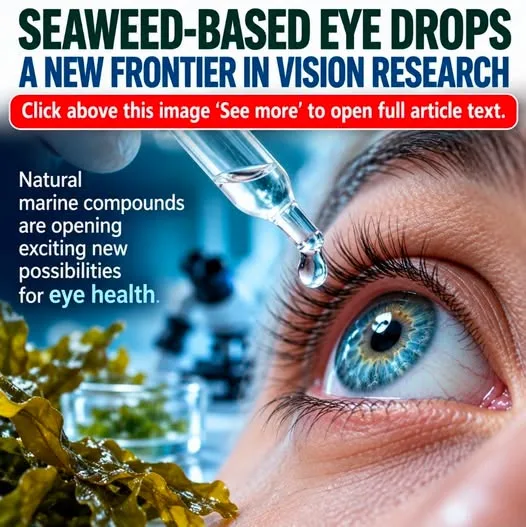
A fascinating new area of ophthalmic research is exploring natural marine-derived polymers and hydrogel technology to improve how therapeutic compounds are delivered to the eye. Rather than simply placing a conventional liquid drop into the eye and allowing much of it to be washed away by blinking and tears, researchers are developing formulations that can remain in contact with ocular tissues for longer and release therapeutic compounds gradually.
WHAT IS THE CONNECTION WITH SEAWEED? Alginate is a natural polysaccharide extracted primarily from brown seaweed. It has attracted considerable interest in medicine because it can form hydrated, transparent gels and can be engineered to respond to the conditions found in the eye. Researchers are investigating alginate-based hydrogels for ocular drug delivery because they can potentially increase residence time and improve the delivery of active compounds.
A NEW GENERATION OF HYDROGEL EYE DROPS: In August 2026, researchers reported a new antioxidant hydrogel eye-drop formulation designed to investigate treatment of dry age-related macular degeneration, or dry AMD. The formulation contained astragaloside IV, a compound derived from Astragalus membranaceus, encapsulated in liposomes and incorporated into a thermosensitive chitosan/sodium glycerophosphate hydrogel. Importantly, this particular formulation is not simply "seaweed eye drops." The hydrogel matrix used in this study was based on chitosan and glycerophosphate, while the marine-derived alginate research represents a related but separate area of ocular biomaterials research.
WHY IS THE HYDROGEL IMPORTANT? One of the major problems with conventional eye drops is that they have a very short residence time. Blinking, tears and drainage through the nasolacrimal system can rapidly remove medication from the ocular surface. In situ hydrogels are being designed to address this problem by remaining liquid during administration and then changing into a gel under physiological conditions. This can potentially provide longer local exposure and more controlled release of the therapeutic compound.
WHAT DID THE NEW STUDY FIND? In a mouse model designed to reproduce important aspects of dry AMD-related oxidative retinal injury, the researchers found that the hydrogel formulation reduced retinal reactive oxygen species and increased expression of SIRT1 and Nrf2, two proteins involved in cellular antioxidant and stress-response pathways. The formulation also showed favourable cytocompatibility in laboratory testing.
WHY SIRT1 AND NRF2 MATTER: Oxidative stress is an important component of retinal degeneration. Nrf2 is a major regulator of cellular antioxidant defence, while SIRT1 is involved in cellular stress responses and can influence antioxidant signalling. The researchers therefore investigated whether improving delivery of an antioxidant compound could influence this protective pathway within retinal tissue.
BUT THERE IS AN IMPORTANT CATCH: This is still preclinical research. The 2026 study used a chemically induced mouse model of dry AMD and laboratory retinal cells. It did not demonstrate that the eye drops restore vision in blind human patients, and it is not evidence that patients should attempt to reproduce the formulation themselves. The researchers themselves note that the mouse model does not completely reproduce the chronic, multifactorial nature of human dry AMD.
THERE IS ANOTHER VERY INTERESTING SEAWEED CONNECTION: Separate research has been investigating alginate-based hydrogels as potential vitreous substitutes following retinal surgery. In a 2024 study, researchers developed a transparent alginate-based composite hydrogel using alginate derived from marine brown seaweed. The material was designed to be injected into the eye and form a stable hydrogel that could act as a tamponade after vitrectomy and retinal detachment. In a rabbit model, the hydrogel inhibited recurrent retinal detachment and preserved vision without obvious adverse effects during the study period.
This is particularly interesting because conventional retinal tamponades such as silicone oil and expanding gases have recognised limitations. Silicone oil, for example, may require subsequent removal surgery, while gas tamponades can temporarily interfere with vision and impose restrictions such as avoiding certain changes in atmospheric pressure. Researchers are therefore searching for materials that can more closely reproduce the physical properties of the natural vitreous body.
AND THE RESEARCH IS MOVING QUICKLY: A 2026 systematic review of experimental vitreous substitutes included the alginate hydrogel research and reported promising results in animal models, while also emphasising that these technologies remain at the experimental stage. Another 2026 study investigated a different injectable hydrogel based on PEG and hyaluronic acid as a potential vitreous substitute.
WHAT ABOUT ACTUALLY RESTORING VISION? This is where another branch of research becomes important. Optogenetic therapy is being investigated for severe retinal degeneration. These therapies use gene delivery to introduce light-sensitive proteins into surviving retinal cells, potentially allowing cells that normally do not detect light to respond to it.
A 2026 clinical trial of the experimental optogenetic therapy UGX-201 involved nine people with advanced retinitis pigmentosa. The study reported visual improvements in participants who already had light perception, while all three participants who initially had no light perception regained some light perception in the treated eye during follow-up. Two of those three participants retained light perception at week 52. This was an experimental intravitreal gene therapy, however, not a seaweed-derived eye drop.
THE BIGGER PICTURE: What we are seeing is the convergence of several fascinating technologies: natural biomaterials such as alginate, advanced hydrogel drug-delivery systems, antioxidant compounds, controlled-release technology and gene-based approaches to retinal repair. Each addresses a different problem, but together they demonstrate how researchers are moving beyond traditional eye drops and conventional surgical materials.
It would therefore be inaccurate to say that "seaweed eye drops have restored sight to blind patients." The science is more nuanced, but arguably even more interesting. Marine-derived biomaterials are being investigated as sophisticated platforms for ocular drug delivery and retinal surgery, while completely separate optogenetic therapies are beginning to demonstrate genuine visual restoration in early human trials.
THE FUTURE OF EYE MEDICINE: The ultimate goal is not simply to develop another eye drop. Researchers are attempting to solve some of ophthalmology's biggest delivery problems: keeping therapeutic compounds in the eye longer, getting them closer to the tissues that need them, protecting vulnerable retinal cells from oxidative damage and, in some cases, restoring light sensitivity to surviving retinal cells. Much more human research is needed, but these developments represent a fascinating direction for future treatments.
Please share this information without making any changes to help increase awareness