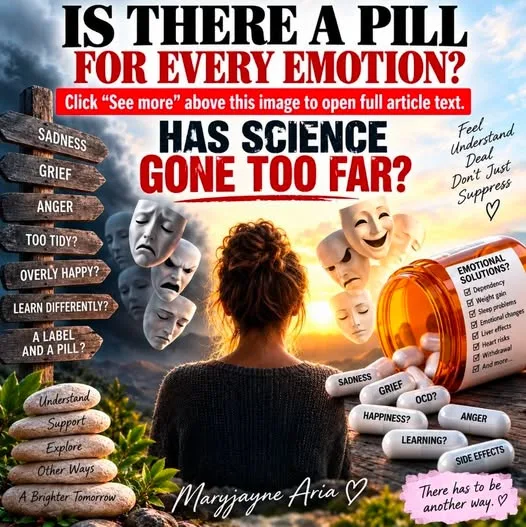
MY PERSONAL CONCERN: I have become increasingly concerned about how quickly we seem to be placing labels on human behaviour, emotions and individual differences. It sometimes feels as though we have quicly moved to a society where almost every aspect of being human is given a diagnostic label, followed by a prescription. I have to ask myself, have we reached the point where there is a pill for every emotion we experience?
SADNESS: If I am sad, is that automatically something that needs a pill? To me, sadness is a normal human emotion. We all experience it. We can be sad because we have lost someone, because we have been hurt, because life has disappointed us or because something we deeply cared about has changed. I do not believe that episodes of sadness should automatically be viewed as something that needs to be chemically suppressed with a pill. There are obviously serious mental health conditions that may require professional treatment, but I believe we need to be very careful about confusing ordinary human sadness with illness and lables.
GRIEF: If I lose someone I love, I expect to grieve. I expect to cry. I expect to feel angry, lost, exhausted, confused and sometimes completely overwhelmed and brief depression. Grief is painful because the person mattered. I find it concerning when we begin to think that painful emotions following a loss must automatically be medicated. I believe grieving is something we need to understand and work through, with support when necessary, rather than simply trying to switch off the feelings and be given a pill.
IF WE ARE TOO TIDY: If someone likes everything clean, organised and perfectly arranged, does that automatically mean they have OCD and need medicating? No, I do not believe it does. There is a huge difference between having a particular personality trait and having a condition that causes significant distress and disruption to someone's life. I worry about how easily labels can become attached to behaviours that may simply represent individual differences. My concern is how quickly doctors reach for presciption pads when all we need to hear is the words, I am here to listen.
IF WE ARE OVERLY HAPPY: What about being extremely energetic, enthusiastic or happy? There is a lable and a pill! I believe we need to be careful not to pathologise personality, enthusiasm or someone simply being full of energy. Human beings are not machines programmed to display exactly the same emotional response every day.
IF WE DO NOT LEARN AS QUICKLY AS SOMEONE ELSE: Children do not all learn at the same speed. Some children understand mathematics quickly. Others struggle with numbers but are exceptional with language, music, art, practical tasks or creative thinking. Some simply need more time. I believe labels and pills are not the answer! Its more useful when we receive understanding and appropriate support, I worry when differences are immediately treated as problems that need to be corrected with medication.
ANGER: What about anger? Anger can certainly become destructive and dangerous when it is uncontrolled, but anger itself is an emotion. Sometimes anger is telling us something. Perhaps we have been hurt. Perhaps we have been treated unfairly. Perhaps our boundaries have been crossed. Perhaps something in our lives desperately needs to change. I do not believe the answer should always be to suppress the emotion with a pill. I believe we should first understand why it is there and learn how to deal with it constructively.
I DO NOT BELIEVE SUPPRESSING EMOTIONS IS THE ANSWER: This is one of the things I feel most strongly about. I do not believe suppressing emotions with pills is the answer. I believe we need to understand our emotions and learn how to deal with them. We need to ask why we feel the way we feel. We need to look at our circumstances, our relationships, our environment, our experiences, our stress levels and the things that may be contributing to what we are experiencing. There have to be other ways of supporting people that do not automatically begin with medication.
THERE HAS TO BE ANOTHER WAY: I believe we should be looking much more seriously at approaches that do not involve medication more. Talking therapies, counselling, emotional support, changes in lifestyle, better sleep, reducing chronic stress, exercise, time in nature, social connection, learning coping strategies and addressing the circumstances causing distress can all form part of a much broader approach. I am not saying medication should never be used. I am saying that I do not believe it should automatically be the first answer to every difficult emotion or behaviour.
PILLS COME WITH A RAPSHEET: This is another reason I question the direction we are taking. Pills are not harmless. They have pharmacological effects and they can come with a long list of potential side effects, interactions, contraindications and risks including death. Some medications can affect sleep, appetite, cognition, the nervous system, cardiovascular system, liver, kidneys and emotional state. Some can also cause withdrawal problems or dependence. When I see the long list of possible adverse effects associated with medications, I believe we should always be asking whether the potential benefits genuinely outweigh the risks.
WHAT HAPPENED TO "DO NO HARM"?: I keep coming back to this simple principle. What happened to "do no harm"? I believe medicine should always consider the whole person, not simply the symptom that is causing difficulty at that particular moment. If someone is grieving, perhaps they need support. If someone is angry, perhaps we need to understand what is causing the anger. If someone is struggling to learn, perhaps we need to understand how they learn and use different learning techniques. If someone is anxious, perhaps we need to understand what is creating that anxiety. I believe we should look underneath the symptom before automatically reaching for a prescription.
Medications are NOT cures, If they were curative, Why would repeat prescriptions be required?
WE ARE PLACING LABELS ON EVERYTHING: My concern is that we are increasingly living in a world where differences are being labelled, emotions are being medicalised and uncomfortable experiences are being treated as problems that need to disappear. I believe there is a danger in forgetting that human beings are individuals. We have different personalities, different experiences, different strengths and different ways of processing the world around us.
I AM NOT SAYING MEDICINE HAS NO PLACE: I know that there are people living with serious psychiatric and neurological conditions for whom medication may play a role. My concern is something different. I question whether we are being too quick to move from "this person is experiencing something difficult" to "this person needs a diagnosis and a pill."
MY QUESTION IS SIMPLE: Are we becoming a society where there is a pill for every emotion? A pill for sadness. A pill for grief. A pill for anger. A pill for depression, A pill for difficulty concentrating. A pill for behaviour that does not fit the expected norm. A label for being different. Where does it end?
I believe emotions should not automatically be viewed as enemies that need to be silenced. Some emotions are painful, but they can also tell us something important. I believe we need to understand them, process them and learn how to manage them. I believe there should be much more discussion about approaches that support the whole person rather than simply suppressing symptoms.
Because not every emotion is an illness.
Not every difference is a disorder.
And I do not believe every uncomfortable feeling needs a pill.
Please share this information without making any changes to help increase awareness and encourage people to question, research and understand the information being presented to them.
What are your thoughts? Drop a comment below
Copyright Maryjayne Aria , author of Immune Health, Terrain and GcMAF