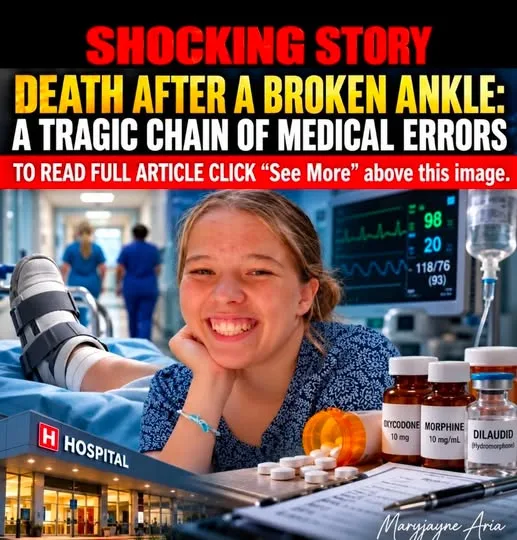
There are stories that make me angry, stories that make me question how a healthcare system can allow something so devastating to happen, and the story of Dale Alice Martin is one of them. Dale was just 21 years old when she went to Waterbury Hospital in Waterbury, Connecticut, United States, after breaking her ankle. She should have been treated for her injury, given appropriate pain relief, carefully monitored and eventually sent home to continue her recovery. Instead, she died. I cannot read a story like this and simply shrug my shoulders and say that mistakes happen. There is a profound difference between accepting that human beings can make mistakes and accepting a healthcare system in which preventable mistakes cost a young person her life. There is no excuse for what happened to Dale.
THE PATIENT TRUSTED THE HOSPITAL: When someone enters a hospital, they are placing their life in the hands of medical professionals. They expect medications to be correctly prescribed, correctly administered and appropriately monitored. They expect doctors and nurses to communicate with each other. They expect the medication chart to be understood. They expect someone to notice if their breathing changes or if they become dangerously sedated. These are not unreasonable expectations. They are the absolute basics of patient safety and care. Dale's family trusted Waterbury Hospital to care for their daughter, and instead they were left grieving a 21-year-old who should have been coming home.
A CHAIN OF MEDICATION ERRORS: According to reporting surrounding the investigation, Dale received powerful opioid medications including oxycodone and morphine for pain following her ankle injury. When she continued to experience pain, the on-call orthopaedic surgeon instructed a nurse to administer Dilaudid, also known as hydromorphone. The investigation found that this instruction was interpreted as adding Dilaudid to the medications she had already received rather than replacing previous medication. Dale was subsequently found not breathing and suffered catastrophic brain injury before being declared brain dead. Reporting on the autopsy stated that she had been fatally overmedicated with narcotic painkillers. Think about that for a moment. A young woman entered hospital with only a broken ankle and ended up dead following medication administration that should have been surrounded by multiple layers of safety.
THE DOCTOR AND THE MEDICATION ORDER: The circumstances surrounding the doctor's instruction are at the heart of the tragedy. Reporting states that the nurse contacted the on-call orthopaedic surgeon because Dale continued to complain of pain, and the surgeon instructed the nurse to "try Dilaudid." The subsequent investigation found that the instruction was interpreted as adding hydromorphone to Dale's existing opioid medications. Dale's parents have since filed a wrongful-death lawsuit naming the doctor, nurse and hospital. I have deliberately not identified the doctor by name because the reliable reporting available to me does not publicly establish the physician's name, and I will not put an unverified name into an article about such a serious matter.
WHERE WAS THE MONITORING?: This is one of the questions that makes this story so disturbing. Powerful opioids can suppress breathing. That is well known. Patients receiving these medications require appropriate observation, particularly when multiple opioid medications are involved. Yet reporting about the investigation stated that Dale's vital signs and breathing were not documented during the night. How can a vulnerable patient receiving powerful respiratory-depressing medication be left without the level of monitoring necessary to detect deterioration? A hospital is not supposed to be a place where a patient can silently stop breathing while everyone assumes everything is fine. Monitoring exists precisely because patients can deteriorate, sometimes rapidly.
WATERBURY HOSPITAL AND THE WIDER QUESTIONS: Dale was treated at Waterbury Hospital in Waterbury, Connecticut, which at the time was part of Prospect Medical Holdings. Reporting has described previous staffing and safety concerns at the hospital, including another serious medication incident involving an incorrect morphine infusion rate months before Dale's death. These circumstances make the wider questions about patient safety even more important. This is not simply about what happened during one medication administration. It is about the systems surrounding medication prescribing, communication, administration, staffing and monitoring that were clearly not strong enough to protect patients. When a hospital is entrusted with people's lives, those systems need to work when they matter most.
I CANNOT ACCEPT "MISTAKES HAPPEN": I have heard this phrase too many times when discussing medical errors, and I reject it when it becomes an excuse for failing to examine what actually happened. Yes, human beings make mistakes. But hospitals are supposed to have sophisticated safety systems specifically designed to prevent one mistake from becoming a death. There should be medication reconciliation, clear orders, checks by trained professionals, appropriate monitoring and immediate action when something appears wrong. If one misunderstanding can result in a 21-year-old dying, then the system has failed to provide enough protection around that patient. We should not normalise that. We should demand answers.
THIS IS NOT JUST ABOUT ONE NURSE OR ONE DOCTOR: I do not believe the responsibility for a tragedy like this should simply be pushed onto one individual and then forgotten. The entire chain needs to be examined. Who prescribed the medication? What exactly was communicated? Who interpreted the order? Who administered the medication? What checks were performed? What did the medication record show? What monitoring was ordered? What monitoring actually occurred? Who was responsible for recognising respiratory depression? What happened when Dale's condition changed? These questions matter because medical safety is supposed to work as a chain of protection. When that chain breaks, someone can die.
THE MOST DISTURBING PART IS THE ORDINARY BEGINNING: Dale did not walk into hospital with an immediately life-threatening injury. She only had a broken ankle. Her family had every reason to believe that this was going to be a temporary medical problem. She would be treated, recover and continue her life, maybe marry and have children. Instead, something that began with an injury that millions of people survive became a devastating loss for her family. That contrast is what makes her story so powerful. The difference between Dale walking out of hospital and never leaving should never have depended upon a chain of failures in basic patient safety.
DALE WAS NOT A NUMBER: When I look at her photograph, I see a young woman smiling. I think about her family looking at that same face and knowing that she should still be here. She should have had decades ahead of her. She should have been making plans, travelling, laughing, working, falling in love, arguing with her family over silly things and experiencing all the ordinary moments that make up a human life. Instead, her family has memories where there should have been a future. That is the human cost of medical error, and sometimes the word "error" itself sounds far too clinical for what a family actually experiences.
MY PERSONAL VIEW: I believe patients have been conditioned to trust hospitals unquestioningly, and I think that needs to change. Trust does not mean silence. Patients and families should be able to ask what medication is being administered, why it is being administered, what other medications have already been given and what monitoring is being performed. Healthcare professionals should welcome those questions because patient involvement can be another layer of protection. Nobody should ever be made to feel difficult for asking what is being put into their body. When powerful medications are involved, asking questions is not paranoia. It is common sense.
THERE IS NO EXCUSE FOR A FAILURE OF BASIC SAFETY: What happened to Dale should force the medical profession to look very hard at the systems that were supposed to protect her. A medication order must be clear. A medication must be administered correctly. Previous medications must be known. A patient receiving powerful opioids must be appropriately monitored. If those basic safeguards fail, we cannot simply move on and call it an unfortunate accident. There must be accountability, transparency and meaningful changes. A family has lost a daughter, and no investigation should be considered complete until the full chain of events has been understood.
NO AMOUNT OF MONEY CAN COMPENSATE FOR A LIFE LOST: Dale's parents have filed a wrongful-death lawsuit, and whatever happens through the legal process, I believe it is important to remember that financial compensation can never restore what was taken from this family. No settlement can give Dale back to her parents. No amount of money can replace her laughter, her presence, her future or the years of memories her family should have had with her. Money can never compensate for the loss of a human life. It can perhaps provide practical support to a family forced to live with the consequences, but it can never make them whole again.
MY HEART GOES OUT TO DALE'S FAMILY, FRIENDS AND EVERYONE WHO KNEW HER: I cannot imagine the pain of losing a 21-year-old daughter in circumstances like these. My heart goes out to Dale's parents, her family, her friends and every person who knew and loved her. They are the people who will carry this loss for the rest of their lives. While the rest of the world eventually moves on to the next story, they will continue waking up every morning knowing that Dale should still be here.
WE MUST STOP TREATING MEDICAL ERRORS AS JUST ANOTHER STATISTIC: Behind every medical-error statistic is a human being. Behind every preventable death is a family whose life is permanently changed. Dale Alice Martin was 21. She went into Waterbury Hospital with a broken ankle. Her family expected treatment. They expected recovery. They expected their daughter to come home. She did not. I believe her story needs to be remembered because the purpose of patient safety is not to create paperwork, satisfy regulations or protect institutions from criticism. The purpose is to keep people alive. When that fundamental purpose is forgotten, patients pay the ultimate price.
I AM WRITING THIS FOR DALE AND FOR EVERY FAMILY WHO HAS EVER ASKED "HOW DID THIS HAPPEN?": We cannot bring Dale back, and nothing written here can undo what her family has suffered. But we can refuse to treat her death as something ordinary. We can ask difficult questions. We can demand transparency. We can insist that medication errors are taken seriously. We can remind people that hospitals are entrusted with human lives and that responsibility should never be taken lightly. Dale went into hospital because she had broken her ankle. Her family expected treatment. They expected recovery. They expected their daughter to come home. Instead, they lost her. For me, there is nothing ordinary about that, and there is no excuse for failures in basic patient safety that can turn a treatable injury into a death.
Please share this information to help increase awareness without making changes. Copyright Maryjayne Aria , author of Immune Health, Terrain and GcMAF.