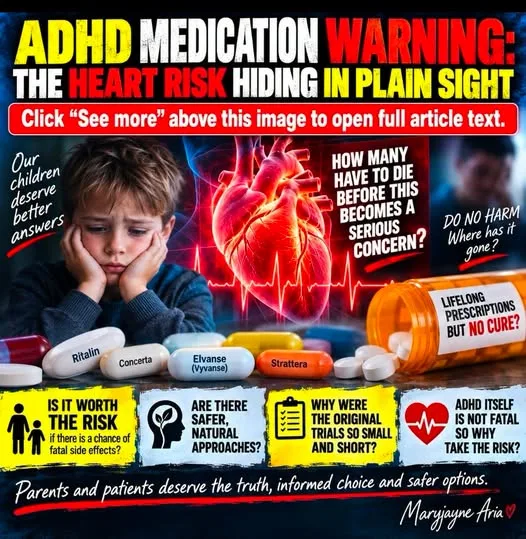
HOW MANY HAVE TO DIE BEFORE THIS BECOMES A SERIOUS CONCERN? I have been looking much more closely at ADHD medication and cardiovascular safety, and the more I examine the evidence, the more questions I have. We are talking about medicines prescribed to children, teenagers and adults, continuously for years, yet the original preapproval trials were remarkably small and only trialed for a 4 week period.
I have to ask the uncomfortable question: how many serious events have to occur before cardiovascular safety becomes a much bigger part of this conversation?
THE DRUGS WE ARE TALKING ABOUT: These include methylphenidate, sold under names such as Ritalin, Concerta, Medikinet and Equasym, and amphetamine based medicines such as lisdexamfetamine, sold as Elvanse in the UK and Vyvanse in the United States. Other ADHD medicines include atomoxetine, sold as Strattera, and guanfacine. Stimulant medicines increase heart rate and blood pressure, and their prescribing information contains cardiovascular warnings. Heart attacks happen and death is something in which no medication can reverse.
THE MEDICATION MANAGES THE SYMPTOMS, IT DOES NOT CURE THE CONDITION: This is something I believe parents and patients deserve to understand clearly. ADHD medication is prescribed to reduce symptoms only. It is not a curative treatment that removes ADHD. That means these vulnerable people remain on medication for extended periods including many years, while others may stop, restart, change medication or use treatment intermittently depending on their circumstances and clinical response. The fact that ongoing repeat prescriptions are handed out without any further analysis of cardio health is important when we consider the question of long term safety. Understand that the trial was for a 4 week period only!
AND THIS IS WHERE I WOULD START ASKING QUESTIONS AS A PARENT: If my child needed medication continuously for years because it manages only symptoms rather than curing the underlying condition, I would want to know exactly how extensively that medication had been studied over those same periods of time to make an informed decision. I would want to know what was known after one month, 3 months, six months? one year, five years, ten years and beyond. I would want to know what the original trials actually looked like, how many children participated, how long they were followed and which long term questions remained unanswered.
HERE IS THE PART THAT I FIND DIFFICULT TO IGNORE: A systematic assessment of premarket ADHD medication trials found that the median number of participants studied per drug was ONLY 75 participants. Seventy percent of the medications examined had been approved after fewer than 100 people had been studied, and the median trial length before approval was ONLY four weeks. Seventy seven percent had been approved after studies lasting less than 2 Months. months. These figures demonstrate an important limitation: short and relatively small trials cannot answer every question about more time of exposure. Therefore not proved safe for purpose following 4 weeks.
FOUR WEEKS VERSUS YEARS OF TREATMENT: Let that sink in. If a child begins ADHD medication at seven years old and remains on treatment throughout childhood and adolescence, exposure extends over a decade but sadly some have died before these time frames. Yet the median preapproval trial length identified in this analysis was four weeks! A four week trial can provide very limited information about short term effects only. What it cannot tell us is everything that might happen after those 4 weeks!
SO WHO BECAME THE MUCH LARGER TEST GROUP? THE REAL WORLD: Once these medicines entered widespread clinical use, the number of people taking the medications became the trial.without knowledge. Those people were vastly larger than the original known as the trial population. Real patients have different genetics, cardiovascular histories, medical conditions, doses, combinations of medications and lengths of exposure. This is why long term pharmacovigilance and population research are so important. So why was this missing? Is a valid question.
What matters is looking at the entire evidence base and being honest about what is known, what is uncertain and what still needs to be investigated.
THEN CAME THE DEATH THAT SHOULD MAKE PEOPLE PAY ATTENTION: On 23 August 2024, 28 year old Jacob Wooderson collapsed and died at home after receiving treatment with Elvanse, the amphetamine based ADHD medication lisdexamfetamine. His dose had been increased from 30 mg to 50 mg and subsequently to 70 mg. The inquest concluded that his medical cause of death was sudden arrhythmic death syndrome, with Elvanse treatment for ADHD listed as a contributing factor to his death.
THE DATE I WANT PEOPLE TO REMEMBER IS 6 AUGUST 2025: On that date, HM Assistant Coroner Sarah Bourke issued a Prevention of Future Deaths report following Jacob's inquest. The report raised concerns about potential serious cardiac effects associated with Elvanse and highlighted the importance of regular monitoring heart rate and blood pressure as doses increase.
AND THERE IS ANOTHER DETAIL I FIND DEEPLY CONCERNING: According to the coroner's report, Jacob was not given clear written advice regarding potential Elvanse side effects or what steps he should take if adverse effects developed. After his dose increased to 70 mg, he experienced poor sleep, exhaustion and feeling that the medication made him feel "weird". The psychiatrist later told the inquest that had those symptoms been known, they would have advised him to stop Elvanse immediately and review his medication in more detail.
WHAT HAPPENED TO "DO NO HARM"? This is the question that keeps coming back to me. Modern medicine recognises that treatments can have both benefits and risks, and decisions must balance those factors. But if a medication has potentially serious cardiovascular adverse effects, I believe the principle of minimising avoidable harm should make us ask difficult questions. Approval of a medicine should not end the safety conversation.
AS A PARENT, I WOULD WANT TO LOOK AT SAFER ALTERNATIVES: If this were my child, I would not want the conversation to begin and end with a prescription. I would want to know whether there were alternative medications with lesser risk profile, whether medication was actually necessary in my child's individual circumstances, and whether non medication approaches could provide meaningful benefit. I would want the risks and benefits of every reasonable option explained clearly.
I WOULD ALSO WANT TO KNOW ABOUT NATURAL APPROACHES: I would want to ask whether nutritional interventions, sleep optimisation, behavioural approaches, psychological support, educational interventions, exercise and other non pharmacological strategies could help my child. I would not automatically assume that something labelled "natural" was safe or effective. I would want to also research them. But I would absolutely want the question asked rather than assuming pharmaceutical medication is the only route.
AND THIS IS WHERE THE RISK VERSUS BENEFIT QUESTION BECOMES VERY PERSONAL: ADHD itself is generally not a fatal condition, although ADHD can be associated with significant impairment and safety risks. If a treatment carries a rare possibility of a life threatening cardiovascular event. One life lost is one life too many. We must pretect our children and loved ones from all harm.
I WOULD WANT TO KNOW WHY A CHILD NEEDS YEARS OF EXPOSURE: If the medication is managing symptoms rather than curing ADHD, then the question of duration becomes enormously important. A medicine that may be appropriate for one period of a person's life does not automatically have to be the only solution for the next ten years. Treatment should be reviewed. Circumstances change. Children develop. Symptoms can change. Support systems can change. And the balance between benefit and risk can quickly change too.
My concern is that parents and patients are being given enough information to make genuinely informed decisions about exposure to these medications.
DID PEOPLE UNDERSTAND HOW LIMITED SOME OF THE ORIGINAL LONG TERM EVIDENCE WAS? It would be inaccurate to say that cardiovascular risks were completely hidden. They were not. Prescribing information contains warnings about blood pressure, heart rate and serious cardiovascular conditions. But I believe there is an important difference between knowing that a medication can increase heart rate and understanding that the preapproval evidence for some medications was based on relatively small populations followed for relatively short periods.
THAT DISTINCTION MATTERS: A parent could reasonably assume that if a medication has been prescribed for decades, there must be decades of controlled clinical trial evidence demonstrating its long term safety. But regulatory approval does not work that way. Long term safety information often accumulates after medicines are already being used by much larger populations known as the real trial. Should you be made aware that you or your child is the trial?
THE ORIGINAL TRIALS CANNOT ANSWER A 1 YEAR QUESTION: If the median preapproval trial lasted four weeks, it cannot tell us everything about one single year or years years of exposure. If relatively few people were studied before approval of these medications, those trials were not large enough to detect very rare adverse events. It demonstrates that the original evidence had serious limitations we were not warned about.
HOW MANY HAVE TO DIE BEFORE IT BECOMES A SERIOUS CONCERN? I am deliberately asking the uncomfortable question. We should not wait for absolute proof before investigating a credible safety signal. Pharmacovigilance exists precisely because rare or long term adverse effects only become apparent once medicines are used by much larger populations over longer periods.
MY QUESTION IS NOT "ARE ADHD MEDICATIONS SAFE OR DANGEROUS?" THAT IS TOO SIMPLE: I want to know which medication, what dose, for how long, what the person's cardiovascular risk was before treatment, what happens to their blood pressure and heart rate after treatment begins, who is monitering and how often, what happens after dose increases, what symptoms develop and whether safer alternatives exist.
AS A PARENT, I WOULD WANT THE CHOICE, NOT PRESSURE: I would want to understand pharmaceutical treatment, behavioural and psychological interventions, educational support, lifestyle factors and appropriate evidence based nutritional or non medication approaches. If medication were recommended, I would want cardiovascular risk assessed and monitored properly. And if there were reasonable alternatives with a lower potential risk profile for my child, I would want to know about them.
I WOULD NOT ACCEPT "THAT IS JUST THE WAY IT IS" AS AN ANSWER: When we are dealing with a child's developing brain, cardiovascular system and potentially years of treatment, parents deserve evidence, transparency and genuine informed choice.
MY FINAL THOUGHT: I am not telling anyone to stop ADHD medication. I am asking parents and patients to ask more questions. What are the benefits? What are the risks? How long were the original trials? How many people were actually studied? What do we know about one, five, ten or fifteen years of exposure? What cardiovascular monitoring is required? And what reasonable alternatives exist?
Because if a medication manages symptoms rather than curing the condition, and a person therefore needs repeated or prolonged treatment, then long term safety becomes one of the most important questions of all.
If this were my child, I would want to know whether there was a safer way.
Death can not be reversed. Thinking that "It will never happen to my child" is not the answer.
THE BRAIN MAY BE THE REASON THE MEDICATION IS PRESCRIBED.
THE HEART IS PART OF THE CHILD TOO.
Sources of information.
DAILY MAIL: https://www.dailymail.co.uk/health/article-15970361/thousands-ADHD-pills-facing-deadly-effect.html
THE GUARDIAN, ADHD medication and cardiovascular risks: https://www.theguardian.com/society/2025/apr/06/adhd-medication-drugs-risks-benefits-children-study
THE GUARDIAN, ADHD prescriptions increasing: https://www.theguardian.com/society/2025/mar/11/adhd-prescriptions-in-england-have-risen-by-18-each-year-since-pandemic
THE GUARDIAN, concerns about ADHD clinics and children: https://www.theguardian.com/society/2026/feb/28/poorly-regulated-clinics-putting-children-adhd-risk-warn-doctors
JAMA PSYCHIATRY, long term cardiovascular risk: https://jamanetwork.com/journals/jamapsychiatry/fullarticle/2811812
JAMA NETWORK OPEN, methylphenidate and cardiovascular risk: https://jamanetwork.com/journals/jamanetworkopen/fullarticle/2815765
Please share this information without making any changes to help increase awareness. Copyright Maryjayne Aria author of Immune Health, Terrain and GcMAF