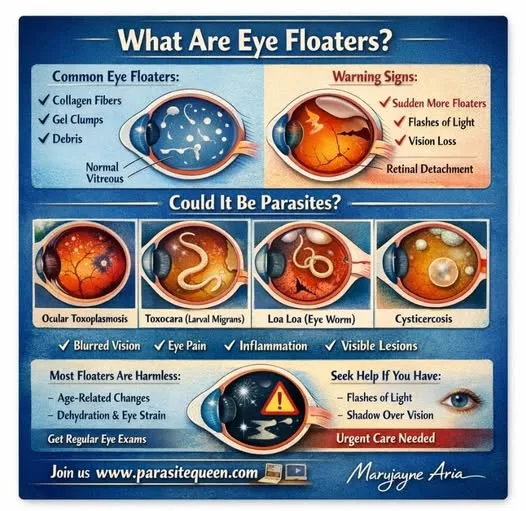
Eye floaters are small shapes that drift across your vision. People describe them as:
• Dots
• Threads or squiggly lines
• Cobweb-like shadows
• Transparent blobs
They are not on the surface of your eye. They are inside the eye, floating in a gel-like substance called the vitreous humor.
Why Do We See Them?
Inside the eye, the vitreous is normally clear. Over time or under certain conditions, tiny fibers and particles form and cast shadows on the retina.
You are not seeing the floaters themselves directly. You are seeing the shadow they cast on the retina, which is why they seem to move when you try to look at them.
Common reasons floaters appear:
• Aging
The vitreous becomes more liquid and collagen fibers clump together
• Dehydration or poor fluid balance
Changes the consistency of the vitreous
• Eye strain and screen exposure
Can make floaters more noticeable
• Posterior vitreous detachment (PVD)
A common condition where the vitreous pulls away from the retina
• Inflammation inside the eye (uveitis)
This can introduce cells or debris into the vitreous
• After eye injury or surgery
Why Are They More Visible Sometimes?
You tend to notice floaters more when:
• Looking at bright backgrounds such as the sky or screens
• You are tired or stressed
• Blood sugar fluctuates
• You suddenly move your eyes
This is because contrast makes the shadows more obvious.
The Parasite Connection
Most floaters are not parasites
The vast majority of floaters are:
• Collagen fibers
• Cellular debris
• Age-related vitreous changes
They are common and usually harmless.
When parasites can be involved
There are documented conditions where parasites affect the eye:
• Ocular toxoplasmosis
• Toxocara (often linked to soil or animals)
• Loa loa (eye worm)
• Cysticercosis (larval tapeworm infection)
In these cases, symptoms are usually more severe than simple floaters:
• Blurred or reduced vision
• Eye pain or pressure
• Light sensitivity
• Redness or inflammation
• Detectable lesions during examination
There are times when the parasite can be seen with naked eye.
Floaters may be present, but they are part of a wider clinical picture.
Why parasites are often suspected
• Floaters can look like threads or worms
• Increased body awareness during cleansing
• Visual comparisons shared online
However, similar appearance does not mean the same cause.
When to Take Floaters Seriously
If someone else can see a white or brown tiny worm shape that clearly moves.
Seek proper evaluation if you notice:
• Sudden increase in floaters
• Flashes of light
• A shadow or curtain across vision
• Loss of peripheral vision
If you can see the parasite and it has been confirmed.
These may indicate retinal changes that require urgent attention.
Diagnosis
Proper diagnosis is essential and cannot rely on imagery alone. Medical evaluation may include:
Slit lamp examination
Retinal imaging
Ultrasound of the eye
Blood tests for parasitic infection
Travel and exposure history
Treatment Options
Treatment depends on the type of parasite:
Surgical removal is often required for visible worms
Antiparasitic medications such as ivermectin or albendazole may be used
Anti inflammatory therapy to reduce tissue damage
Early intervention significantly improves outcomes.
1. Hydration
The vitreous is mostly water. Staying well hydrated can help support overall eye health and may reduce how noticeable floaters are over time.
2. Nutritional support
Supporting the eye from a tissue and oxidative stress perspective can help:
Vitamin C
Vitamin A
Zinc
Omega 3 fatty acids
Lutein and zeaxanthin
These do not “remove” floaters, but they support the eye environment.
3. Movement and adaptation
Over time, your brain often learns to ignore floaters. Also:
Looking up and down quickly can shift them out of your central vision temporarily
4. Reduce oxidative stress
Floaters are often linked with aging or degeneration of the vitreous.
Supportive habits:
Avoid smoking
Reduce exposure to toxins
Eat antioxidant rich foods (berries, greens, herbs)
Medical options (for persistent or severe cases)
1. Vitrectomy
Surgical removal of the vitreous gel
Very effective but invasive and carries risk (retinal detachment, infection)
2. Laser vitreolysis
Breaks up floaters using a laser
Less invasive but not suitable for all floaters
When to take floaters seriously
Seek urgent eye evaluation if you notice:
Sudden increase in floaters
Flashes of light
A shadow or curtain in your vision
This could indicate retinal detachment, which is an emergency.
Important perspective
A lot of people worry that floaters are parasites. In the vast majority of cases, they are not. They are structural changes in the eye itself. Never rule parasites out.
Why Awareness Matters
Ocular parasites are not as common as many other types of parasites, however parasites must not be ruled out. Parasites do highlight a broader truth. The human body can host organisms that travel beyond the gut and into critical systems, including the eyes and brain.
Understanding parasite life cycles, transmission routes, and symptoms is essential for prevention and early detection.
Prevention
Maintain good hygiene
Wash hands regularly
Avoid contaminated food and water
Deworm pets and maintain animal hygiene
Protect against insect bites
Be cautious when travelling to endemic regions
A Balanced Perspective
There is value in understanding parasites as part of overall health. At the same time, it is important to distinguish between structural eye changes and true infection
Important perspective
A lot of people worry that floaters are parasites. In the vast majority of cases, they are not. They are structural changes in the eye. However parasites should not be ruled out.
Closing Notes
While not every worm-like structure in the eye is a parasite, documented cases show that ocular parasitic infections are real and can be serious. Proper evaluation is always necessary to confirm diagnosis and guide treatment.
Raising awareness helps people recognise symptoms early and seek appropriate care.
Written by Maryjayne Aria , author of the book Immune Health, Terrain & GcMAF.
Feel free to visit our website
Join our Facebook group Parasitequeen



