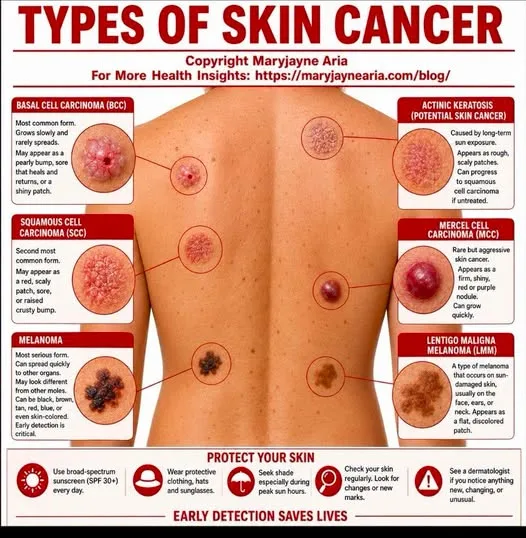
Your skin is your body's largest organ. It provides a protective barrier against the outside environment, helps regulate body temperature, supports immune defence and constantly responds to injury, sunlight and environmental exposure.
Skin cancer can develop when skin cells acquire genetic damage, often associated with ultraviolet radiation from the sun or artificial UV sources. Some forms grow slowly and rarely spread, while others can become aggressive and spread to other parts of the body.
Knowing the different types of skin cancer and recognising changes early can be extremely important.
Basal Cell Carcinoma (BCC): Basal cell carcinoma is the most common type of skin cancer. It often develops on areas frequently exposed to the sun, including the face, ears, scalp, neck and upper body. It may appear as a pearly or shiny bump, a pink growth, a persistent sore, or a lesion with visible small blood vessels. BCC usually grows slowly and rarely spreads to distant organs, but untreated lesions can cause significant local tissue damage.
Squamous Cell Carcinoma (SCC): Squamous cell carcinoma is another common form of skin cancer. It may develop as a rough, scaly or crusted patch, a firm red nodule, a thickened area of skin or a sore that does not heal. SCC can occur on sun-exposed areas but may also develop elsewhere. Unlike most basal cell carcinomas, some squamous cell carcinomas can spread beyond the original site, making early assessment important.
Melanoma: Melanoma develops from melanocytes, the cells responsible for producing pigment. Although less common than basal cell and squamous cell carcinoma, melanoma is responsible for a disproportionate number of skin cancer deaths because it can spread to other parts of the body.
Melanoma may develop from an existing mole or appear as a completely new mark. A useful guide is the ABCDE warning system: Asymmetry, irregular Borders, uneven or multiple Colours, increasing Diameter and Evolving or changing appearance.
A mole or mark that changes, grows, bleeds, itches or looks noticeably different from the others should not be ignored.
Merkel Cell Carcinoma (MCC): Merkel cell carcinoma is a rare but aggressive type of skin cancer. It may appear as a rapidly growing, painless, firm and shiny nodule. The lesion may be flesh-coloured, pink, red, purple or bluish. Because it can grow and spread quickly, prompt medical assessment is important.
Less Common Forms of Skin Cancer: Other skin cancers can develop from different cell types within the skin. These include rare forms such as dermatofibrosarcoma protuberans, sebaceous carcinoma and cutaneous lymphomas. Their appearance can vary considerably, which is one reason persistent or unusual skin changes should not be dismissed simply because they do not resemble a typical mole.
A New or Changing Lesion Should Never Be Ignored: One of the most important messages in skin cancer awareness is that change matters. Pay attention to lesions that increase in size, alter in colour, develop irregular borders, become raised, repeatedly crust or bleed, or fail to heal.
The "ugly duckling" principle can also be useful. A mark that looks noticeably different from your other moles or skin lesions deserves attention.
GcMAF cream with saffron offers a useful approach to supporting skin comfort and maintaining a healthy skin environment. Saffron contains bioactive compounds, including crocin and crocetin, which have been studied for antioxidant and anti-inflammatory properties, while a well-formulated topical cream can help support skin hydration and barrier comfort. GcMAF is of scientific interest because of its relationship to macrophage activation and immune function, people find the effects of topical GcMAF cream on specific skin diseases or skin cancer very useful. GcMAF and saffron formulation is therefore be valued for its skin-supportive properties im the case of many types of skin cancer when applied regularly.
Your Skin Is Your Biggest Organ: Your skin is exposed every day to sunlight, personal-care products, environmental pollutants and physical stress. Looking after it involves more than simply applying products. Regularly examine your skin and become familiar with your normal moles, freckles and marks so that new or changing lesions are easier to recognise.
Avoid Unnecessary Chemicals on Your Skin: The skin comes into contact with numerous products every day, including soaps, shower gels, shampoos, fragrances, cosmetics, lotions and creams. Consider simplifying your skincare routine, using only NATURAL products and avoiding unnecessary products, particularly heavily fragranced or irritating formulations.
Choose products based on their ingredients and your individual skin needs rather than assuming that more products automatically mean better skin health. Natural does not automatically mean safe, and synthetic does not automatically mean harmful, but reducing unnecessary exposure to products and ingredients that irritate your skin can be a sensible approach.
Bathing and Showering With Simpler Products: Gentle bathing practices can help support the skin barrier. Avoid excessively hot water, harsh scrubbing and products that repeatedly irritate or dry your skin. Some people prefer simple, minimally formulated products or carefully selected plant-based products.
Natural oils and botanical ingredients can be useful for some people, but they can also cause allergic reactions or irritation. Essential oils are highly concentrated and should be used with care. Introducing one new product at a time can make it easier to identify what your skin tolerates well.
Choose Your Sun Protection Carefully: Excessive ultraviolet exposure is a major preventable risk factor for several types of skin cancer. Protective clothing, wide-brimmed hats, shade and limiting intense sun exposure are important strategies.
People seeking mineral-based sunscreen options often choose products containing zinc oxide or titanium dioxide. Broad-spectrum protection and appropriate SPF are important considerations. Sunscreen should be viewed as one part of a wider strategy rather than a reason to spend prolonged periods intentionally exposed to intense sunlight.
Know Your Skin and Watch for Change: Check areas that are easy to overlook, including the scalp, ears, neck, back, soles of the feet, between the toes and under the nails. Skin cancer can develop in areas that are not routinely exposed to sunlight.
A changing mole, a new unexplained growth, a persistent sore or a lesion that repeatedly bleeds or crusts should be assessed by a qualified healthcare professional or dermatologist.
Your skin is your body's largest organ. Protect it, avoid unnecessary irritation and excessive ultraviolet exposure, and pay attention when it sends you signals that something has changed.
Please share this information to help increase awareness of the different types of skin cancer and the importance of recognising suspicious skin changes early.



