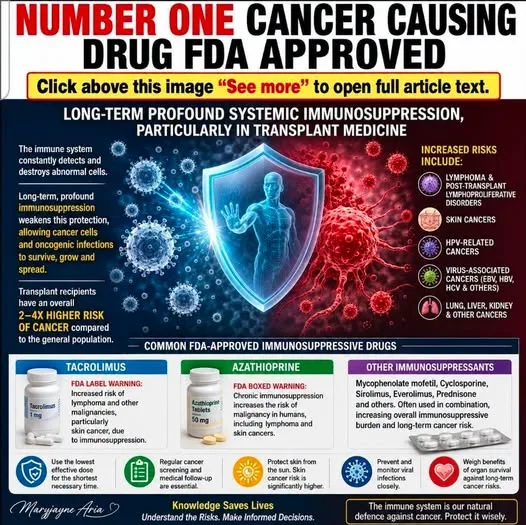
Some of the strongest and most clearly documented medication-associated high cancer risk occur in people exposed to profound systemic immunosuppression, particularly organ transplant recipients. In short you severely risk termal cancer by having a transplant!
The issue is not that every individual immunosuppressive drug directly damages DNA in the same way as a classic chemical carcinogen. Rather, profound and sustained suppression of immune surveillance creates biological conditions in which cancer cells and cancer-causing infections are more able to survive, expand and progress.
For transplant recipients, this risk is not theoretical. It is openly acknowledged in drug safety information and extensively documented in cancer research. It can not be challenged.
Why the immune system matters in cancer prevention: The immune system does far more than fight colds and infections. Immune cells continually identify and eliminate abnormal cells. This process, often called immune surveillance, is one of the body's important defences against the development and progression of cancer.
When the immune system is deliberately suppressed, several protective mechanisms weaken simultaneously:
• Drastically reduced recognition and destruction of abnormal cells.
• Drastically reduced control of viruses capable of contributing to cancer.
• Drastically reduced immune control over Epstein-Barr virus, human papillomavirus, hepatitis viruses and other oncogenic infections.
• Drastically reduced surveillance of emerging malignant cells.
• Drastically Increased susceptibility to chronic and opportunistic infections.
• Direct cancer-promoting effects associated with individual immunosuppressive agents.
The National Cancer Institute openly explain that transplant recipients receiving immunosuppressive medication have an increased risk of cancer because immune suppression reduces the body's ability to detect and destroy cancer cells and fight infections that causes cancer.
The scale of the cancer risk: Large studies of solid-organ transplant recipients have demonstrated that overall cancer risk is substantially high in the general population. The National Cancer Institute opely admitt reports a high overall cancer risk
One large United States study involving more than 175,000 solid-organ transplants found an overall cancer incidence approximately 4 times as expected in the general population and identified increased risks across 32 different malignancies. Cancer research stated that one in two people alive today, will have cancer at somepoint in thier lives! That is a remarkable number.
Which cancers increase? The spectrum is extremely broad. Transplant recipients have elevated risks of non-Hodgkin lymphoma, post-transplant lymphoproliferative disorders, multiple skin cancers, Kaposi sarcoma, cancers associated with human papillomavirus, and increased rates of certain cancers affecting organs including the lung, kidney and liver.
The increased risk of lymphoma is particularly important because immune suppression can reduce the body's control over Epstein-Barr virus. Epstein-Barr virus is strongly involved in many cases of post-transplant lymphoproliferative disorder, a serious complication that can range from abnormal lymphoid proliferation to aggressive lymphoma.
The intensity and duration of immunosuppression matter: Cancer risk is not simply a matter of taking one tablet and developing cancer. The relationship is closely connected to the overall intensity and duration of immune suppression.
FDA-approved tacrolimus labeling explicitly warns of an increased risk of lymphoma and other malignancies, particularly skin cancer, associated with immunosuppression. The prescribing information states that the risk appears related to the intensity and duration of immunosuppression rather than necessarily to one specific agent alone.
This is crucial. Transplant medicine frequently requires combinations of drugs because preventing rejection requires suppression of several immune pathways. The cumulative biological effect of long-term multidrug immunosuppression is therefore profound.
Tacrolimus: Tacrolimus is an FDA-approved calcineurin inhibitor widely used to prevent organ rejection. Its official prescribing information carries a boxed warning concerning malignancies and serious infections, including an increased risk of lymphoma and other malignancies, particularly of the skin, due to immunosuppression. But is the patient or carehiver given the box to read?
Azathioprine: Azathioprine provides an especially explicit example. Current official drug labeling includes a boxed warning stating that chronic immunosuppression with azathioprine increases the risk of malignancy in humans. Again, only the doctor see the box! Reported malignancies include post-transplant lymphoma and hepatosplenic T-cell lymphoma in certain patient populations. The label also discusses the increased occurrence of skin cancer and lymphomatous malignancies in transplant recipients receiving immunosuppressive therapy.
Is there really one "number one cancer-causing drug"? Scientifically, there is no universally accepted ranking system that identifies one FDA-approved medication as the single "number one cancer-causing drug" across all medicines, all doses, all durations and all patient populations. However, the title draws attention to an extremely important reality: long-term profound systemic immunosuppression is among the clearest examples of a medically necessary treatment exposure that can substantially increase cancer risk.
A study examining more than 5,000 transplant patients found that cancer risks differed between immunosuppressive medications, illustrating why it is scientifically inappropriate to treat every drug or every transplant regimen as having identical cancer risk.
The medical dilemma: These medicines are not used because cancer risk is ignored. They are used because organ rejection can rapidly destroy a transplanted organ and can be life-threatening. This creates one of the most profound risk-benefit calculations in modern medicine.
Cancer surveillance becomes essential: Because cancer risk is increased, transplant recipients often require careful long-term monitoring. Depending on the individual and transplant type, this includes regular skin examinations, monitoring for viral complications, age-appropriate cancer screening and investigation of suspicious symptoms.
Prevention and early detection are particularly important because the increased cancer risk persist for many years following transplantation. The National Cancer Institute notes that the consequences of transplant-related immune suppression extend well beyond the immediate transplant period.
The bottom line: Long-term profound systemic immunosuppression provides one of the clearest examples in medicine of how altering immune function influences cancer risk.
What the evidence does clearly show is that people receiving immunosuppressive therapy, particularly after solid-organ transplantation, experience substantially elevated risks of multiple cancers. This increased risk is sufficiently established that official FDA-regulated prescribing information for drugs such as tacrolimus and azathioprine contains prominent warnings concerning lymphoma and other malignancies.
The deeper lesson is an important one.
It is an essential component of the body's ongoing surveillance against abnormal and potentially malignant cells.
When immune function is profoundly suppressed, the consequences extend far beyond infection and organ rejection.
Knowledge saves lives. Always understand both the benefits and the long-term risks of any medication capable of profoundly altering immune function.
Please share this article without making any changes to help others understand the relationship between long-term immune suppression and cancer risk.



