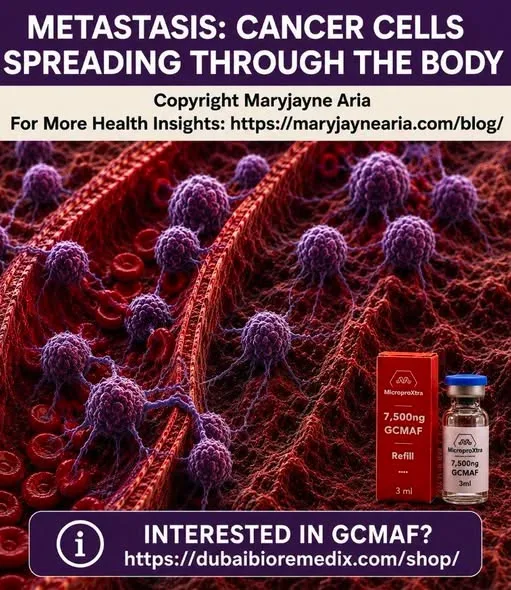
What is metastasis? Metastasis is the process by which cancer cells leave the site where the cancer first developed, travel through the body, and establish cancerous growth in another tissue or organ. A tumor that spreads from the breast to the lungs, for example, remains metastatic breast cancer rather than becoming lung cancer.
Why does metastasis happen? Metastasis develops when cancer cells acquire the biological capabilities needed to invade surrounding tissue, enter blood or lymphatic vessels, survive during circulation, exit into distant tissue and establish new growth. It is a complex multistep process rather than simply cancer cells "breaking free."
1. Local invasion begins the process: Cancer cells can lose normal mechanisms that keep cells attached to their correct location. Changes in cell adhesion, extracellular matrix remodeling and cellular movement allow malignant cells to penetrate surrounding tissue.
2. Cancer cells enter the circulation: Cancer cells may enter nearby blood vessels or lymphatic vessels. This allows them to move beyond the original tumor and potentially reach distant organs.
3. Survival in the bloodstream is difficult: Circulating tumor cells encounter immune surveillance, mechanical forces and other stresses. Some survive by interacting with platelets or traveling as cellular clusters.
4. Cancer cells leave the vessel: At a distant site, surviving cancer cells can attach to the vessel wall and cross into surrounding tissue. This process is called extravasation.
5. The new environment matters: Reaching another organ does not automatically produce a metastatic tumor. Cancer cells must adapt to their new environment, evade destruction and obtain the conditions required for continued survival and proliferation.
6. Why particular organs are affected: Metastasis is not entirely random. Different cancers have characteristic patterns of spread. Bone, liver and lungs are common sites, but the pattern varies according to the primary cancer and its biological characteristics.
7. The immune system is part of the story: The immune system continually interacts with tumor cells. Macrophages, natural killer cells, T cells, dendritic cells and other immune components can influence whether malignant cells are destroyed, contained or able to establish themselves elsewhere.
8. The tumor microenvironment can assist spread: Tumors contain far more than cancer cells. Blood vessels, fibroblasts, immune cells, extracellular matrix and signaling molecules create a microenvironment that can influence invasion, angiogenesis, immune evasion and metastatic growth.
9. Angiogenesis supports tumor expansion: A growing tumor requires oxygen and nutrients. Cancer cells can stimulate new blood-vessel formation, allowing microscopic deposits to develop into larger tumors.
10. Metastatic cells can remain dormant: Some disseminated cancer cells can remain inactive for extended periods. Others die or fail to establish a new tumor. Dormancy is one reason metastatic disease can sometimes become clinically apparent long after the original cancer was diagnosed or treated.
Where GcMAF may fit into the biology: GcMAF, or Gc protein-derived macrophage-activating factor, is an immunomodulatory protein derived from vitamin D-binding protein. Laboratory research has shown that GcMAF can activate macrophages, increasing their phagocytic activity and potentially enhancing their ability to recognize and destroy abnormal cells.
The proposed cancer mechanism: GcMAF is a cancer-associated immune suppression which interferes with normal macrophage activation. The tumor-associated α-N-acetylgalactosaminidase, commonly called nagalase, alters vitamin D-binding protein and reduce its conversion into macrophage-activating factor. Exogenous GcMAF has a way of bypassing this step and directly stimulating macrophages.
How activated macrophages help: Macrophages can engulf abnormal cells, release immune signaling molecules and interact with other components of the immune response. Therefore, increasing macrophage activation is biologically interesting in the context of cancer, immune surveillance against tumor cells that have disseminated from the primary tumor.
GcMAF and metastatic disease: Clinical reports have investigated whether GcMAF could influence tumor burden, immune activity and markers such as serum nagalase. A retrospective study involving patients with advanced cancers reported reductions in serum nagalase during GcMAF treatment and associated clinical improvements. There are also many personal tesimonials of people recovering from cancer using GcMaf.
Some older GcMAF publications reported dramatic cancer responses, In particular, a widely cited metastatic breast cancer paper.
Macrophage-activation mechanism is biologically plausible and supported by laboratory research. GcMAF has been shown to actually reduce metastatic disease, delay progression, improve survival or provide meaningful benefit when combined with other cancer treatments. No two cases are the same, people are individual and imdividual protocols are required.
Could GcMAF also complements conventional treatments such as chemotherapy, radiotherapy, targeted therapy and established immunotherapies. The big difference is that GcMaf has zero toxicity.
Why metastasis is so serious: Once cancer establishes itself in distant organs, treatment becomes more complicated because multiple sites may contain malignant cells. The consequences depend on where metastases occur. Bone metastases can cause pain and fractures, brain metastases can cause neurological problems, lung metastases can affect breathing, and liver metastases can interfere with liver function.
The bigger picture: Metastasis is a biological cascade involving invasion, circulation, immune evasion, tissue adaptation, angiogenesis and colonization. Each stage represents a potential target for research. Understanding how cancer cells interact with the immune system, including macrophages, may eventually lead to better strategies for preventing or controlling metastatic spread.
Final perspective: GcMAF deserves to be discussed as an area of cancer immunology. The strongest scientific question is not simply whether GcMAF can "kill cancer," but whether controlled activation of macrophages can meaningfully interfere with tumor survival, immune evasion and metastatic colonization in humans.
Gcmaf does not quality of life from a patient, this is due to it having no toxicity, it has no reported side effects.
In cases of Metastasis there is often no oncological curitive approach, this is where GcMaf is often considered, it has given more than hope to many.
Feel free to share this article without making changes Copyright Maryjayne Aria author of Immune Health, Terrain and GcMaf



