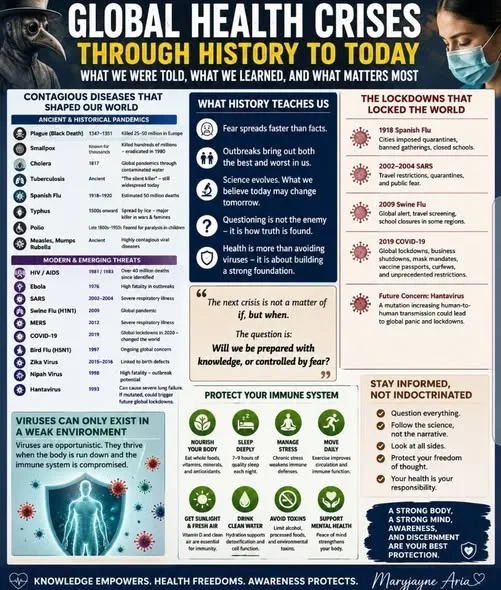
Throughout human history, societies have faced waves of infectious disease that reshaped civilization, altered economies, fueled fear, and changed the relationship between governments, science, medicine, and the public.
Some outbreaks were undeniably serious. Others became surrounded by political narratives, media amplification, public confusion, commercial interests, and emotional fear campaigns. In nearly every era, humanity has struggled to separate real danger from panic, scientific caution from propaganda, and genuine public health from financial or political opportunism.
An open minded discussion about global health crises should not dismiss the reality of disease. At the same time, it should also allow room to question how fear is communicated, how statistics are presented, and how emergency powers can permanently alter society.
History shows that both blind denial and blind obedience can become dangerous.
The Ancient World Was Shaped by Contagion
Long before modern medicine, infectious disease devastated populations.
The Plague wiped out enormous portions of Europe during the Black Death between 1347 and 1351. Entire towns disappeared. Fear, isolation, quarantine, and social breakdown became common. Even then, governments introduced travel restrictions and isolation measures.
Smallpox became known as one of the deadliest contagious diseases in recorded history, apparently killing hundreds of millions over centuries. Survivors were often left permanently scarred or blinded. Entire indigenous populations were devastated after exposure.
Cholera spread through contaminated water during the 1800s, exposing how poor sanitation and overcrowding could fuel massive outbreaks.
Tuberculosis became known as the “silent killer,” slowly infecting millions worldwide. For decades, fear surrounded even being near infected individuals.
Human civilization has repeatedly learned that contagious disease can alter every aspect of society.
The 20th Century Introduced Global Panic on a New Scale:
The Spanish Flu became known as one of the deadliest pandemics ever recorded. It spread rapidly across the globe during and after World War I. Some estimates suggest tens of millions died worldwide.
The fear surrounding infectious disease intensified further during outbreaks of Polio, where parents feared public swimming pools, schools, and playgrounds. Paralysis in children created widespread terror.
Then came HIV/AIDS in the 1980s.
In its early years, AIDS was viewed almost as a death sentence. Fear spread faster than understanding by media outlets. People feared touching infected individuals, sharing public spaces, or even casual contact before the routes of transmission became fully understood. Media coverage often intensified public panic.
Yet over time, science and understanding evolved and media outlets stopped discussing it as what was once considered universally fatal became, for many, a manageable chronic condition. Fear proceeded fact when it came to presenting the news in media outlets.
This pattern matters.
History repeatedly shows that early fear surrounding emerging disease often changes dramatically as knowledge improves or is revealed.
COVID-19 Changed the Modern World
No modern event reshaped society globally quite like COVID-19.
For the first time in modern history, entire countries entered lockdowns simultaneously without true understanding and based on fear promoting. Businesses closed. International travel nearly stopped. Schools shut down. Citizens were confined to their homes. Curfews, mandates, vaccine passports, censorship debates, and emergency powers became part of everyday life.
Fear messaging dominated headlines daily.
Death counters appeared on television screens worldwide. People were told they could unknowingly infect family members simply by being near them. Governments and media outlets often emphasized worst case scenarios to encourage compliance.
Some believe these measures saved millions of lives. Statistics show this is not true.
Many argue the psychological, economic, educational, and social damage from lockdowns may continue for generations and may have been resposible for taking more lives than Covid.
An open minded position recognizes that both realities may contain truth.
COVID-19 was clearly dangerous for people with weak immune systems as all are all"virus" , especially the elderly and vulnerable. At the same time, many legitimate questions emerged regarding censorship, pharmaceutical influence, risk communication, data transparency, and whether all emergency policies were proportionate or scientifically justified.
Science should always allow room for questioning.
The Viruses That Terrified the World
Several other outbreaks generated intense global concern due to their advertised fatality rates or pandemic potential.
Ebola Virus Disease shocked the world because of its severe bleeding symptoms and high mortality rates.
Severe Acute Respiratory Syndrome and Middle East Respiratory Syndrome was advertised how rapidly coronaviruses could spread internationally.
Bird Flu and Swine Flu sparked fears of catastrophic influenza pandemics.
Even when outbreaks remained geographically limited, media coverage often created worldwide psychological impact.
In today’s interconnected world, fear itself spreads virally.
Could Hantavirus Trigger a Future Global Lockdown?
Hantavirus Pulmonary Syndrome is currently via a large advertising budget heavily advertised as one of the most feared viral illnesses because of its claimed to cause severe respiratory complications and high fatality rates in those with severely affected immune systems.
Traditionally, hantaviruses have been associated primarily with rodent exposure rather than widespread human to human transmission. However, few are now claiming certain strains have shown limited human transmission under specific conditions.
With an open checkbook for advertising deathly claims, and if a high percentage believe in the controlled media outlets regarding this mutation or strain effecting respiratory transmission between humans, global concern could escalate rapidly.
In a post COVID world, governments now possess a tested framework for lockdowns, emergency declarations, border restrictions, digital surveillance systems, and population wide public health mandates.
That reality changes everything.
Whether justified or not, future outbreaks advertising a highly fatal respiratory virus could trigger immediate international responses long before any scientific certainty is established.
Many people no longer ask whether another lockdown could happen.
They ask when.
Protecting the Immune System Matters
One important lesson from many infectious outbreaks is that individual health resilience matters.
A strong immune system plays a major role in how the body responds to infectious disease. Factors such as nutrition, sleep, stress levels, metabolic health, environmental exposures, chronic illness, and overall lifestyle can influence immune function.
A weakened immune system may increase vulnerability to severe illness, complications, or prolonged infection.
Protecting immune health remains important regardless of the specific outbreak.
Supporting the body through proper nutrition, reducing chronic inflammation, maintaining healthy vitamin and mineral status, managing stress, getting adequate sleep, regular movement, sunlight exposure, and avoiding toxic overload may help strengthen overall resilience.
Public health conversations should not focus only on fear of pathogens. They should also include discussion about strengthening the terrain of the body itself.
The Challenge of Modern Science
Modern society faces a difficult balancing act.
History shows that fear can become commercialized, politicized, and weaponized.
Scientific institutions are not immune to financial incentives, corporate influence, career pressures, political agendas, or media sensationalism. At the same time, not every public health measure is automatically malicious or corrupt.
The problem begins when questioning becomes forbidden.
Healthy science depends on open debate, reproducibility, transparency, biological understanding, and the willingness to re examine assumptions when evidence changes.
True science is not supposed to fear questions.
Fear, Media, and Human Psychology
One overlooked reality of global health crises is the psychological effect of constant fear exposure.
During outbreaks, populations are repeatedly shown death statistics, emergency imagery, and emotionally charged headlines. This can create chronic stress, social division, and even mass behavioral conditioning.
Fear changes how societies think.
People may surrender freedoms during emergencies that would otherwise be unthinkable. Governments may gain extraordinary powers. Pharmaceutical industries may experience unprecedented profits. Social media platforms may censor dissenting voices under the justification of “public safety.”
At the same time, misinformation can also spread rapidly online, creating confusion from the opposite direction.
This is why discernment matters more than ever.
Moving Forward
Humanity will almost certainly face future pandemics. When one succeeds, others follow.
Some may be genuine civilization level threats. Others may prove less catastrophic than initially feared. Some may trigger sweeping political and economic responses regardless of their final mortality rates.
The lesson is to remain informed, rational, biologically literate, and open minded without falling into either panic or blind trust.
Protect your immune system. Protect your metabolic health. Protect your mental resilience.
Public health should protect people. Science should remain transparent and complete with biology and chemistry. Questions should never become forbidden.
Written by Maryjayne Aria maryjaynearia.com
Author of Immune Health, Terrain & GcMAF
Join our facebook group The Good Doctor Reveals All.
FEEL FREE TO FOLLOW ME



