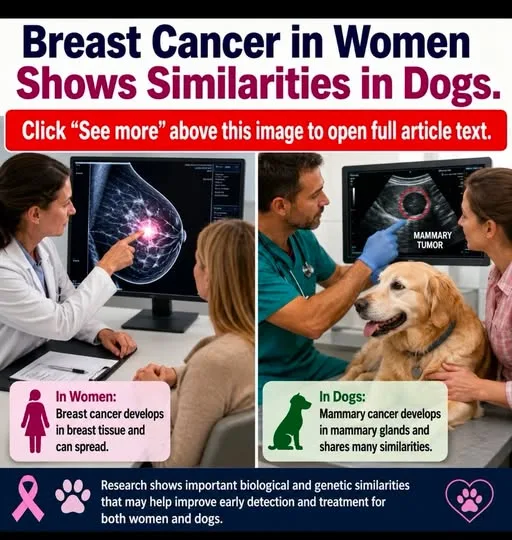
Comparative oncology is an increasingly important field of research that studies cancer across different species to improve our understanding of how tumours develop, progress and respond to treatment. Dogs and humans share more than companionship and domestic environments. They also share many biological pathways involved in immunity, genetics, ageing and cancer. One particularly interesting area of research involves canine mammary tumours and the BRCA1 and BRCA2 genes, which are widely recognised for their role in hereditary breast and ovarian cancer susceptibility in humans.
THE RESEARCH INTO BRCA GENES IN DOGS: Research has investigated whether genes associated with human breast cancer may also influence the development of mammary tumours in dogs. A 2009 study of English Springer Spaniels examined genetic variants in ten genes previously associated with human breast cancer, comparing dogs with mammary tumours to unaffected control dogs. The researchers identified statistically significant associations involving regions containing BRCA1 and BRCA2, suggesting that genetic variation in these regions may contribute to mammary tumour susceptibility in the population studied. The findings provided important evidence that some cancer-related genetic pathways may have relevance across species.
WHY BRCA1 AND BRCA2 ARE IMPORTANT: BRCA1 and BRCA2 play essential roles in protecting genomic stability. DNA within every cell is continually exposed to damage through normal metabolic processes and environmental influences. Cells have multiple repair mechanisms that help correct this damage, but when important DNA repair pathways are impaired, errors can accumulate over time. These errors may contribute to genomic instability, one of the processes involved in the development of cancer. In humans, certain inherited pathogenic variants in BRCA1 and BRCA2 are associated with an increased risk of several cancers, particularly breast and ovarian cancer. Research into these pathways in dogs may therefore help scientists better understand both canine and human cancer biology.
CANINE MAMMARY TUMOURS ARE A COMPLEX DISEASE: Mammary cancer in dogs is not identical to breast cancer in humans, and it is important not to oversimplify the similarities. Cancer is a complex disease involving multiple biological processes. Genetics can contribute to susceptibility, but tumour development may also be influenced by age, hormonal exposure, reproductive history, immune function, inflammation, environmental factors and additional genetic changes acquired during life. A genetic association does not mean that every animal carrying a particular genetic variant will develop cancer. Equally, an animal without a known variant may still develop cancer through other mechanisms.
DOGS AS NATURAL MODELS FOR CANCER RESEARCH: Pet dogs provide researchers with a valuable opportunity to study naturally occurring cancer. Unlike laboratory models in which disease may be experimentally induced, companion dogs develop cancer spontaneously while living in real-world environments. They may share exposure to household chemicals, air pollution and other environmental factors with the humans around them. Dogs also have shorter lifespans, allowing researchers to observe the development and progression of disease across generations and over the lifetime of an animal more rapidly than is possible in humans. These characteristics have made naturally occurring canine cancer increasingly valuable in comparative oncology research.
THE IMPORTANCE OF BREED GENETICS: Selective breeding has created genetically distinct dog populations, and some breeds have an increased susceptibility to particular diseases. This can help researchers identify genetic patterns that may be more difficult to detect in genetically diverse human populations. However, findings from one breed should not automatically be applied to all dogs. The association between genetic variants and mammary tumour risk identified in English Springer Spaniels may not have the same significance in every breed. Breed-specific genetics, environmental influences and population differences must all be considered when interpreting research.
WHAT HUMANS AND DOGS MAY SHARE: The value of comparative oncology lies in identifying important similarities while also recognising meaningful differences. Dogs and humans can develop tumours involving related biological processes, including abnormalities in cell growth, DNA repair, immune regulation and tumour spread. Studying these shared pathways may help researchers identify mechanisms that deserve further investigation. At the same time, differences between species can also provide valuable scientific information. Understanding why a particular cancer pathway behaves differently in dogs and humans may reveal new information about the biology of the disease.
THE FUTURE OF GENETIC RESEARCH IN CANINE CANCER: Continued research into BRCA-related pathways may eventually contribute to improved genetic risk assessment and more personalised approaches to veterinary cancer care. Scientists are increasingly interested in whether knowledge of tumour genetics could help identify animals at increased risk, improve earlier detection or support the development of targeted treatments. However, this field is still developing, and genetic information must be interpreted carefully. A single genetic finding rarely provides a complete explanation for cancer risk because tumour development is usually influenced by multiple interacting biological and environmental factors.
THE ROLE OF DNA REPAIR IN CANCER DEVELOPMENT: DNA repair mechanisms are among the most important protective systems within the body. Every day, cells must repair damage caused by normal metabolism, oxidative processes and other influences. When damage is not properly repaired, mutations can accumulate. Some mutations may have little biological effect, while others can alter genes involved in cell division, growth regulation or programmed cell death. Over time, the accumulation of critical genetic changes can contribute to the transformation of a normal cell into a cancerous one. BRCA-related pathways are therefore of major interest because they are involved in maintaining the integrity of the genome.
A TWO-WAY BENEFIT FOR HUMAN AND VETERINARY MEDICINE: Comparative oncology is not simply about using dogs to learn about human disease. The relationship can benefit both species. Advances in human molecular genetics may contribute to improved understanding and treatment of canine cancer, while research involving naturally occurring tumours in dogs may generate new questions and insights relevant to human oncology. This creates an important scientific partnership between veterinary and human medicine. Research findings from one species may identify biological pathways worth exploring in another, potentially accelerating future discoveries.
WHAT DOG OWNERS SHOULD UNDERSTAND: A family history of cancer or a breed predisposition does not mean that cancer is inevitable. Genetics can influence susceptibility, but they represent only one part of a much larger biological picture. Owners concerned about mammary tumour risk should discuss appropriate monitoring and veterinary care with a qualified veterinarian. Early recognition of unusual lumps or changes in mammary tissue is important because prompt veterinary assessment can help determine whether further investigation is needed. Decisions regarding screening and treatment should be based on the individual animal and the best available veterinary evidence.
THE BIGGER PICTURE: Research into BRCA1, BRCA2 and canine mammary tumours demonstrates how interconnected cancer biology can be across species. Dogs and humans are not biologically identical, and their cancers should never be treated as interchangeable. Nevertheless, the existence of shared genetic and molecular pathways provides valuable opportunities for scientific discovery. By studying naturally occurring cancer in dogs alongside human cancer research, scientists may gain a more complete understanding of how genetics, environment, immunity and cellular biology interact during tumour development.
THE BOTTOM LINE: Evidence suggests that genetic regions involving BRCA1 and BRCA2 may contribute to mammary tumour susceptibility in certain dog populations, including the English Springer Spaniels investigated in research. These findings support the growing importance of comparative oncology and reinforce the need for continued investigation into the shared biological pathways involved in cancer. The goal is not to claim that canine and human cancer are the same, but to understand where their biology overlaps and how this knowledge may eventually improve cancer prevention, detection and treatment for both animals and humans.
Please share this information without making any changes to help increase awareness of the importance of proper diagnosis for suspected parasitic infections.



