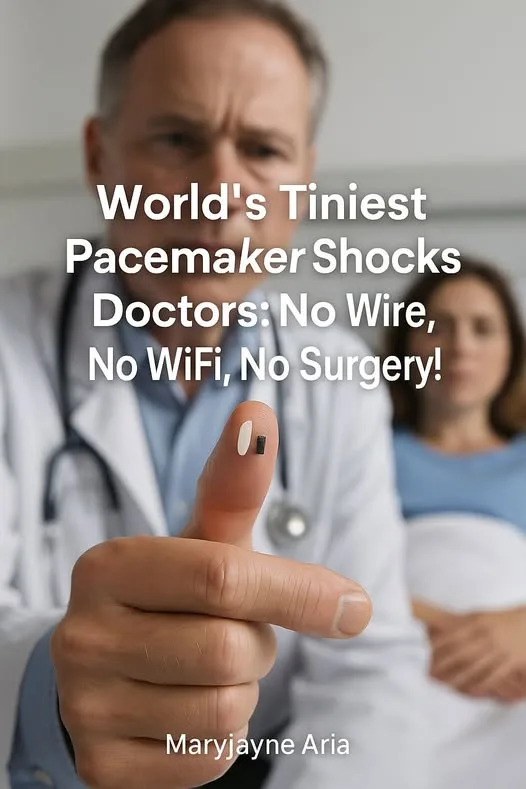
Imagine a pacemaker so tiny it balances on your fingertip. No wires. No surgery. And when it has finished its job, it dissolves harmlessly inside the body. Scientists at Northwestern University have just unveiled this breakthrough, and it could change the future of heart repair.
 The Pros:
No surgery required: Inserted with minimal invasion, sparing patients from major operations.
No wires or bulky batteries: Reduces the risk of infection and complications common with traditional devices.
Temporary support: Perfect for newborns with congenital heart defects or patients recovering after surgery.
Self-dissolving: Once the heart stabilizes, the device biodegrades, eliminating the need for extraction.
Biocompatible materials: Made from metals and polymers the body can safely process.
No WiFi signaling: Unlike some “smart” implants, it doesn’t use wireless internet protocols or constant radio signals. It’s activated by safe near-infrared light from a wearable patch, so you’re not a walking antenna.
 The Cons:
Short lifespan: Works for days to a few weeks, not years. Patients needing long-term pacing still require standard pacemakers.
Patch dependent: Needs an external chest patch to send near-infrared light pulses. If the patch fails or shifts, pacing can stop.
No backup: Unlike traditional devices with batteries, this has no reserve if external control is lost.
Still experimental: Tested only in animals and donor heart tissue so far. Human trials are pending.
Limited use cases: Designed mainly for newborns and short-term recovery, not chronic heart patients.
Toxicity Concerns:
The device is built from magnesium, zinc, molybdenum, and bioresorbable polymers. These elements are generally tolerated in small amounts, but:
As the device dissolves, trace metals and polymer byproducts are released into the bloodstream.
In theory, accumulation or uneven breakdown could cause localized inflammation, scarring, or irritation.
Long-term effects in humans remain unknown because clinical trials haven’t yet been conducted.
Sensitive patients, such as newborns, may respond differently to the degradation products.
So while the idea of a vanishing implant is appealing, safety data still needs to be proven in real-world patients.
Sources:
Northwestern University News: "World’s smallest pacemaker is activated by light"
Scientific American: "Tiny Injectable Pacemaker Runs on Light and Then Dissolves"
ScienceAlert: "Breakthrough: World’s Smallest Pacemaker is the Size of a Rice Grain"
We do the research, so you don't have to.
For more health insights feel free to join me on my social media group: A Good Doctor https://www.facebook.com/groups/agooddoctor/
Written by Maryjayne Aria



