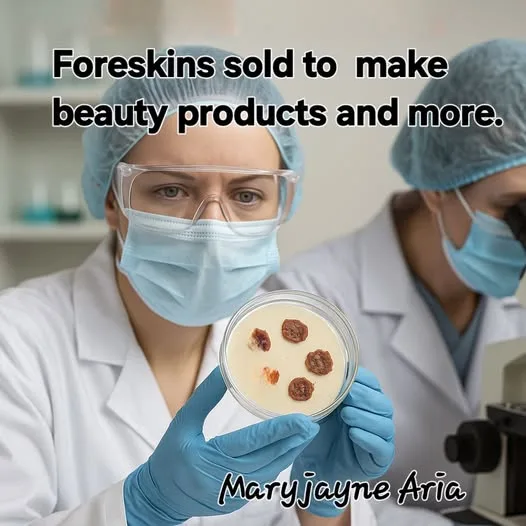
In the glossy promise of youthful skin, a little known source has quietly found its way into high end skincare and medical therapies: human foreskin cells. The small piece of tissue removed during a newborn circumcision is proving surprisingly valuable to cosmetics companies and pharmaceutical firms worldwide.
What is actually being used:
Researchers harvest tissue from newborn circumcisions and isolate fibroblasts, the skin connective cells that help rebuild tissue. These cells are then grown in laboratories, where they produce growth factors and a substance called “conditioned media,” which contains the proteins and chemicals secreted by these cells.
This material, known as human fibroblast conditioned media, is a prized ingredient in certain skin care and pharmaceutical products.
The products that use foreskin derived ingredients:
A number of recognizable brands and therapies make use of foreskin fibroblast material.
SkinMedica TNS Recovery Complex, contains human fibroblast conditioned media, derived from neonatal foreskin fibroblasts. It sells for around $230 per bottle.
Osmosis Beauty StemFactor Growth Factor Serum, also uses human fibroblast conditioned media, priced at about $136 for 30 mL.
Factor Five Eye and Lash Cream promotes “human stem cell growth factors,” selling for $149.
Dermagraft, a medical wound care product that uses fibroblasts grown from donated foreskin tissue for diabetic foot ulcers.
Celprogen Human Fibroblast Derived Stem Cell Conditioned Media, sold for research purposes at $3,034 per litre.
Even luxury spas have jumped on board. So called “foreskin facials” have appeared in New York and Los Angeles, featuring epidermal growth factors that originate from newborn foreskin fibroblasts.
According to industry insiders, a single foreskin sample can be expanded in laboratories to produce fibroblast cultures covering surfaces equal to several football fields. Some analysts estimate that a single foreskin could generate biological materials worth up to 190 million dollars over its lifetime.
Who buys them and how many are sold:
Biotech and pharmaceutical companies purchase foreskin tissue or derived fibroblast lines through tissue banks and laboratory suppliers. The American Type Culture Collection (ATCC) lists neonatal foreskin fibroblast cell stocks for around $440 per millilitre. Hospitals often treat foreskins as medical waste, yet some enter supply chains that feed pharmaceutical and cosmetic industries.
The number of foreskins sold annually is not officially published, but with over a million circumcisions performed each year in the United States alone, the volume available to research and industry is substantial.
Are parents made aware:
Here lies the ethical tension. Many parents are not told that their child’s discarded foreskin may be sold to research institutions or biotech companies. Consent forms often mention medical use or research, but few specify commercial applications or cosmetic production.
In one study, about 60 percent of parents agreed to donate the removed tissue for research after circumcision, yet it remains unclear if they were informed about its potential for commercial resale or industrial use. Babies cannot consent, and their parents rarely benefit financially from the significant profits generated from these tissues.
Why this matters;
For consumers, this raises uncomfortable questions. That anti aging cream on the bathroom shelf may contain lab cultured material originating from a newborn baby’s foreskin.
For ethicists, it highlights an issue of transparency, consent, and the commodification of human tissue.
For regulators, it reveals the gap between safety testing and full disclosure. Cosmetic manufacturers must ensure their ingredients are sterile and safe, but they are not required to disclose their biological origin in detail.
The bigger picture:
Imagine this: a foreskin removed in a hospital is sent to a tissue bank, processed in a lab, multiplied into millions of fibroblast cells, and turned into high end creams and medical therapies. These products are then sold for hundreds or even thousands of dollars each, while the parents who once signed a simple consent form remain unaware that their newborn’s tissue became part of a global industry.
This is the kind of story that reminds us how science, money, and ethics can intertwine in surprising ways.
We do the research so you don't have to.
For more health insights feel free to join our growing community
https://www.facebook.com/groups/agooddoctor/
Written by Maryjayne Aria
Sources:
1. https://www.allohealth.com/.../do-hospitals-sell-foreskin
2. https://www.skinmedica.com/.../prod.../correction/95863.html
3. https://www.ncbi.nlm.nih.gov/articles/PMC10597482
4. https://www.discovermagazine.com/why-human-foreskin-is-a...
5. https://celprogen.com/human-fibroblast-derived-stem-cell...
6. https://anthonylosquadro.medium.com/circumcision-in...
7. https://go.drugbank.com/drugs/DB10770
8. https://discovery.ucl.ac.uk/1443969/1/U591227.pdf
9. https://www.elle.com/.../g46103472/best-growth-factor-serums



